

TL;DR:
- Denver’s gold market offers competitive prices, negotiation opportunities, and strong independent retailer presence.
- Buyers should verify gold purity, request documentation, and use independent appraisals for secure transactions.
- Understanding gold types, purpose, and market dynamics helps buyers make ethical and value-informed decisions.
Walk into a Denver gold shop unprepared, and you’ll quickly notice a pattern: confusing karat markings, prices that seem to shift by the hour, and salespeople who assume you already understand the terminology. Whether you’re a first-time buyer looking to diversify your savings, an investor tracking spot prices, or someone searching for a stunning piece of luxury jewelry, the process can feel overwhelming without a clear roadmap. This guide breaks down every step of buying gold in Denver, from understanding purity grades to completing a secure, ethical purchase, so you walk in knowing exactly what to expect.
Table of Contents
- Understanding gold types, purity, and pricing
- The step-by-step retail gold buying process in Denver
- Key factors in ensuring a secure and ethical purchase
- Buying for investment vs. luxury: knowing your goals
- Why most gold buying advice overlooks your Denver advantage
- Ready to buy or sell gold with confidence?
- Frequently asked questions
Key Takeaways
| Point | Details |
|---|---|
| Gold purity basics | Understanding karats and markings ensures you buy exactly what you expect. |
| Ethics and security | Verifying sourcing and store reputation protects you from scams and regret. |
| Process transparency | Knowing the local retail workflow empowers you to demand better deals and clarity. |
| Buyer goals matter | Investment and luxury purchases require distinct approaches—define yours first. |
Understanding gold types, purity, and pricing
With the importance of clarity in mind, let’s start by breaking down the basics of gold itself.
Gold doesn’t come in just one form. When you walk into a Denver retailer, you’ll encounter multiple types: bullion bars and coins for investment purposes, gold jewelry ranging from simple bands to elaborate custom pieces, and scrap or estate gold that’s been repurposed or resold. Each category carries its own pricing logic, and confusing them is one of the most common mistakes buyers make.
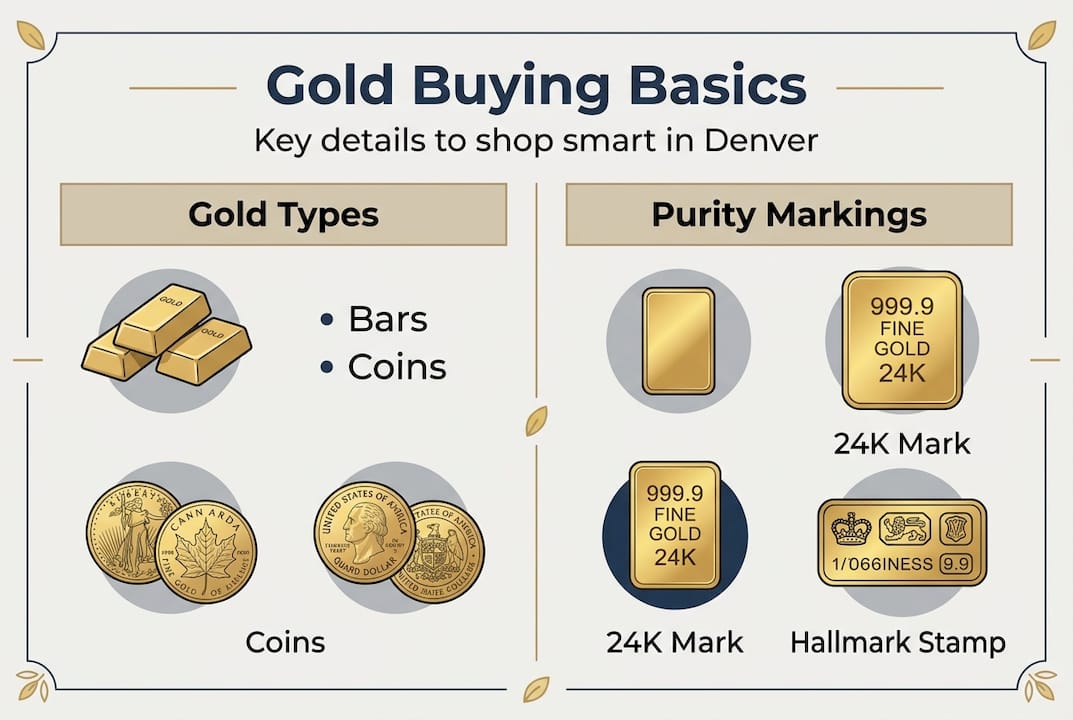
Purity is measured in karats. Pure gold is 24 karats (24K), meaning 24 out of 24 parts are gold. As you move down the scale, other metals like copper, silver, or palladium are mixed in to increase durability and alter color. Understanding Colorado jewelry terminology is essential here because retailers use terms like “hallmark,” “alloy,” and “fineness” interchangeably, and not all buyers realize these terms carry specific, measurable meanings.
Here’s a quick comparison to clarify the most common grades:
| Karat | Gold content | Appearance | Durability | Typical use |
|---|---|---|---|---|
| 24K | 99.9% | Deep yellow | Soft, bends easily | Bullion, investment coins |
| 18K | 75% | Rich yellow or rose | Moderate | Fine jewelry, engagement rings |
| 14K | 58.3% | Lighter yellow | Hard, scratch-resistant | Everyday jewelry, fashion pieces |
| 10K | 41.7% | Pale yellow | Very hard | Budget jewelry, class rings |
Beyond karat grade, three other elements drive the price you’ll pay at retail:
- Spot price: The live global market price for gold per troy ounce, updated throughout each trading day
- Weight: Heavier pieces cost more, even at the same purity grade
- Craftsmanship and labor: For jewelry, the skill of the artisan and complexity of the design add significant value above raw metal cost
- Retailer markup: Every seller adds a margin; reputable shops disclose this openly
As outlined in fine jewelry terminology guides, hallmark stamps on gold pieces are legally required in many countries and indicate purity, country of origin, and assay office. In the U.S., stamps like “14K,” “585,” or “750” tell you exactly what you’re holding, as long as you know how to read them.
Pro Tip: Higher purity isn’t always better for your purpose. 24K gold is too soft for daily-wear rings or bracelets and will scratch and deform over time. For wearable pieces, 14K or 18K strikes a better balance between value and durability. Reserve 24K for bars and coins you plan to store rather than wear.
Understanding bespoke jewelry definitions also matters when you move into custom design territory. A “bespoke” piece is made specifically to your specifications, which means the gold type you choose directly affects the final look, weight, and longevity of the finished product.
The step-by-step retail gold buying process in Denver
Now that you understand gold types and values, it’s time to see what the buying process really looks like in a Denver store.
Knowing the theory is one thing. Walking through the actual workflow is another. The retail gold buying experience in Denver follows a fairly predictable sequence, but most buyers arrive without knowing what to expect at each stage. That uncertainty is exactly what some less reputable sellers exploit. The cash for gold guide lays out this process for sellers, and the same logic applies in reverse when you’re the one buying.
Here are seven essential steps from entry to completed purchase:
-
Research before you visit. Look up current gold spot prices online before walking in. Websites like Kitco or the World Gold Council update prices in real time. Know your baseline so you can evaluate any offer or price tag objectively.
-
Verify the retailer’s credentials. Check for Better Business Bureau ratings, Google reviews, and state licensing. In Colorado, precious metals dealers may operate under specific local regulations. Ask for their policy on certification and returns before you buy anything.
-
Bring valid identification. Most reputable gold retailers require a government-issued ID, especially for transactions above certain dollar thresholds. Some will also log your purchase for compliance with state anti-fraud rules.
-
Ask about the gold’s certification. Any piece worth buying should come with documentation: a certificate of authenticity, an assay certificate for bullion, or a gemological lab report if stones are involved. No paperwork? That’s a red flag.
-
Request a purity test. Professional retailers use acid testing, X-ray fluorescence (XRF) machines, or electronic gold testers. These tests are fast and non-destructive. A trustworthy seller will test pieces on the spot at your request.
-
Confirm the full pricing breakdown. Ask for a written, itemized quote that includes the metal’s current spot-based value, any craftsmanship premium, taxes, and the retailer’s markup. A reputable shop will hand this to you without hesitation.
-
Review all paperwork before payment. Read the receipt carefully. Confirm the karat, weight in grams or troy ounces, total price, and return or buyback policy. Sign only when you’re satisfied.
Documentation isn’t bureaucratic formality. It’s your only proof of what you paid, what you received, and what recourse you have if anything goes wrong. Always leave the store with a physical or digital receipt that specifies purity, weight, and price.
The Denver luxury jewelry guide adds another layer of context here: luxury buyers should also confirm whether the piece has been independently appraised, since retail pricing and market value don’t always align. For investment-grade bullion, always verify the piece against published mint specifications.
Pro Tip: Bring your own ID, a notepad, and a photo of the current spot price on your phone. When sellers see a prepared buyer, the conversation shifts. You signal that you know your numbers, and that changes how you’re treated.
Key factors in ensuring a secure and ethical purchase
A stepwise approach is only effective when backed by trust. Here’s how to ensure safety and ethics are central to your purchase.
Denver’s gold market is active and largely reputable, but like any market involving significant sums of money, it attracts some bad actors. Knowing the warning signs and markers of trustworthiness will protect your investment and your conscience.
According to the Federal Trade Commission, jewelry fraud complaints consistently rank among the most common consumer fraud reports in the U.S., with mislabeled purity and inflated appraisals being the two most frequently cited issues. That’s not a reason to avoid buying gold. It’s a reason to buy smart.
Here are five markers of a trusted gold retailer or jeweler in Denver:
- Transparent pricing posted publicly, not just quoted verbally on the spot
- Third-party or independent appraisal available on request, or offered proactively
- Clear return or buyback policy in writing with specific terms
- State-registered and nationally recognized credentials, such as membership in the Jewelers of America or the American Numismatic Association for bullion dealers
- Physical storefront or verified appointment-only location, not just a pop-up or online-only operation with no traceable address
Ethical sourcing is equally important, especially for luxury buyers. Gold mined under exploitative labor conditions or from conflict zones can be legally sold in the U.S. without disclosure. If you care about where your metal comes from, the ethical gold sourcing guide outlines what questions to ask and what certifications to look for, including Fairtrade Gold and Responsible Jewellery Council compliance.
An independent appraisal isn’t a sign of distrust toward your seller. It’s a standard step in any serious purchase. A confident, ethical retailer will actively encourage it.
Jewelry appraisals in Denver are available from independent appraisers who charge a flat fee rather than a percentage of value, which eliminates the incentive to inflate estimates. Always use an appraiser who is not affiliated with the store selling you the piece.

One often-overlooked risk: verbal guarantees. If a seller promises a buyback price, a purity grade, or a certificate “to come later,” get it in writing before you pay. Verbal commitments vanish quickly once the transaction is complete.
Buying for investment vs. luxury: knowing your goals
Once security and ethics are accounted for, your goal defines the next steps. Let’s distinguish between investing and splurging.
Gold serves two very different purposes depending on why you’re buying, and mixing up those purposes leads to expensive mistakes. An investor optimizing for resale value and an anniversary gift shopper looking for something beautiful operate in the same market but need completely different things from it.
| Factor | Investment buyer | Luxury buyer |
|---|---|---|
| Primary goal | Preserve and grow wealth | Own a beautiful, meaningful piece |
| Preferred gold type | 24K bullion bars or coins | 14K or 18K fine jewelry |
| Resale value expectation | High, tied closely to spot price | Lower, craftsmanship value doesn’t always resell well |
| Key pitfall | Paying high premiums over spot | Overlooking metal quality for design alone |
| Ideal retailer | Licensed bullion dealer with live pricing | Custom jeweler with sourcing transparency |
The Denver sustainable jewelry workflow offers a practical decision framework for buyers who want to align their purchase with both personal values and financial goals, a growing concern among younger buyers in particular.
If you’re buying for investment, here are the two most common mistakes:
- Paying excessive premiums over spot price. A 10-15% premium on a recognized coin like a Gold Eagle is standard. Paying 30% or more is a warning sign.
- Buying jewelry as an investment. Retail jewelry carries labor and design costs that rarely recover at resale. If you want value retention, buy recognized bullion formats.
If you’re buying for luxury, the most common mistakes look different:
- Prioritizing aesthetics while ignoring gold quality. A stunning piece in 10K gold is worth significantly less per gram than the same design in 18K, and not all retailers make that difference obvious.
- Skipping the jewelry design checklist when commissioning a custom piece. Bespoke jewelry requires a clear brief covering metal type, stone preferences, wearability, and budget before work begins.
For buyers who fall somewhere in between, such as someone buying an engagement ring shopping Denver style heirloom piece that should hold both sentimental and monetary value, the answer is usually 18K gold with a well-documented provenance and an independent appraisal on file. That combination gives you beauty and a reasonable resale floor.
Why most gold buying advice overlooks your Denver advantage
Most national gold buying guides are written for a generic American buyer, usually someone in a major coastal city surrounded by chain stores with fixed pricing and little room to negotiate. Denver is a different market, and treating it as interchangeable with everywhere else means leaving real advantages on the table.
Denver has a genuinely competitive local jewelry and precious metals scene. Independent retailers here compete aggressively for business, which means prices are negotiable more often than most buyers realize. Local jewelers, especially those without franchise overhead, can offer custom work, price matching, and trade-in credits that chain stores simply cannot. The Denver jewelry scene rewards buyers who ask questions and push back politely on pricing.
Denver’s appraisal culture is also unusually strong. The concentration of independent appraisers in the metro area gives buyers real leverage. When a seller knows you can get an immediate second opinion, they’re less likely to overprice or misrepresent a piece.
Our perspective is this: stop treating gold buying as a passive transaction where you accept whatever is offered. Denver gives you the tools to be an active, informed buyer. Use them.
Ready to buy or sell gold with confidence?
Taking the next step is simple when you have local experts on your side.
At Eternal Carat, we built our entire approach around the kind of transparency and expertise this guide describes. We offer competitive, market-rate evaluations for gold and silver bullion, estate jewelry, and scrap pieces, and we’re equally equipped to help you design or acquire something new. Whether you’re selling inherited gold or investing in a lab-grown diamond piece, our team provides honest guidance at every stage.
Visit Eternal Carat to explore our full collection, learn about our gold and precious metals exchange, or book a private appointment at our secure Parker, Colorado location. You deserve an experience where the process is as valuable as the piece you take home.
Frequently asked questions
What documents do I need to buy or sell gold in Denver?
A government-issued ID is usually required for any gold transaction, and for larger sales or purchases, proof of funds or source of the metal may also be requested by reputable dealers.
How do I know if gold is real before purchasing?
Request a purity certificate and ask the retailer to perform an on-site test using XRF equipment or acid testing. Retailers who understand gold purity and certification will complete this without hesitation.
Can I negotiate the price of gold jewelry in Denver stores?
Yes, many independent jewelers in Denver are open to negotiation or trade-in deals, especially for custom work or estate pieces, which is one real advantage of buying locally rather than from national chains.
Is buying lab-grown diamond jewelry different from traditional?
Lab-grown pieces deliver the same optical quality and brilliance as mined diamonds but typically cost 30-50% less and carry a documented, conflict-free origin, making them a smart choice for both budget-conscious and ethically motivated buyers.
Recommended
- Gold explained: Denver’s guide to luxury jewelry & appraisals – Eternal Carat
- Ethical Jewelry Buying Workflow for Denver: Sustainable Luxury Guide – Eternal Carat
- Fine Jewelry Terms Explained: What Colorado Buyers Need – Eternal Carat
- Ethical diamond shopping in Denver: sustainable luxury guide – Eternal Carat


