

TL;DR:
- Ethical jewelry should ensure conflict-free sourcing, transparent supply chains, and reduced environmental impact.
- Lab-grown diamonds and recycled metals are key options for sustainable and traceable jewelry.
- Consumers should ask for detailed documentation and energy disclosures to verify ethical practices.
Buying ethical jewelry sounds straightforward until you realize how many supply chains are hidden behind a single ring. Most consumers want to do the right thing, but opaque sourcing, misleading certifications, and outright greenwashing make it genuinely hard to know what you’re getting. The good news is that ethical jewelry buying prioritizes lab-grown diamonds for reduced environmental impact and conflict-free sourcing, giving Denver buyers a clear starting point. This guide walks you through a practical, step-by-step workflow so you can shop with confidence, ask the right questions, and build a jewelry collection that actually reflects your values.
Table of Contents
- What makes jewelry ethical?
- Prepare: What to look for and shortlist in Denver
- Execute: Step-by-step ethical jewelry buying workflow
- Verify and avoid common pitfalls
- Our take: The future of ethical jewelry buying in Denver
- Discover ethical luxury jewelry in Denver
- Frequently asked questions
Key Takeaways
| Point | Details |
|---|---|
| Lab-grown eco advantage | Lab-grown diamonds use far less water and avoid mining, minimizing environmental impact. |
| Certifications are key | GIA, IGI, and RJC certifications help verify ethical sourcing but do not guarantee sustainability. |
| Verify energy and metals | Always ask about lab diamond energy sources and confirm recycled metals in custom settings. |
| Denver ethical jewelry options | Local retailers Lux Forge, Miro, and JK Diamond Co. offer lab-grown and bespoke pieces with strong ethical credentials. |
| Avoid greenwashing risks | Demand documentation and transparency to ensure true ethical luxury and avoid misleading claims. |
What makes jewelry ethical?
Before you even open a browser or walk into a store, you need a working definition of “ethical.” It is not just about avoiding conflict diamonds. True ethical jewelry covers three pillars: conflict-free sourcing, transparent supply chains, and reduced environmental impact. Each one matters, and a piece can fail on any of them while still carrying a reassuring label.
Lab-grown diamonds are the clearest win on the environmental side. Lab-grown diamonds use roughly 18 gallons of water per carat compared to 126 gallons for mined diamonds, and net-zero production is achievable when manufacturers use renewable energy at around 250 kWh per carat. No open-pit mines, no displaced communities, and full traceability from creation to setting. That is a fundamentally different product from a mined stone, even a certified one.
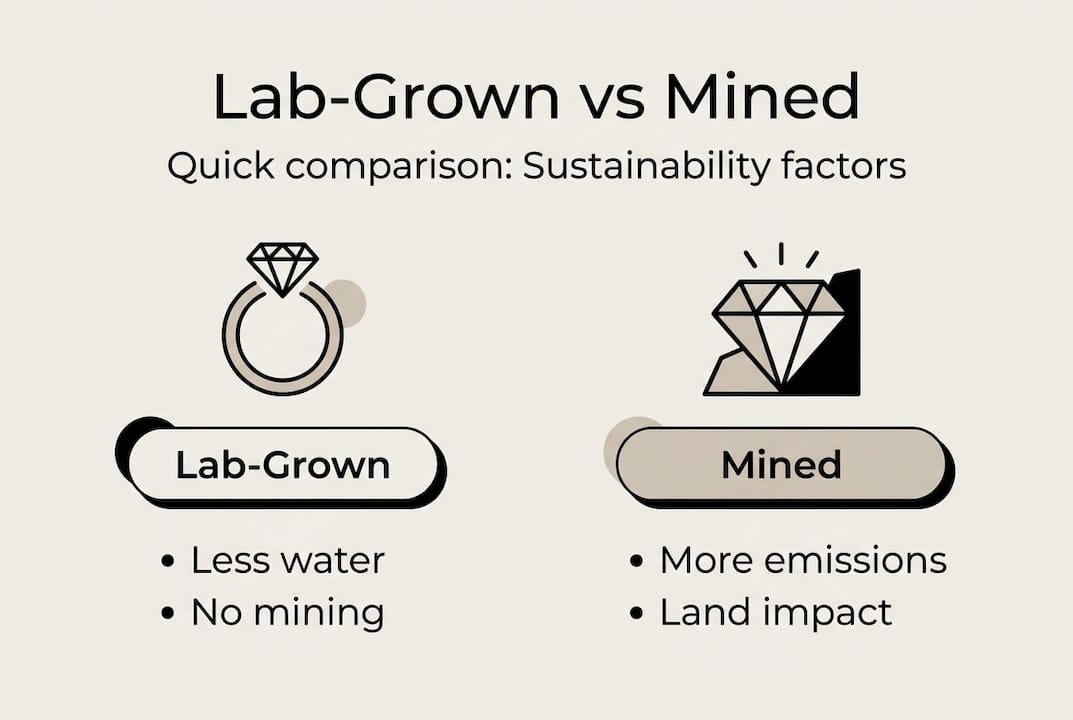
For metals, recycled gold and silver close the loop. Recycled metals require no new mining, dramatically cut carbon emissions, and are increasingly available from reputable suppliers. When you combine a lab-grown diamond with a recycled metal setting, you are looking at a piece with a genuinely small footprint.
Here is a quick comparison of key ethical criteria:
| Criterion | Mined diamond | Lab-grown diamond |
|---|---|---|
| Water use per carat | ~126 gallons | ~18 gallons |
| Supply chain traceability | Partial | Full |
| Conflict-free guarantee | Kimberley Process only | Inherent |
| Carbon footprint | High | Low to net-zero (renewables) |
| Metal pairing option | Any | Recycled metals preferred |
Key certifications to recognize when you shop:
- GIA grading report: Confirms diamond quality (cut, color, clarity, carat) but does not verify sustainability.
- IGI grading report: Widely used for lab-grown diamonds; confirms origin as lab-grown.
- RJC membership: The Responsible Jewellery Council sets ethical standards for supply chains across the industry.
Pro Tip: A GIA or IGI report tells you what a diamond is, not how it was made or powered. Always ask separately about the energy source used in production.
When you are ready to go deeper on the science and quality side, the lab-grown vs natural diamonds comparison and the guide on choosing lab-grown diamonds are excellent next reads.
Prepare: What to look for and shortlist in Denver
Now that you know what ethical jewelry means, let’s move to how to prep and create a Denver-specific shortlist. The Denver market has grown meaningfully in the past few years, and you have real choices between local boutiques and national brands with local access.
Local Denver options for lab-grown and bespoke jewelry include Lux Forge, which focuses on net-zero lab diamonds and recycled metals; Miro Jewelers, which offers certified lab-grown stones and custom design; and JK Diamond Co., which specializes in bespoke pieces with high-quality diamonds. National brands like Brilliant Earth are also accessible and ship to Denver with strong ethical documentation.
Here is how those options stack up on the criteria that matter most:
| Retailer | Lab-grown certified | Recycled metals | Custom/bespoke | Energy disclosure |
|---|---|---|---|---|
| Lux Forge | Yes | Yes | Yes | Net-zero stated |
| Miro Jewelers | Yes | Available | Yes | Partial |
| JK Diamond Co. | Yes | Available | Yes | On request |
| Brilliant Earth | Yes | Yes | Limited | Partial |
| Eternal Carat | Yes | Yes | Yes | On consultation |
When building your shortlist, follow these steps:
- Confirm lab-grown certification. Ask for the IGI or GIA report number and verify it independently on the grading lab’s website.
- Ask about metal origin. Recycled gold and silver should come with documentation, not just a verbal claim.
- Check for bespoke and repair options. A jeweler who can resize, repair, and redesign your piece extends its life and reduces waste.
- Read reviews for transparency. Buyers who ask hard questions and get straight answers are a strong signal of a trustworthy retailer.
- Look for local presence. An appointment-based consultation gives you the chance to ask questions face to face, which is far harder to fake than a website.
Pro Tip: Search for the retailer’s name alongside terms like “energy source” or “recycled metals” before your first visit. How a brand talks about its process online tells you a lot before you ever walk in.
For a broader view of the Denver market, the Denver diamond retailers guide and the Denver jewelry shopping guide are worth bookmarking. If you are specifically looking for engagement rings, the eco-friendly engagement rings Denver guide covers that niche in detail.
Execute: Step-by-step ethical jewelry buying workflow
With your shortlist ready, here is how to actually navigate the purchase, step by step.
Step 1: Define your style and budget before you contact anyone. Know your preferred metal, stone shape, and a realistic price range. Lab-grown diamonds typically cost 60 to 80 percent less than mined equivalents of the same quality, so your budget goes further than you might expect.
Step 2: Contact your shortlisted retailers with specific questions. Do not wait for a sales pitch. Ask directly: What is the metal origin? Is it recycled? Where was the diamond grown, and what energy source was used?
Step 3: Request documentation. Ask for metal origin, gem country and labor standards, any treatments applied to the stone, and confirmation of durability and resizing capability. GIA and IGI reports are essential, but they are not sustainability proof. Prefer CVD or HPHT diamonds grown with renewable energy disclosure.
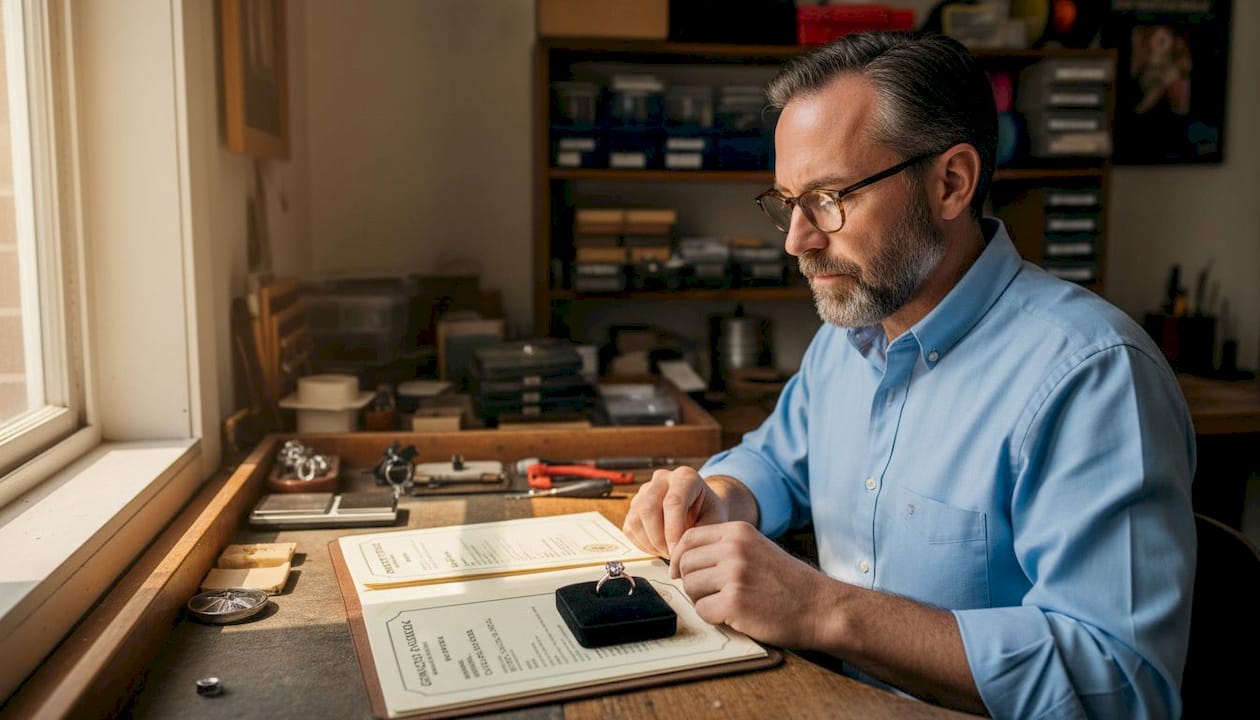
Step 4: Schedule a bespoke consultation if custom design is your goal. A custom piece lets you specify recycled metals, choose your exact stone, and confirm every detail of the supply chain before anything is made.
Step 5: Verify repairability before you commit. Ask whether the piece can be resized, re-tipped, and repaired locally. A ring you can maintain for 30 years is far more sustainable than one you replace in five.
Here is a quick verification checklist to bring to every consultation:
- IGI or GIA report with verifiable report number
- Metal origin documentation (recycled content percentage)
- Energy source disclosure for diamond production
- Repair and resize policy in writing
- Return and upgrade policy
For a deeper look at the purchase process, the buying lab-grown diamonds guide and the article on how to verify diamond quality cover the technical side thoroughly. You can also review lab-grown diamond certifications to understand what each report actually confirms.
Verify and avoid common pitfalls
After purchase, it is vital to verify ethics and avoid common traps that undermine sustainability.
The biggest misconception in ethical jewelry is that certification equals sustainability. It does not. The Kimberley Process, for example, is a baseline standard that ignores labor and environmental issues entirely. A diamond can pass the Kimberley Process and still come from a mine with terrible labor conditions and catastrophic land damage. That is not a technicality. It is a fundamental gap in the standard.
Lab-grown diamonds are not automatically low-carbon either. If the facility runs on coal-powered electricity, the carbon footprint can rival or exceed that of some mined diamonds. Greenwashing is common in this space, and “eco-friendly” language on a website means nothing without an actual energy disclosure.
Here is what to watch for and demand:
- Energy source documentation: Ask for the specific energy mix used at the production facility.
- Recycled metal certification: Request a written statement or third-party certification, not just a verbal assurance.
- Modular and repairable design: Bespoke pieces should be built to last and be serviced locally.
- Supply chain transparency: A reputable jeweler can trace your stone from growth to setting. If they cannot, that is a red flag.
- Greenwashing signals: Vague terms like “responsibly sourced” or “eco-conscious” without documentation are warning signs.
“The question is not whether a diamond is lab-grown. The question is whether the entire piece, from energy to metal to design, was built to minimize harm and maximize longevity.”
For a broader look at why these choices matter financially and ethically, the article on ethical luxury benefits makes a compelling case for the long-term value of doing this right.
Our take: The future of ethical jewelry buying in Denver
Here is an uncomfortable truth the industry rarely admits: lab-grown diamonds are ethically superior in traceability and free from mining harms, but the energy debate is real and unresolved. Buying lab-grown from a facility powered by fossil fuels is not the win most buyers think it is.
Our view is that Denver buyers are positioned to push the market further than any other consumer group in the country. Colorado has a strong renewable energy infrastructure, a culture of environmental accountability, and a growing appetite for luxury that does not compromise values. That combination is rare.
The next level is not just choosing lab-grown. It is demanding net-zero production, recycled metal settings, and modular designs built for repair and longevity. It is asking hard questions and walking away when answers are vague. Recycled metals are the missing piece most buyers overlook, and they are essential for closing the sustainability loop. When Denver buyers start treating repairability as a non-negotiable, the whole market shifts. We have seen it happen in other categories, and jewelry is next. Read more in our ethical luxury guide for 2026.
Discover ethical luxury jewelry in Denver
Ready to put this workflow into practice? At Eternal Carat, we built our entire model around the questions this guide asks you to raise. Every piece in our collection starts with a lab-grown diamond and a conversation about what matters to you.
Our appointment-only studio in Parker, Colorado gives you the space to ask every question on your checklist without pressure. From recycled metal settings to fully custom bespoke designs, we document every step so you never have to take our word for it. Browse our full range of lab-grown diamond jewelry online, or book a private consultation to start designing something built to last a lifetime and beyond.
Frequently asked questions
What certifications prove a diamond is ethical?
GIA and IGI reports confirm diamond quality and origin, while RJC membership signals supply chain accountability, but always request supply chain documentation separately since grading reports do not verify energy source or sustainability practices.
Are lab-grown diamonds always sustainable?
Not automatically. Lab-grown diamonds have a lower environmental footprint in most cases, but fossil fuel-powered production can offset those gains, so always ask for an energy disclosure before you buy.
How do I verify recycled metals in jewelry?
Ask your jeweler for written documentation or third-party certification confirming recycled content, since verbal assurances on metal origin are not sufficient proof of recycled sourcing.
What are the best local ethical jewelers in Denver?
Lux Forge, Miro Jewelers, and JK Diamond Co. are strong local Denver options focused on lab-grown and bespoke jewelry, with Brilliant Earth offering a well-documented national alternative accessible to Denver buyers.


