

TL;DR:
- Denver’s jewelry scene now offers a wide range of ethical and sustainable diamond options. Lab-grown diamonds provide verified environmental and social benefits, often at lower costs than mined diamonds. Reputable local jewelers facilitate transparent sourcing, customization, and luxury ethical pieces.
Buying an ethical diamond in Denver used to feel like choosing between your values and the ring of your dreams. That tension is fading fast. Today, Denver’s jewelry scene offers a remarkable range of custom, luxury options built around transparency, sustainability, and genuine craftsmanship. Whether you want a lab-grown solitaire, a reclaimed stone set in recycled gold, or a fully bespoke design guided by an expert, this guide walks you through exactly what to look for, where to go, and how to make a confident, values-aligned choice.
Table of Contents
- What makes a diamond ethical?
- Denver’s top ethical jewelers and custom ring designers
- Lab-grown vs. mined diamonds: Ethics, value, and tradition
- How to shop for ethical diamonds in Denver: Step-by-step
- The truth most overlook: Ethics and luxury go hand-in-hand
- Ready for your ethical Denver diamond? Start your journey
- Frequently asked questions
Key Takeaways
| Point | Details |
|---|---|
| Understand ethical diamonds | Ethical diamonds prioritize environmental care and full supply chain transparency. |
| Know your Denver jewelers | Top local retailers offer both customization and verifiable ethical sourcing. |
| Lab-grown advantages | Lab-grown diamonds deliver eco-friendly luxury often at significant savings. |
| Shop with confidence | A step-by-step approach ensures your Denver diamond is both stunning and sustainably sourced. |
What makes a diamond ethical?
The phrase “ethical diamond” gets used a lot, but it actually covers two distinct concerns: environmental impact and social responsibility. A diamond can fail on either front and still carry a polished certification. That’s why it pays to understand both dimensions before you shop.
On the environmental side, traditional diamond mining disturbs enormous amounts of earth. Open-pit mines can displace millions of tons of rock to recover a single carat. Water usage, habitat destruction, and carbon emissions are all real costs attached to a mined stone. On the social side, conflict diamonds, sometimes called blood diamonds, have historically funded armed groups in war zones. The Kimberley Process was introduced to address this, but many experts note it has significant gaps in enforcement.
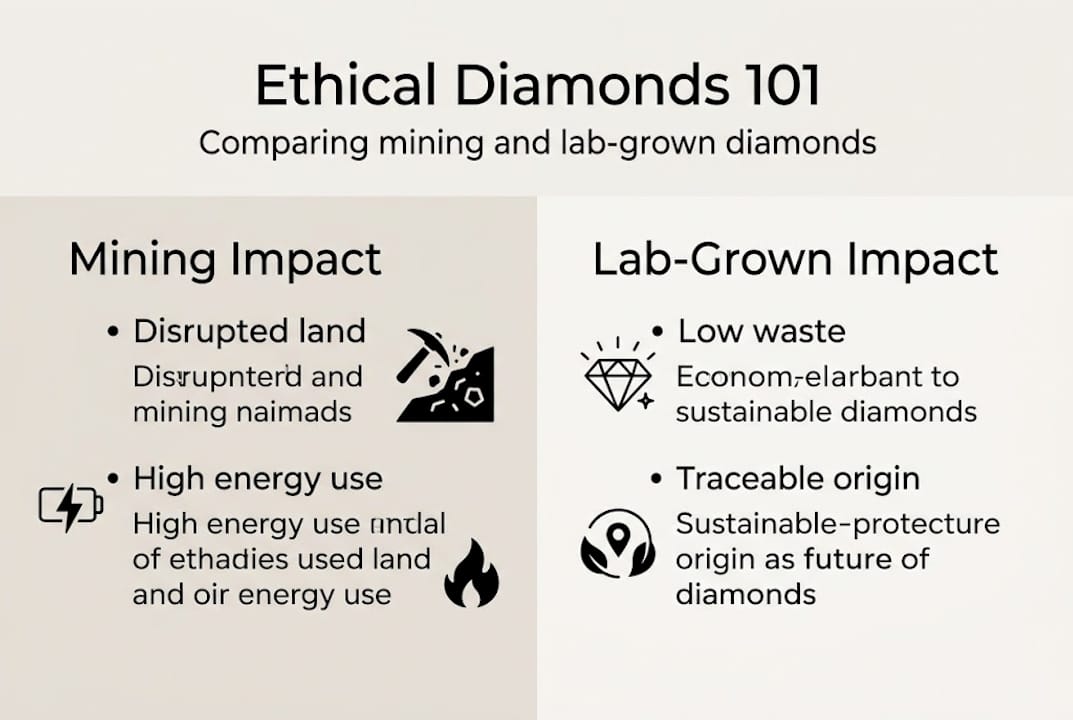
Lab-grown diamonds solve both problems at once. They are created in controlled environments using either High Pressure High Temperature (HPHT) or Chemical Vapor Deposition (CVD) methods. The result is a stone that is chemically, physically, and optically identical to a mined diamond. As lab-grown diamonds offer verifiable ethics and cost savings over mined diamonds, they have become the leading choice for eco-conscious buyers.
When evaluating any diamond, ethical or otherwise, look for:
- A grading report from GIA, IGI, or GCAL
- Full disclosure of the stone’s origin (mine location or lab)
- Recycled or responsibly sourced metal for the setting
- A jeweler willing to answer direct questions about their supply chain
For a broader look at sustainable jewelry options in the Denver area, the landscape has genuinely improved in recent years.
“An ethical diamond is not just about where it came from. It’s about the full story, from source to setting, being one you’re proud to tell.”
Pro Tip: Ask your jeweler for the specific mine or lab name for your diamond. A retailer committed to transparency will have that information ready without hesitation. If they can’t tell you, that’s a signal worth taking seriously.
If you want to go deeper on the sourcing conversation, a detailed look at lab-grown vs natural diamonds breaks down the ethical and quality differences clearly.
Denver’s top ethical jewelers and custom ring designers
Once you know what defines an ethical diamond, it’s time to discover where to find them in Denver. The city has a strong and growing community of jewelers who take sustainability seriously, and several stand out for both their sourcing practices and their design quality.
According to recent research, top Denver ethical jewelers include Brilliant Earth, Sarah O., Miro Jewelers, Eternal Carat, and others who have built their reputations around transparent sourcing and custom craftsmanship.
| Jeweler | Ethical focus | Customization | Notable strength |
|---|---|---|---|
| Brilliant Earth | Conflict-free, recycled metals | High | Wide online selection |
| Sarah O. | Responsibly sourced stones | High | Unique, artistic designs |
| Miro Jewelers | Certified diamonds | Medium | Strong local reputation |
| Eternal Carat | Lab-grown, private consult | Very High | Bespoke luxury, Parker CO |
| Kate Maller Jewelry | Reclaimed diamonds | High | Handmade, artisan quality |
Here’s what separates the best from the rest:
- Certifications on display: Top shops show GIA or IGI reports without being asked.
- Recycled metal options: Ethical sourcing extends beyond the stone to the gold or platinum setting.
- Design flexibility: The best jewelers let you co-create, not just choose from a catalog.
- Honest conversations: Reputable shops will discuss trade-offs openly, including resale value.
One important note: some online reviews flag durability concerns with lower-tier lab-grown stones sold through discount retailers. This is not a lab-grown problem. It’s a quality-control problem. Buying from a reputable jeweler with documented grading reports eliminates this risk entirely.
For couples starting their search, Denver engagement ring shopping has never offered more genuinely ethical options at the luxury level.
Lab-grown vs. mined diamonds: Ethics, value, and tradition
Understanding your retailer options, let’s compare the two main diamond choices: lab-grown and mined. This is where a lot of buyers get stuck, often because of myths that don’t hold up to scrutiny.
First, the science is settled. Lab-grown diamonds provide identical quality, cost savings, and clearer ethics compared to mined stones. A gemologist cannot tell them apart without specialized equipment. They score the same on hardness, brilliance, and fire.
| Attribute | Lab-grown | Mined |
|---|---|---|
| Chemical composition | Identical | Identical |
| Hardness (Mohs) | 10 | 10 |
| Average cost per carat | 50-80% less | Higher |
| Traceability | Full | Variable |
| Resale value | Lower currently | Higher currently |
| Environmental impact | Significantly lower | Higher |
Here’s a practical framework for making your decision:
- Define your priority. Is this about legacy, ethics, or value? Most couples find ethics and value win.
- Set your budget honestly. Lab-grown stones let you buy a larger, better-graded stone for the same spend.
- Consider the setting separately. Recycled gold or platinum elevates any stone ethically.
- Request a grading report. For both types, a third-party report is non-negotiable.
- Think long-term. The resale market for lab-grown diamonds is evolving rapidly.
Some buyers still prefer mined diamonds for sentimental or traditional reasons. That’s a valid choice, provided the stone carries a Kimberley Process certificate and ideally a more detailed origin report. For a full diamond comparison covering every attribute, the data strongly favors lab-grown for eco-conscious buyers.
Pro Tip: If resale value concerns you, consider this: most engagement rings are never resold. They become heirlooms. Choosing a stone you feel proud of every day matters far more than a theoretical future price.
Curious about the science behind your stone? Learning how lab-grown diamonds are made gives you a clear picture of the process and why quality control is actually easier in a lab than in a mine.
How to shop for ethical diamonds in Denver: Step-by-step
Now that you know your options, here’s exactly how to turn your ethical values into the perfect Denver ring. This process works whether you’re shopping online, visiting a showroom, or booking a private consultation.
- Write down your values first. Before you look at a single stone, agree on what matters most: environmental impact, social ethics, budget, or design. This prevents decision fatigue later.
- Research jewelers before visiting. Check for certifications, read reviews specifically about sourcing transparency, and look at their custom design portfolio.
- Request documentation upfront. Ask for grading reports, origin documentation, and metal sourcing details before you fall in love with a ring.
- Compare at least three options. Even if you’re certain about one jeweler, comparing builds confidence and sometimes reveals better value.
- Book a private consultation. The best ethical jewelers offer one-on-one time. Use it. Ask every question you have.
- Confirm the full cost breakdown. Ethical jewelry should come with transparent pricing. No hidden fees, no vague “sourcing charges.”
Questions worth asking your jeweler directly:
- Where was this diamond grown or mined?
- What certification does this stone carry?
- Is the metal recycled or responsibly sourced?
- Can I see the full grading report?
- What is your return or exchange policy?
“The couples who feel most confident in their purchase are the ones who asked the most questions. A great jeweler welcomes every single one.”
As top Denver retailers now offer custom ethical options that blend luxury with transparent sourcing, you have real leverage as a buyer. Use it.
Common mistakes to avoid: skipping the grading report, assuming “conflict-free” means fully ethical, and rushing the custom design process. Take your time. This is a piece you’ll wear every day.
For a complete walkthrough, the ethical jewelry buying workflow covers each step in detail. If you’re leaning toward a fully custom piece, exploring custom design with ethical luxury shows what’s possible when craftsmanship meets values. And if you want inspiration before your first consultation, browsing eco-friendly engagement rings in Denver will show you just how beautiful sustainable can look.
The truth most overlook: Ethics and luxury go hand-in-hand
Here’s what we’ve seen working with couples across the Denver area: the fear of compromise is almost always bigger than the actual compromise. People come in worried that choosing an ethical diamond means settling for something smaller, less brilliant, or less special. They leave with the opposite experience.
Demand for sustainable jewelry is not lowering the bar. It’s raising it. Jewelers who specialize in ethical sourcing tend to be more skilled, more transparent, and more invested in your satisfaction because their reputation depends on it. They can’t hide behind vague supply chains or generic catalog pieces.
The couples who regret their ring choices almost never say they wish they’d bought a bigger stone. They say they wish they’d asked more questions, spent more time on the design, or chosen a jeweler who felt like a real partner. Choosing ethics forces all of those good habits.
As sustainable fine jewelry continues to evolve, the quality ceiling keeps rising. In Denver right now, you can have a fully custom, luxury ring with a certified lab-grown diamond, set in recycled platinum, designed in collaboration with an expert, and delivered with complete transparency. That’s not a compromise. That’s a better ring.
Ready for your ethical Denver diamond? Start your journey
You’ve done the research. You know what makes a diamond ethical, which Denver jewelers lead on sustainability, and how to walk into any consultation with confidence. Now it’s time to take that knowledge and turn it into something real.
At Eternal Carat, we specialize in exactly what eco-conscious Denver couples are looking for: lab-grown diamonds, bespoke designs, and private consultations at our secure Parker, Colorado location. Every piece we create starts with your values and ends with something you’ll be proud to wear for a lifetime. Whether you’re ready to explore ethical custom rings or simply want to ask a few questions, we’re here to make the process feel as good as the ring itself.
Frequently asked questions
Are lab-grown diamonds as durable and beautiful as mined diamonds?
Yes. Lab-grown diamonds are identical in chemical composition and hardness to mined diamonds, offering the same brilliance, fire, and long-term durability.
How can I verify if a diamond is ethically sourced?
Request a grading report from GIA, IGI, or GCAL, and ask your jeweler for complete origin documentation. Certification is key for confirming a diamond’s ethical sourcing, so never skip this step.
What Denver jewelers offer private consultations for custom ethical rings?
Eternal Carat offers lab-grown luxury with private, appointment-only consultations at their Parker, Colorado location, alongside several other top Denver showrooms focused on ethical, custom design.
Is it possible to design a custom engagement ring with reclaimed diamonds in Denver?
Absolutely. Kate Maller Jewelry offers handmade custom pieces using reclaimed diamonds, and several other Denver jewelers can source reclaimed stones for fully bespoke designs.


