

TL;DR:
- Craftsmanship influences jewelry’s durability, uniqueness, and lasting value.
- Visible and invisible details reveal the skill and ethical standards behind a piece.
- Knowledge of creation methods helps buyers choose authentic, ethically-made luxury jewelry.
Two rings sit side by side in a glass case. Both hold a brilliant round diamond. Both catch the light. From three feet away, you cannot tell them apart. But pick one up, turn it over, and look closely — the story changes completely. One has clean prong tips, smooth solder joints, and a finish that holds its mirror polish all the way into the setting. The other shows rough edges, uneven metal mass, and tool marks that betray a rushed process. Craftsmanship is the invisible architecture of luxury jewelry, and for Denver buyers who want pieces that carry real meaning, understanding it changes everything about how you shop.
Table of Contents
- How craftsmanship shapes luxury jewelry
- Handcrafted vs. machine-made: What really matters
- The connection between craftsmanship, ethics, and value
- How to recognize and choose authentic craftsmanship in Denver
- Our perspective: Why craftsmanship is the future of ethical luxury in Denver
- Discover ethical luxury and true craftsmanship with us
- Frequently asked questions
Key Takeaways
| Point | Details |
|---|---|
| Craftsmanship reveals authenticity | The way a piece is made separates genuine luxury from lookalikes. |
| Ethics and artisanship align | True craftsmanship often signals ethical sourcing and transparency. |
| Buyers can recognize excellence | Knowing what to inspect empowers you to make wise luxury purchases. |
| Custom drives lasting value | Handcrafted and ethically made jewelry retains value and personal meaning. |
How craftsmanship shapes luxury jewelry
Craftsmanship in jewelry is not just about how a piece looks on day one. It is about the decisions made at every stage of creation, from wax carving to final polish, that determine how a piece wears, lasts, and feels on your hand a decade from now. True understanding jewelry craftsmanship means recognizing both what you can see and what you cannot.
The visible signs are easier to spot once you know what to look for. Prong tips should be uniform in size and rounded, not sharp or jagged. Solder joints, the points where metal components are fused, should be nearly invisible. Inspecting tool marks, prong mass, and solder joints offers clues to a jewelry piece’s craftsmanship that no amount of photography can reveal. The invisible signs matter just as much: metal thickness at stress points, the security of stone settings, and the weight balance of a ring shank all speak to a jeweler’s skill and intention.
Here is what separates authentic luxury from mass-market jewelry:
- Consistent metal thickness throughout the shank and gallery, preventing weak points that bend or crack
- Hand-finished surfaces that show subtle, intentional texture rather than uniform machine polish
- Secure stone settings where each prong or bezel is shaped specifically to the stone it holds
- Clean interior finishing inside the band, which signals care even where no one looks
- Proportional design where every element relates to the others with intention
“Craftsmanship is not decoration. It is the difference between a piece that tells your story for generations and one that simply fills a box.”
This level of attention is exactly what drives luxury brand loyalty over time. Buyers who invest in bespoke fine jewelry are not just purchasing an object. They are purchasing a standard of care that shows up every single time the piece is worn.
Handcrafted vs. machine-made: What really matters
Now that we’ve established the basic elements of craftsmanship, let’s compare how different creation methods impact what you actually get when you buy luxury jewelry.
The jewelry world today operates across a wide spectrum of production methods. Understanding where a piece falls on that spectrum helps you evaluate whether you are getting genuine value for a luxury price.
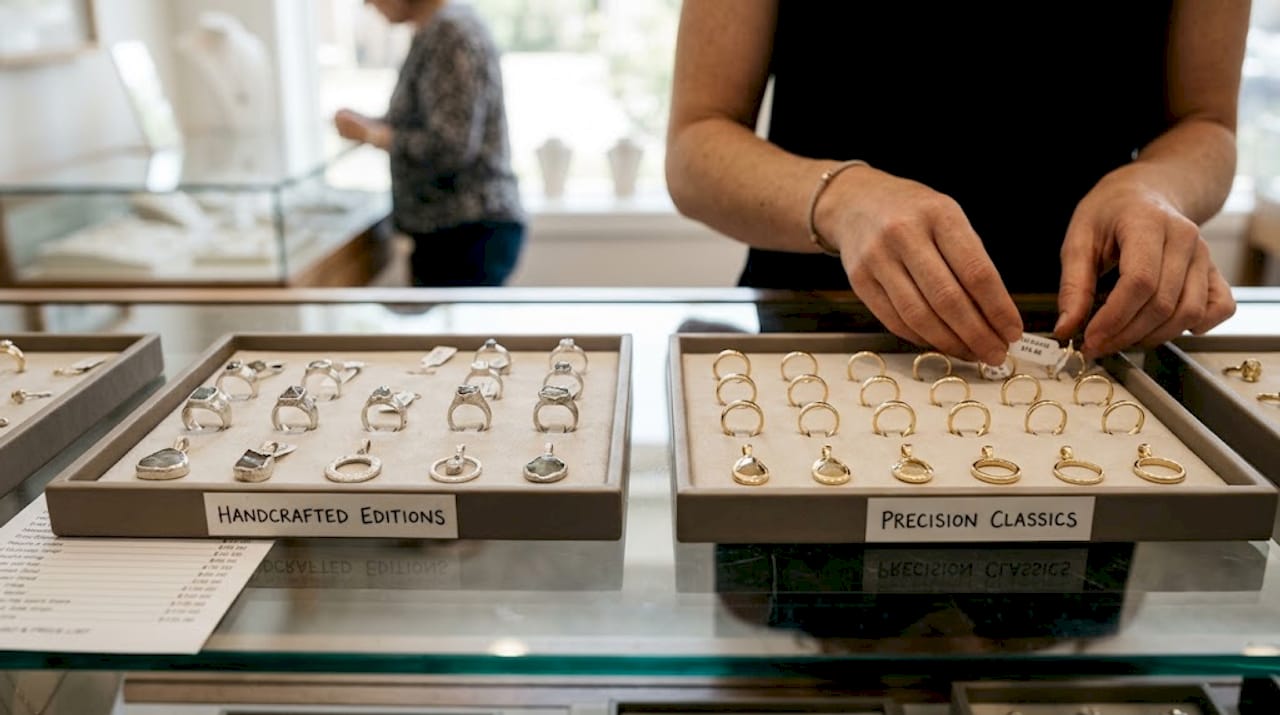
| Feature | Handcrafted | Machine-made | Hybrid || |—|—|—|—| | Uniqueness | High, each piece varies | Low, identical units | Medium, customizable base | | Durability | High with skilled maker | Consistent but limited | Depends on finishing quality | | Cost | Higher due to labor | Lower, volume-driven | Mid-range | | Personalization | Full | Minimal | Moderate to high | | Ethical traceability | Easier to verify | Harder to trace | Varies by studio |
Hybrid ateliers use CNC blanks with hand finishing, blurring the line between handmade and machine-assisted jewelry. This is not necessarily a bad thing. A CNC-cut blank can provide precision geometry that even a skilled hand cannot match, and when a master finisher refines it by hand, the result can be exceptional. The key is knowing which parts of the process were done by human hands and which were automated.
When evaluating custom jewelry advantages over ready-to-wear options, ask these questions directly: Was the wax model carved by hand or printed? Who did the finishing work? Can you see photos of the piece at each stage? A jeweler who takes pride in their process will answer these questions without hesitation.
For buyers interested in designer jewelry and ethics, the creation method also signals something about values. A studio that invests in skilled labor and careful finishing is more likely to apply that same rigor to sourcing ethical materials.
Pro Tip: When commissioning a bespoke piece, ask to see the jeweler’s bench work photos or even visit the studio. A maker confident in their craft will welcome the scrutiny. If they hesitate, that tells you something important.
The connection between craftsmanship, ethics, and value
Craftsmanship doesn’t just impact beauty or durability. It plays a pivotal role in the ethical and financial value of every piece you consider.
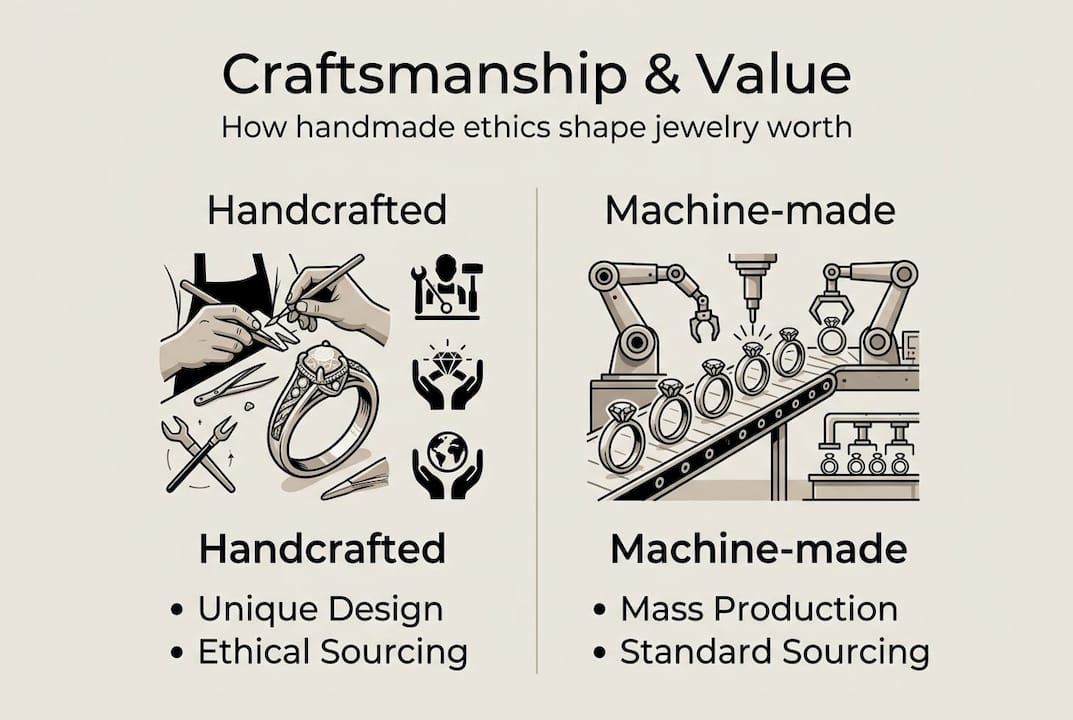
The relationship between skill and ethics in jewelry is more direct than most buyers realize. Many buyers use craftsmanship as a proxy for ethics; meticulous detailing often signals a more ethical or transparent supply chain. A jeweler who cares deeply about finishing every interior surface is also likely to care about where their metal came from and how their stones were grown or mined.
Here is how to evaluate a piece for both quality and ethical value:
- Ask for sourcing documentation on all metals and stones before committing to a purchase
- Request a process breakdown showing which stages were handcrafted vs. machine-assisted
- Verify lab-grown diamond certification from recognized bodies such as the International Gemological Institute
- Look for fair labor statements or studio transparency about who made the piece
- Examine the custom jewelry ethical benefits of working directly with a local jeweler who controls their supply chain
The financial case is equally strong. Consider how value holds over time:
| Piece type | 5-year value retention | 10-year value retention |
|---|---|---|
| Handcrafted with ethical materials | 75 to 90% | 80 to 95% |
| Mass-produced, traditional sourcing | 30 to 50% | 20 to 40% |
| Custom lab-grown diamond setting | 70 to 85% | 75 to 90% |
| Machine-made, mined diamond | 40 to 60% | 35 to 55% |
These figures reflect market trends in the luxury segment and the growing premium buyers place on provenance and craftsmanship. Understanding the full custom jewelry design process helps you see exactly where that value is built in, long before the piece reaches your hand.
The bottom line: a piece crafted with intention holds its value because the market recognizes what went into it. Shortcuts in craftsmanship almost always show up eventually, and when they do, they affect resale, repair costs, and your own satisfaction.
How to recognize and choose authentic craftsmanship in Denver
With this in mind, let’s talk about how this knowledge translates into making smarter, values-driven decisions here in Denver.
Denver’s jewelry scene has grown significantly, and the range of quality is wide. Knowing how to evaluate a studio or jeweler before you invest protects you from paying luxury prices for mass-market work. Inspecting details under magnification reveals quality work and ethical standards embedded in fine jewelry, and any reputable jeweler will let you do exactly that.
Here is a practical checklist for evaluating craftsmanship in person:
- Request a loupe or magnification to examine prong tips, solder joints, and interior surfaces
- Check for consistent metal weight by holding the piece. Well-crafted jewelry has a satisfying, balanced weight
- Look at the stone setting from the side to confirm each prong is uniform and the stone sits level
- Ask about the technology and ethical jewelry practices the studio uses, including CAD design, hand finishing, and sourcing
- Review finished photos of past work rather than renderings or stock images
- Confirm whether customization and personal values are part of the design conversation, not an afterthought
Red flags to watch for include vague answers about sourcing, reluctance to show bench work, and pricing that seems too low for the claimed level of craftsmanship. Authentic luxury is never a bargain, and a jeweler who undercuts dramatically is usually cutting corners somewhere.
Staying current with modern jewelry trends also helps you recognize when a studio is genuinely innovative versus simply following mass-market aesthetics. The power of detail in luxury is what separates a piece that feels generic from one that feels made for you specifically.
Pro Tip: Before your appointment, prepare three to five specific questions about process and sourcing. A jeweler who answers confidently and in detail is one who has nothing to hide and everything to be proud of.
Our perspective: Why craftsmanship is the future of ethical luxury in Denver
Building on where and how to find true craftsmanship, here is why we believe this movement is transforming Denver’s luxury jewelry scene.
We have watched a real shift happen among Denver buyers over the past few years. Clients are no longer satisfied with a beautiful object. They want to know who made it, how it was made, and what values it represents. That is not a trend. That is a permanent change in what luxury means.
Craftsmanship has become the clearest answer to every concern about sustainability, uniqueness, and lasting value. When a piece is made with genuine skill and ethical intention, it carries a kind of personal luxury and impact that no mass-produced ring can replicate. It becomes part of your story, not just your collection.
We also believe that ethical luxury is no longer a niche. It is a competitive standard. Studios that cannot demonstrate heritage and brand prestige through their process and sourcing will find it harder to earn the trust of discerning buyers. Denver clients are asking better questions, and that is making the entire market better.
Discover ethical luxury and true craftsmanship with us
If you’re ready to experience craftsmanship and ethical excellence firsthand, here’s how we can help you get started.
At Eternal Carat, every piece we create or curate reflects the standards you have just read about. We specialize in custom ethical jewelry featuring lab-grown diamonds set with the same precision and care you would expect from the finest traditional ateliers. Our appointment-only studio in Parker, Colorado gives you a private, unhurried environment to ask every question, examine every detail, and design something that is genuinely yours.
Whether you are designing an engagement ring from scratch, upgrading a stone, or simply exploring what ethical luxury looks like up close, we are here to guide you through every step with full transparency and genuine expertise. Reach out to schedule your consultation today.
Frequently asked questions
How can I tell if a piece of jewelry is truly handcrafted?
Use a loupe to inspect tool marks, prong mass, and solder joints. Handcrafted pieces show subtle variations in these areas that machine-made pieces do not, and hybrid pieces will show hand finishing over a precision-cut base.
Why does craftsmanship affect the value of jewelry?
Expert craftsmanship improves durability, uniqueness, and beauty while signaling ethical sourcing, all of which raise long-term value significantly compared to mass-produced alternatives. Handcrafted ethical pieces can retain 75 to 95% of their value over a decade.
How does craftsmanship relate to ethical luxury jewelry?
Craftsmanship often signals that a maker applies the same care to sourcing ethical materials as they do to their finishing work. Buyers increasingly treat meticulous detailing as evidence of a transparent and responsible supply chain.
Are lab-grown diamonds considered a sign of craftsmanship?
Lab-grown diamonds represent an ethical sourcing choice, but true craftsmanship shows in the custom setting and finish that surrounds them. A brilliant lab-grown stone deserves a mount crafted with the same precision and intention as any fine jewelry piece.
Recommended
- Understanding jewelry craftsmanship for ethical luxury – Eternal Carat
- 7 advantages of custom jewelry design for discerning buyers – Eternal Carat
- Jewelry Customization: Expressing Identity and Values – Eternal Carat
- Luxury Jewelry Definitions: Ethical and Bespoke Fine Jewelry – Eternal Carat
- 7 Examples of Premium Positioning Luxury Brands Can Use - Corrado Manenti


