

TL;DR:
- Sustainable jewelry focuses on minimizing environmental harm and ensuring ethical labor practices.
- Verifiable certifications and transparency are essential to avoid greenwashing and ensure genuine sustainability.
- Choosing lab-grown diamonds and recycled metals significantly reduces environmental impact while maintaining quality.
Shopping for an engagement ring should feel joyful, but for eco-conscious buyers, it often feels like navigating a maze of vague claims, recycled buzzwords, and certifications that may mean very little. Greenwashing is rampant in the fine jewelry industry, and without a clear framework, even well-intentioned shoppers can end up with a ring that falls short of their values. Sustainable jewelry selection prioritizes lab-grown diamonds, recycled metals, and credible certifications. This guide walks you through every step, from setting your criteria to verifying claims, so you can shop with real confidence.
Table of Contents
- Understand sustainability in fine jewelry
- Step 1: Set your sustainability criteria
- Step 2: Select materials and makers
- Step 3: Verify claims and avoid greenwashing
- Expected results and ongoing impact
- Our perspective: What eco-conscious consumers should really demand
- Discover truly sustainable luxury with Eternal Carat
- Frequently asked questions
Key Takeaways
| Point | Details |
|---|---|
| Verify certifications | Insist on RJC, SCS-007, and thorough grading to confirm sustainability claims. |
| Choose recycled materials | Opt for recycled gold and settings for the lowest environmental impact. |
| Demand supply chain transparency | Ask jewelers for energy audits and life cycle analysis, not just green labels. |
| Lab-grown leads luxury trends | Nearly half of U.S. engagement rings now feature lab-grown stones, merging ethics and elegance. |
| Avoid greenwashing | Be wary of vague ethical claims—require specific proof and documentation before buying. |
Understand sustainability in fine jewelry
Before you can choose a sustainable ring, you need to know what that term actually covers. “Sustainable” in jewelry refers to minimizing environmental harm across the full supply chain, from material extraction to final polish. “Ethical” focuses on fair labor, safe working conditions, and community impact. These two ideas overlap, but they are not the same thing, and a piece can be one without fully being the other.
Lab-grown diamonds are created in controlled environments using either High Pressure High Temperature (HPHT) or Chemical Vapor Deposition (CVD) methods. They are physically and chemically identical to mined diamonds. Recycled metals, such as reclaimed gold or platinum, avoid the need for new mining entirely. Together, these materials form the backbone of what makes jewelry sustainable in a meaningful way.
Certifications are your proof of claims. Here is a quick comparison of the most recognized standards:
| Certification | Focus area | Key benefit |
|---|---|---|
| RJC (Responsible Jewellery Council) | Supply chain ethics | Audited standards for mines and manufacturers |
| Fairmined | Artisanal gold mining | Fair wages, safe conditions, eco practices |
| Fairtrade Gold | Small-scale mining | Community premiums and environmental rules |
| SCS-007 | Sustainability claims | Third-party verified eco and social standards |
| GIA / IGI grading | Diamond quality | Confirms stone origin and lab-grown status |
Key sustainability markers to look for include:
- Lab-grown diamonds with IGI or GIA grading reports
- Recycled or Fairmined gold settings with documented sourcing
- Third-party certifications from RJC, SCS-007, or Fairtrade
- Transparent energy sourcing for the lab or manufacturer
- Made-to-order production that reduces inventory waste
The market is already moving in this direction fast. Lab-grown diamond rings made up 47% of the U.S. engagement ring market by 2025, a number that reflects a genuine shift in buyer values, not just a trend. Certifications like RJC, Fairmined, and SCS-007 are now the baseline expectation for serious sustainable jewelers, not a bonus feature.
Step 1: Set your sustainability criteria
With a solid grasp of sustainability basics, you are ready to establish what matters most to you in your jewelry search. Not every buyer weighs the same factors equally. Some prioritize zero new mining. Others focus on fair labor. A few care most about carbon footprint. Knowing your non-negotiables before you start shopping saves time and prevents you from being swayed by polished marketing.
Start by asking yourself these questions:
- Do I require a lab-grown diamond, or will I consider ethically sourced mined stones?
- Is recycled metal a must, or will Fairmined gold satisfy my sourcing concerns?
- Do I need a specific certification such as RJC or SCS-007, or is a grading report from GIA or IGI enough?
- How important is the energy source used by the lab or manufacturer?
- Am I open to made-to-order designs, which reduce overproduction waste?
One critical point many buyers overlook: not all lab-grown diamonds are automatically ethical. Some labs run on coal-powered grids, and without transparency about energy sourcing, the environmental benefit shrinks considerably. Always ask specifically about the energy mix used in production.
For stone grading, prioritize IGI or GIA reports. These documents confirm whether a diamond is genuinely lab-grown and provide quality details like cut, color, clarity, and carat. For a deeper look at what to check before buying, the how to buy lab diamonds guide covers the full evaluation process.
Pro Tip: Write your criteria down as a short checklist before you start browsing. When a jeweler’s website or salesperson makes a claim, you can check it against your list instead of relying on memory or in-the-moment enthusiasm.
Understanding sustainable engagement rings also means recognizing that “sustainable” is a spectrum. A ring made from 100% recycled gold with a solar-powered lab-grown diamond sits at one end. A ring with a Fairmined gold band and a GIA-certified mined stone sits somewhere in the middle. Both are valid choices depending on your priorities. The goal is informed alignment, not perfection.
For additional context on how labs and mines compare on environmental transparency, independent reporting offers a useful counterbalance to brand marketing.
Step 2: Select materials and makers
Once you know what to prioritize, it is time to evaluate which materials and jewelers deliver real sustainability. This is where research pays off, because the difference between a genuinely sustainable brand and one that simply uses the right vocabulary can be significant.

Here is a quick overview of your main material options:
| Material | Sustainability benefit | What to verify |
|---|---|---|
| Lab-grown diamond | No new mining, identical quality | IGI or GIA grading report, energy source |
| Recycled gold or platinum | Eliminates new extraction | Recycled content percentage, supplier chain |
| Fairmined gold | Ethical artisanal mining | Fairmined certification document |
| Moissanite | Very low environmental footprint | Lab origin confirmation |
| Recycled silver | Avoids new mining impact | Supplier documentation |
When evaluating a specific jeweler, follow these steps:
- Request documentation. Ask for the grading report, recycled metal certification, and any third-party audit results before committing.
- Check the recycled content percentage. Some brands use a small fraction of recycled metal and market it heavily. Look for brands using 90% or more.
- Verify lab provenance. For lab-grown stones, confirm where the diamond was grown and what energy source the facility uses.
- Research the brand’s supply chain. Reputable brands publish their sourcing policies publicly, not just in response to direct questions.
- Look for custom or made-to-order options. These reduce overstock and waste, which is a genuine sustainability advantage.
Leading brands set a useful benchmark. Brilliant Earth uses 93% recycled metals and offers traceable stones, while Mejuri has built a strong reputation for Fairmined sourcing. These examples show what transparent, accountable jewelry retail looks like in practice.
The advantages of lab-created diamonds go beyond the environment. They offer the same brilliance and durability as mined stones at a fraction of the price, which means more of your budget can go toward a better cut or a more intricate setting. For style inspiration that pairs sustainability with modern aesthetics, contemporary ring designs show what is possible.
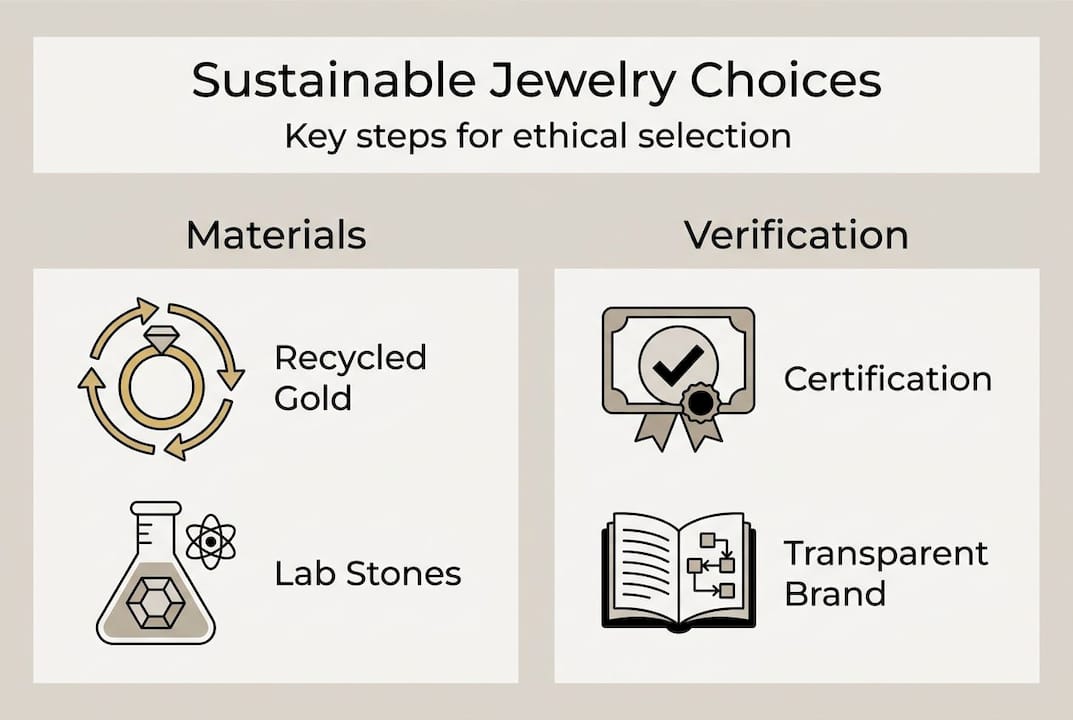
It is also worth acknowledging the socioeconomic side of diamond choices. In some regions, artisanal mining supports entire communities. Fairmined and Fairtrade certifications exist precisely to protect those communities while raising environmental standards. Choosing lab-grown is not the only ethical path; choosing certified mined can also be a responsible decision.
Step 3: Verify claims and avoid greenwashing
After narrowing down your favorites, you need to confirm every claim stands up to scrutiny. This is the step most buyers skip, and it is exactly where greenwashing slips through.
Here is what to request from any jeweler before purchasing:
- Grading report from GIA or IGI confirming lab-grown origin and quality specs.
- Recycled metal certification or Fairmined/Fairtrade documentation for the setting.
- Energy sourcing statement for the diamond lab, ideally with renewable energy evidence.
- Life cycle analysis (LCA) if available, showing the full environmental footprint of the piece.
- Third-party audit results from RJC, SCS-007, or equivalent bodies.
A critical point: the Kimberley Process alone is not sufficient proof of ethical sourcing. It only addresses conflict diamonds, not environmental harm or labor conditions. Demand RJC or SCS-007 certification and transparent grading to go beyond the minimum.
“Green” claims without third-party data are marketing, not accountability. If a jeweler cannot produce documentation, that is your answer.
Pro Tip: Search for a brand’s sustainability report or sourcing policy on their website before contacting them. Genuine sustainable jewelers publish this information openly. If you cannot find it, ask directly. A vague or evasive response is a red flag.
Made-to-order settings are another strong indicator of genuine sustainability commitment. Brands that produce only what is ordered generate far less waste than those maintaining large inventory. This also often means better customization for you.
For a detailed side-by-side look at lab-grown versus natural diamond ethics, the tradeoffs are more nuanced than most marketing suggests. And for independent reporting on energy audits in diamond production, the data tells a more complex story than “lab-grown is always greener.”
Expected results and ongoing impact
With a sustainable jewelry purchase, you are investing in more than a piece. You are creating long-term impact, and it helps to know what that impact actually looks like.
Here is what you can realistically expect from a well-chosen sustainable ring:
- Dramatically lower carbon footprint. Recycled gold settings carry a 99% lower environmental impact than newly mined gold, which is one of the most striking statistics in the entire jewelry industry.
- Equivalent diamond quality. Lab-grown stones are graded by the same standards as mined diamonds. You are not sacrificing brilliance or durability.
- Resale value awareness. Lab-grown diamond resale values are currently lower than mined diamonds due to falling production costs. This is worth knowing upfront, though for most buyers, the ring’s sentimental value far outweighs its resale price.
- Durability equal to mined stones. A lab-grown diamond scores 10 on the Mohs hardness scale, identical to a mined diamond. It will not wear down faster or chip more easily.
- Ongoing ethical ownership. Keep your grading reports and certifications in a safe place. These documents matter if you ever resize, insure, or resell the piece.
For ongoing care, choose jewelers or repair shops that use non-toxic cleaning solutions and ethically sourced replacement metals if any repairs are needed. Ask about their repair practices the same way you asked about their sourcing. The role of lab-grown diamonds in reshaping the luxury market is still unfolding, and your purchasing decisions are part of that story.
Our perspective: What eco-conscious consumers should really demand
Here is the uncomfortable truth: the “sustainable jewelry” label has become a marketing tool almost as fast as it became a genuine movement. Buyers who stop at the label and do not push further are, in many cases, funding the same supply chains they thought they were avoiding.
The real game-changer is not finding a brand that calls itself sustainable. It is demanding verifiable proof. Verifiable transparency, including energy audits and full life cycle analysis, matters far more than a sustainability tagline on a homepage. When buyers consistently ask for this documentation, brands that cannot produce it lose business. That is the market pressure that drives actual change.
Custom and made-to-order jewelry takes this a step further. When you work directly with a jeweler to design your ring, you can specify every material, verify every source, and create a piece with a fully documented chain of custody. That is not just better for the planet. It is a better ring. For a direct comparison of sourcing options, comparing diamond sources lays out the tradeoffs clearly. Luxury buyers have more power than they realize. Use it.
Discover truly sustainable luxury with Eternal Carat
Ready to start your own journey toward a truly sustainable luxury ring? At Eternal Carat, we build every piece around the principles this guide covers: certified lab-grown diamonds, recycled and traceable metals, and full transparency at every step.
Whether you want to browse our curated collection online or book a private consultation at our appointment-only location in Parker, Colorado, we are here to help you find or design a ring that reflects both your values and your vision. Every client receives personalized guidance, complete documentation, and a piece crafted with genuine care. Visit Eternal Carat to explore your options and take the next step toward jewelry you can feel proud of.
Frequently asked questions
How do I know if a lab-grown diamond is actually sustainable?
Ask for third-party certification, details on energy sourcing, and a full life cycle analysis. Greenwashing is common in this space, so verifiable documentation is the only reliable proof.
Which certifications are most trustworthy for ethical jewelry?
RJC, Fairmined, Fairtrade, and SCS-007 offer the strongest ESG and ethical verification standards. GIA and IGI grading confirm diamond origin and quality but focus on the stone rather than the full supply chain.
Does recycled gold really make a difference?
Absolutely. Recycled gold carries a 99% lower environmental footprint than newly mined gold, making it one of the highest-impact choices you can make in a ring’s construction.
Is there a tradeoff between sustainability and luxury in engagement rings?
Not anymore. Lab-grown rings now represent 47% of the U.S. market, and leading brands have proven that traceability, ethical sourcing, and genuine luxury can coexist beautifully in a single piece.


