

Most American couples in Denver are redefining luxury by choosing ethical lab-grown diamonds for their engagement rings. With a strong desire for sustainability and style, modern couples want guidance so each choice reflects their values and tastes. This guide reveals how to confidently navigate design, budget, and the crucial factors that influence lab-grown diamond quality, helping you discover a ring that feels truly personal and responsible.
Table of Contents
- Step 1: Define Your Style And Budget Preferences
- Step 2: Research Lab-Grown Diamond Benefits And Types
- Step 3: Evaluate The 4Cs: Cut, Color, Clarity, And Carat
- Step 4: Compare Certification And Ethical Sourcing
- Step 5: Verify Diamond Quality And Finalize Your Choice
Quick Summary
| Essential Insight | Clarification |
|---|---|
| 1. Define Style and Budget | Understanding your personal style and setting a clear budget is crucial for selecting lab-grown diamond jewelry that suits you. |
| 2. Research Diamond Types | Familiarize yourself with the different types of lab-grown diamonds, particularly CVD and HPHT, including their creation processes and advantages. |
| 3. Evaluate the 4Cs | The four characteristics—Cut, Color, Clarity, and Carat—significantly affect the quality and appeal of your diamond, so analyze each carefully. |
| 4. Check Certifications | Verify that your chosen diamond comes with certification from reputable institutions like GIA or IGI, confirming its quality and ethical sourcing. |
| 5. Inspect Before Purchase | Always inspect the diamond under various lighting conditions to ensure it meets your aesthetic standards and matches certification details. |
Step 1: Define Your Style and Budget Preferences
Choosing the perfect lab-grown diamond jewelry starts with understanding your personal aesthetic and financial boundaries. Your style and budget will guide every subsequent decision, helping you select a piece that resonates with your individual taste while staying financially comfortable.
Begin by exploring different design aesthetics that appeal to you. Lab-grown diamond jewelry trends showcase a range of options from minimalist elegance to bold statement pieces. Consider whether you gravitate towards classic solitaire designs, vintage inspired settings, or contemporary geometric shapes. Some people prefer understated pieces that complement professional attire, while others seek eye-catching jewelry that makes a dramatic statement.
Financial planning is equally important. Lab-grown diamond jewelry prices can range dramatically from $300 to $10,000, so establishing a clear budget prevents overspending. Take time to assess your current financial situation and determine a comfortable spending range. Remember that lab-grown diamonds offer significant value compared to traditional mined stones, allowing you to potentially get a larger or higher quality stone within your budget.
Pro tip: Create a mood board or digital folder of jewelry styles you love to help crystallize your aesthetic preferences and budget expectations.
Step 2: Research Lab-Grown Diamond Benefits and Types
Understanding lab-grown diamonds means diving into their unique characteristics and advantages. Your research will help you make an informed decision about selecting the perfect sustainable and brilliant gemstone for your jewelry.
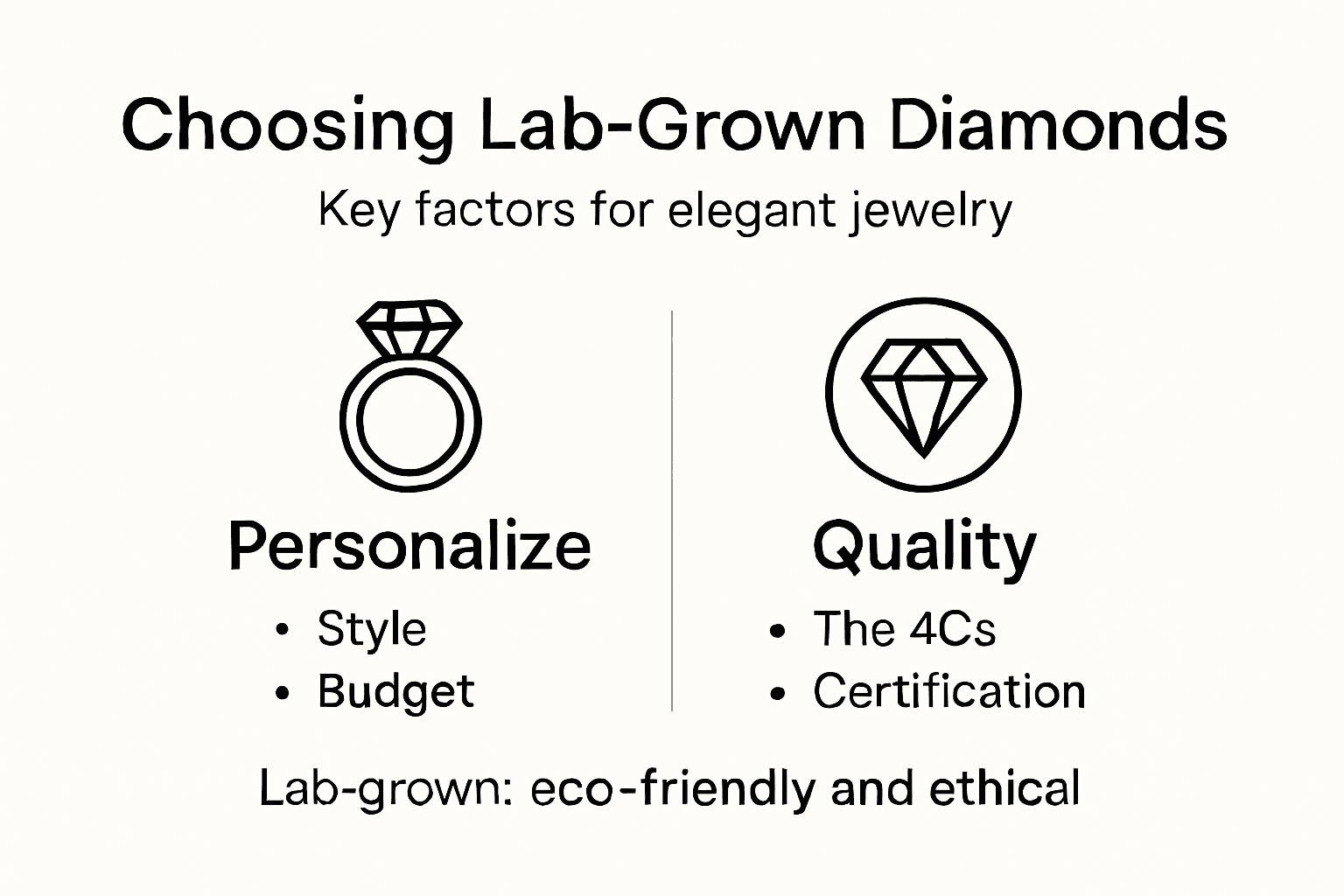
Lab-grown diamond jewelry represents a revolutionary approach to gemstone creation that combines cutting-edge technology with exceptional quality. These diamonds are scientifically produced using advanced technological processes that precisely replicate the natural diamond formation conditions. Unlike traditional mined diamonds, lab-grown stones offer remarkable benefits including identical physical properties lower environmental impact and more transparent sourcing.
Your research should focus on understanding the primary types of lab-grown diamonds. Typically these include Chemical Vapor Deposition (CVD) and High Pressure High Temperature (HPHT) diamonds. CVD diamonds are created through a process involving heated gases that deposit carbon atoms layer by layer, while HPHT diamonds simulate the extreme pressure and temperature conditions found deep within the Earth. Both methods produce diamonds with identical chemical composition and visual characteristics to mined stones, providing you with an ethical and sustainable alternative.
Here is a quick comparison of the two main lab-grown diamond creation methods:
| Method | Creation Process | Key Advantages | Typical Uses |
|---|---|---|---|
| CVD (Chemical Vapor Deposition) | Gases deposit carbon atoms in layers | Lower cost, high purity | Engagement rings, fine jewelry |
| HPHT (High Pressure High Temperature) | Simulates earth’s high pressure and heat | Larger stones, vibrant colors | Large statement pieces, fashion jewelry |
Pro tip: Request certification documents for any lab-grown diamond to verify its precise origin, quality specifications, and authenticity before making a purchase.
Step 3: Evaluate the 4Cs: Cut, Color, Clarity, and Carat
Understanding the 4Cs is crucial for selecting a lab-grown diamond that meets your aesthetic and quality expectations. These four characteristics will help you make an informed decision about your ideal gemstone.
Diamond evaluation techniques reveal that each of the 4Cs plays a critical role in determining a diamond’s overall quality and visual appeal. The cut is perhaps the most important factor, directly influencing the stone’s brilliance and sparkle. A well-cut diamond reflects light beautifully, creating that mesmerizing internal fire that makes diamonds so captivating. Color grades range from D (completely colorless) to Z (noticeable yellow or brown tints), with higher grade diamonds commanding premium prices.
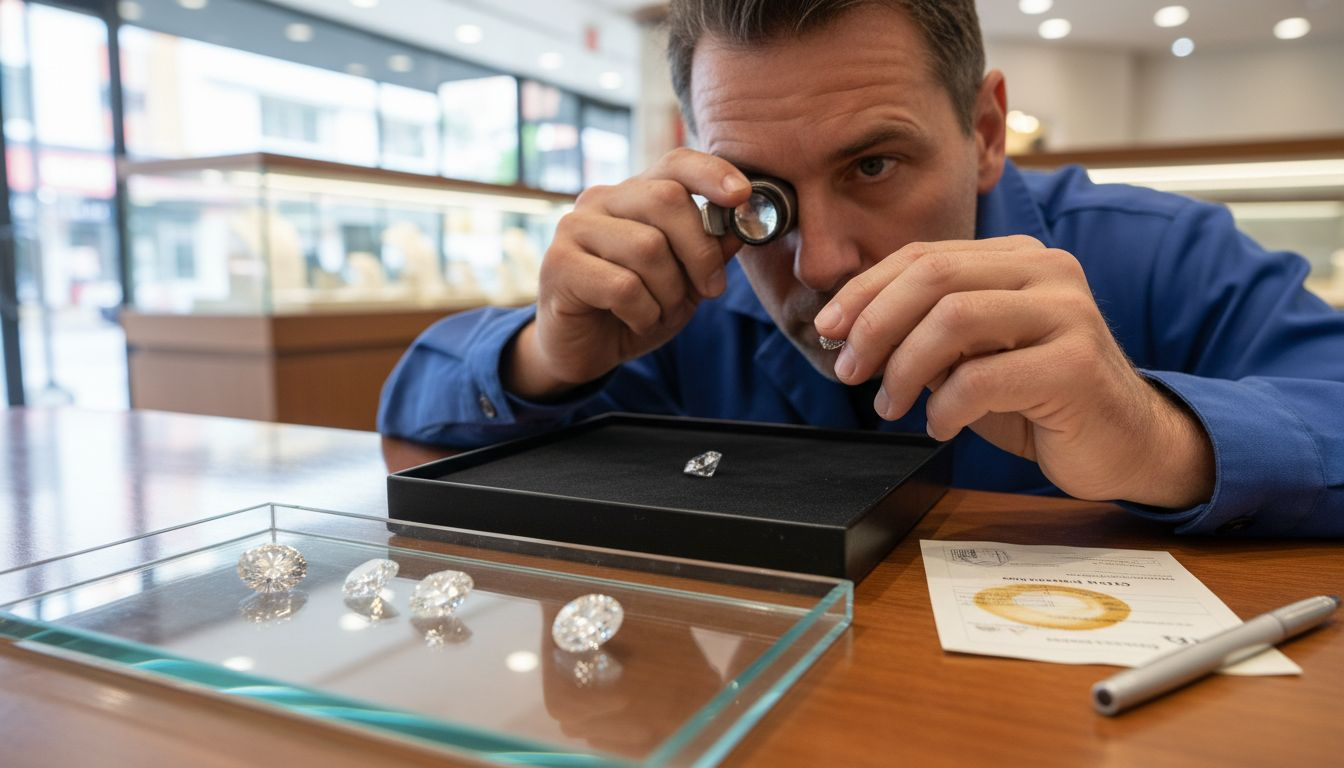
Clarity and carat weight complete the evaluation process. Clarity assesses the presence of internal or external imperfections, with fewer inclusions indicating a higher quality stone. Carat measures the diamond’s weight, with larger stones typically being more valuable. However, the key is finding a balanced combination that fits your budget and aesthetic preferences. A smaller diamond with exceptional cut and clarity can often appear more brilliant than a larger stone with lower quality characteristics.
Use this summary to understand how each of the 4Cs impacts your lab-grown diamond selection:
| Characteristic | What It Impacts | Why It Matters |
|---|---|---|
| Cut | Sparkle and fire | Superior cut enhances brilliance |
| Color | Diamond hue | Near-colorless stones demand a premium |
| Clarity | Internal flaws | Fewer inclusions increase beauty |
| Carat | Size and weight | Higher carat raises value and presence |
Pro tip: Request side-by-side comparisons of diamonds with similar specifications to train your eye and understand how subtle differences in the 4Cs impact a diamond’s overall appearance.
Step 4: Compare Certification and Ethical Sourcing
Certification and ethical sourcing are crucial elements in selecting a high-quality lab-grown diamond that aligns with your values and ensures you receive an authentic, responsibly created gemstone. This step will help you navigate the verification process and understand the importance of transparent diamond origins.
Lab-grown diamond certifications provide a critical layer of assurance about your diamond’s quality and authenticity. Reputable gemological laboratories like GIA (Gemological Institute of America) and IGI (International Gemological Institute) offer comprehensive documentation that details every aspect of your diamond. These certificates include precise measurements of the 4Cs, verification of the diamond’s origin, and validation of its laboratory creation process, giving you complete transparency about your gemstone.
Ethical sourcing is a fundamental advantage of lab-grown diamonds. Unlike traditional mined diamonds, which can have complex and sometimes problematic supply chains, lab-grown diamonds are created in controlled environments with minimal environmental impact. They eliminate concerns about conflict diamonds, reduce carbon footprints, and provide a sustainable alternative that does not compromise on quality or aesthetic appeal. When comparing certifications, look for documents that not only verify the diamond’s technical characteristics but also confirm its responsible production methodology.
Pro tip: Always request and personally review the full certification document before finalizing your diamond purchase, paying special attention to the detailed grading information and origin statements.
Step 5: Verify Diamond Quality and Finalize Your Choice
You are now at the most critical stage of selecting your perfect lab-grown diamond where careful verification and confident decision-making will transform your jewelry vision into reality. This final step ensures that you select a diamond that meets your quality expectations and personal aesthetic.
Lab-grown diamond jewelry selection demands meticulous attention to detail during the final verification process. Beyond reviewing the certification, you need to visually inspect the diamond under different lighting conditions and assess its real world appearance. Request to view the diamond through professional jeweler loupes that allow you to examine its microscopic details. Compare the actual stone against its certification document, checking that the visual characteristics match the written specifications exactly.
Beyond technical specifications, trust your personal aesthetic judgment. A diamond might technically meet all quality standards but still not feel right for you. Consider how the diamond interacts with light, its overall symmetry, and how it complements your intended jewelry setting. Reputable jewelers will provide multiple viewing options and encourage you to compare different stones side by side. Ask questions about the diamond’s specific origin, the precise laboratory creation process, and request a comprehensive explanation of its unique characteristics.
Pro tip: Request natural daylight and artificial light comparisons to fully understand how your diamond will sparkle in different environments.
Discover The Perfect Lab-Grown Diamond Jewelry With Confidence
Choosing lab-grown diamonds involves weighing key factors like the 4Cs, certification, and ethical sourcing to find a piece that truly reflects your style and values. If you want to avoid confusion and uncertainty while securing brilliance and sustainability in your jewelry, Eternal Carat offers a streamlined experience tailored to your unique preferences. Our collection showcases stunning engagement rings, pendants, and earrings crafted with precision from ethically sourced lab-grown diamonds that meet the highest standards of cut, color, clarity, and carat.
Explore exquisite designs and customize your dream piece with expert guidance on all aspects of lab-grown diamond quality and certification at Eternal Carat. Don’t wait to embrace luxury that shines eternally with eco-friendly beauty. Begin your journey to unforgettable elegance today by visiting our homepage and discover why discerning buyers trust us to deliver timeless sparkle matched with responsible craftsmanship.
Frequently Asked Questions
How do I define my style preferences for lab-grown diamonds?
Start by exploring different design aesthetics that appeal to you, such as minimalist, vintage-inspired, or contemporary styles. Create a mood board or digital collection to visualize your preferences and guide your selection process.
What should I consider when setting a budget for lab-grown diamonds?
Determine a comfortable spending range, keeping in mind that lab-grown diamonds typically offer greater value than mined stones. Assess your financial situation to create a budget that allows you to select a beautiful piece without overspending.
What are the key benefits of lab-grown diamonds compared to traditional mined diamonds?
Lab-grown diamonds have identical physical properties to mined diamonds but offer a lower environmental impact and more transparent sourcing. Understand these advantages to feel confident in choosing a sustainable and ethical gemstone.
How can I evaluate the quality of lab-grown diamonds using the 4Cs?
Focus on the characteristics of Cut, Color, Clarity, and Carat to assess diamond quality. Compare diamonds based on these criteria to find a balance that meets both your aesthetic and budgetary needs.
Why is certification important when choosing lab-grown diamonds?
Certification provides assurance regarding the diamond’s quality and origin, documenting vital information about the 4Cs and the laboratory creation process. Always request the full certification document and review the detailed grading before making your final purchase.
What steps should I take to verify the quality of my chosen lab-grown diamond?
Conduct a visual inspection under different lighting conditions and use a jeweler’s loupe to examine the stone’s details. Ensure that the visual characteristics match what is outlined in the certification to confirm the diamond meets your expectations.
Recommended
- 14k White Gold 2.65ctw Lab-Grown Diamond Tennis Bracelet – 6.5" – Eternal Carat
- 14K Yellow Gold 1.0 Cttw Lab-Grown Marquise Diamond Floral Leaf Stud E – Eternal Carat
- Lab Grown Diamond Jewelry & Custom Engagement Rings – Eternal Carat
- IGI 1.84ct G VVS2 Asscher – Eternal Carat
- Opal Precious Stone Ladies Ring - STOMART.CO.UK


