

TL;DR:
- Ethical jewelry involves comprehensive traceability, conflict-free sourcing, fair labor, and transparency.
- Verify certifications like RJC, Fairtrade, and Kimberley Process through official registries and documentation.
- Buyers should ask detailed questions about material origins, labor conditions, and ongoing supply chain audits.
When someone says a ring is “ethically sourced,” what does that actually prove? Surprisingly little, on its own. The jewelry industry is filled with well-meaning labels and carefully worded marketing, but genuine ethics in jewelry run far deeper than any single phrase printed on a tag. From the mine where gold is extracted to the hands of the artisan who sets the stone, ethical concerns touch every link in a long and complex chain. This guide is written specifically for Denver-area buyers who want to move past vague promises and understand, in concrete terms, what ethical jewelry really looks like, and how to spot the real thing.
Table of Contents
- Why ethics matter in the jewelry world
- Core pillars of ethical jewelry: Sourcing, labor, and transparency
- How ethics are enforced: Audits, standards, and certifications
- Risks, greenwashing, and evidence: What buyers should look for
- Putting ethics into practice: Smart buying for Denver jewelry shoppers
- What most people get wrong about ethical jewelry
- Discover ethical jewelry options in Denver
- Frequently asked questions
Key Takeaways
| Point | Details |
|---|---|
| Evidence over labels | Claims of ethical jewelry mean little without documentation, third-party verification, and full transparency. |
| Multiple pillars of ethics | True ethical jewelry involves traceable sourcing, fair labor, and responsible disclosure throughout the process. |
| Spotting greenwashing | Be alert for vague ‘ethical’ marketing and always ask for substantiation before buying. |
| Ongoing due diligence | Responsible jewelers continually monitor and improve their practices—not just once, but as a regular commitment. |
Why ethics matter in the jewelry world
The jewelry industry has a complicated history with ethics, and that history is not ancient. In the late 1990s, the global spotlight fell on “conflict diamonds,” also called blood diamonds, gemstones mined in war zones and sold to finance armed conflict. That crisis forced the industry to confront how deeply its supply chains could be tied to human suffering. The Kimberley Process was introduced in 2003 as a partial response, but researchers and advocacy groups quickly pointed out it only addressed diamonds funding rebel movements, leaving out a much wider range of abuses.
Today, the scope of concern has expanded considerably. Why sustainable jewelry matters connects directly to how mining and production affect communities, ecosystems, and labor forces worldwide. The issues buyers now expect jewelers to address include:
- Child labor in artisanal gold and gemstone mining across parts of sub-Saharan Africa and Southeast Asia
- Environmental damage from mercury use in small-scale gold mining and destructive open-pit operations
- Worker exploitation, including unsafe conditions, poverty wages, and forced overtime
- Conflict financing, where mineral revenues fund armed groups or authoritarian governments
- Misleading provenance claims, where “origin” labeling is vague or outright false
Denver consumers, in particular, tend to be highly informed. The city consistently ranks among the most environmentally conscious in the nation, and that mindset extends to purchasing decisions. Buyers here ask harder questions and expect real answers.
“Ethics in jewelry primarily operates through ethical sourcing and responsible supply-chain practices, including worker welfare, environmental protections, and conflict-free sourcing.”
What makes jewelry ethics especially challenging compared to, say, clothing or food, is the extreme opacity of the supply chain. A diamond may pass through a dozen countries before it reaches a retail display. Gold is routinely melted and mixed with metal from multiple sources, making origin tracking nearly impossible without deliberate systems in place. Consumers rarely see any of this, which is exactly why education matters so much.
Core pillars of ethical jewelry: Sourcing, labor, and transparency
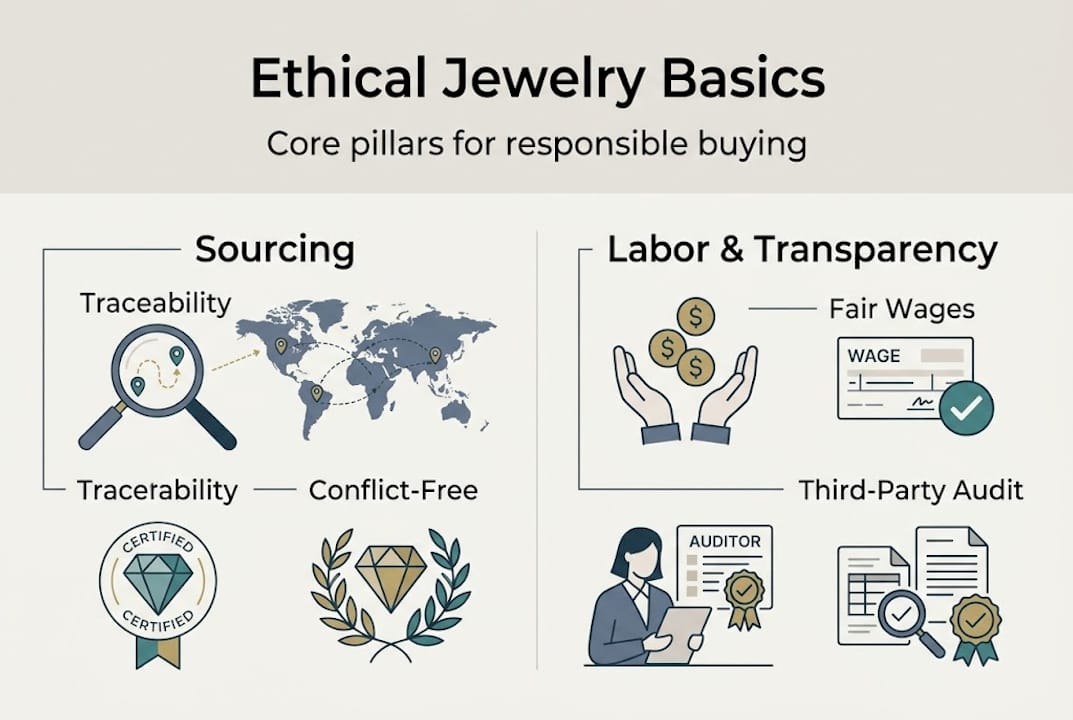
When industry experts talk about ethical sourcing in jewelry, they generally point to five interconnected pillars. Each one builds on the others, and a weakness in any one area can undermine an otherwise strong ethics posture.
The five core pillars recognized across the industry are:
- Traceability from mine to market: The ability to document where every material originated and how it moved through the supply chain
- Conflict-free materials: Assurance that no gemstone or metal financed armed conflict or gross human rights abuses
- No child labor: Verified absence of underage workers at any stage, including artisanal and small-scale mining
- Fair wages and safe working conditions: Not just legal minimums, but genuinely dignified conditions throughout production
- Full supply-chain transparency: Proactive disclosure of sourcing information to consumers and independent auditors
As ethical jewelry standards make clear, these pillars must all be addressed together, not cherry-picked.
| Pillar | What it means in practice | How buyers can verify |
|---|---|---|
| Traceability | Paper trail from source to sale | Ask for chain-of-custody documentation |
| Conflict-free | No funding of armed groups | Check for Kimberley or RJC certification |
| No child labor | Age-verified workforce throughout | Request third-party audit reports |
| Fair wages | Above-poverty pay, safe conditions | Look for Fairtrade Gold or similar marks |
| Transparency | Full disclosure on sourcing | Retailer should provide clear written answers |
Labor rights deserve special attention because they are the pillar most commonly glossed over in marketing. A jeweler can truthfully say a diamond is “conflict-free” under the narrow Kimberley definition while the gold setting was refined by workers earning poverty wages in a facility with no safety standards. The two issues are entirely separate. When designing ethical jewelry with a custom jeweler, asking about the metal’s origin is just as important as asking about the stones.
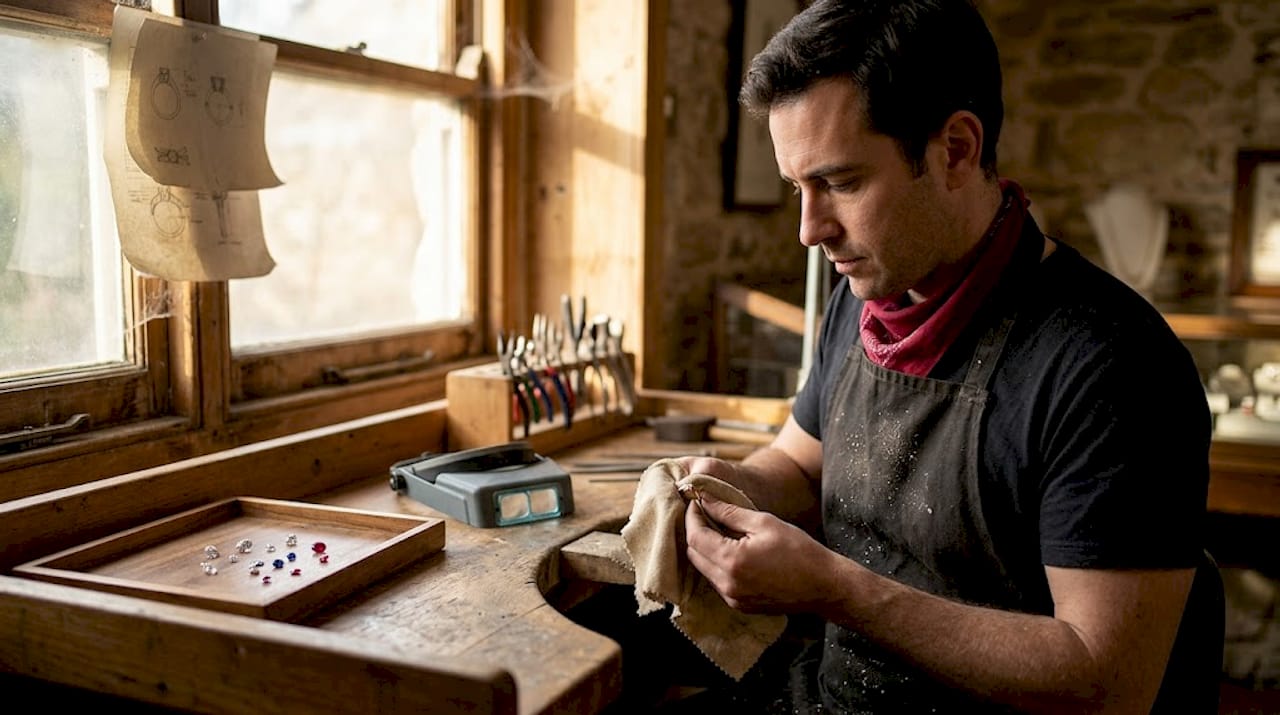
Pro Tip: When shopping for a custom engagement ring, ask specifically where the gold or platinum comes from and whether the refinery carries any third-party certification. A reputable jeweler will have a clear answer ready. If they seem surprised by the question, that itself is a signal.
Third-party verification is what separates credible claims from marketing language. Standards worth looking for include Fairtrade Gold, the Responsible Jewellery Council certification, the Conflict-Free Sourcing Initiative, and laboratory grading reports for gemstones from institutions like the Gemological Institute of America.
How ethics are enforced: Audits, standards, and certifications
Understanding which certifications carry genuine weight is one of the most practically useful skills a conscious buyer can develop. The landscape of ethical jewelry certifications is crowded, and not every logo on a website means the same thing.
Here is a side-by-side look at how some leading frameworks compare:
| Standard | Covers | Enforced by |
|---|---|---|
| Responsible Jewellery Council (RJC) | Precious metals, diamonds, gemstones | Independent third-party auditors |
| Kimberley Process | Rough diamonds only | Government-to-government verification |
| Fairtrade Gold | Artisanal and small-scale gold mining | Fairtrade International |
| SCS-007 Sustainably Rated Diamonds | Environmental, social, governance | Scientific Certification Systems |
The RJC assurance system is among the most rigorous in the industry. As the RJC itself states, it uses independent third-party audit and certification to ensure members meet its standards, including traceability and responsible processing through its Chain of Custody standard for precious metals. That Chain of Custody (COC) standard is significant because it tracks material through refiners, manufacturers, and retailers, not just at the point of origin.
In practice, this is what a sound ethics enforcement system looks like:
- Initial audit: An accredited, independent auditor reviews a company’s sourcing documents, supplier contracts, and labor records.
- Site visits: Auditors may visit production facilities to observe conditions firsthand, not just review paperwork.
- Corrective action plans: If problems are found, companies must address them within a defined timeframe or risk losing certification.
- Renewal cycles: Certifications are not permanent. Most require re-auditing every one to three years to maintain standing.
- Consumer disclosure: Certified members must make their certification status publicly verifiable, typically through a searchable online registry.
The difference between this process and a brand simply claiming to be “ethical” on its website is enormous. Industry ethics, as the RJC makes explicit, is operationalized through verifiable standards and third-party assurance systems, not through marketing claims alone.
Pro Tip: Before trusting a certification, verify it directly. The RJC, Fairtrade International, and others maintain online databases where you can confirm whether a specific company is actually certified and when their certification was last renewed. A logo on a website that cannot be verified in the official registry is a red flag.
Sustainable jewelry explained in full detail often reveals just how much work goes into maintaining legitimate standing in these programs. Retailers who have done that work are usually proud to show it.
Risks, greenwashing, and evidence: What buyers should look for
Greenwashing is the practice of making environmental or ethical claims that are vague, misleading, or unsupported by evidence. In the jewelry sector, it is remarkably common, partly because consumers have historically not known enough to push back.
The 2025 CIBJO ethics report addresses this directly, noting that ethics claims in jewelry are scrutinized for substantiation and greenwashing risk, and that genuine ethics includes accurate, verifiable consumer disclosure about provenance and product integrity.
“Ethics claims in jewelry are scrutinized for substantiation and greenwashing risk; ethics includes accurate, verifiable consumer disclosure about provenance and product integrity.”
What does greenwashing actually look like in a jewelry store or on a website? Watch for these patterns:
- Vague language: Terms like “responsibly sourced,” “eco-friendly,” or “sustainable” with no supporting documentation
- Self-certified claims: A brand declaring itself ethical without any third-party verification
- Cherry-picked coverage: Highlighting that diamonds are conflict-free while saying nothing about the labor conditions of metal refiners
- Outdated certifications: A logo that refers to a certification that has since lapsed or been suspended
- Deflection: A jeweler who becomes evasive or defensive when asked specific sourcing questions
You also have the right to request documentation. Any retailer making ethics claims at the point of sale has a responsibility to support those claims with actual evidence. This might include a supplier’s certification letter, a laboratory grading report, a chain-of-custody document, or an audit summary. If a retailer cannot produce any of this, the claims they are making should be treated with caution.
The benefits of custom ethical jewelry include the opportunity to specify exactly what materials you want and ask for documentation before a single stone is set. That level of control is much harder to exercise when buying a mass-produced piece from a large retailer.
Putting ethics into practice: Smart buying for Denver jewelry shoppers
Knowledge is useful only when it shapes action. For Denver shoppers navigating a growing market of jewelers who claim ethical credentials, here is a practical framework for evaluating your options.
Start with these steps before you ever walk into a store or submit an online inquiry:
- Research the retailer’s certifications: Search their name in the RJC member registry, Fairtrade’s partner database, or relevant lab grading directories
- Check for a sourcing policy: A credible jeweler should have a written sourcing policy somewhere on their website, not just buzzwords in their branding copy
- Look for specificity: Ethical retailers name their suppliers, refiners, and certification bodies. Vague references to “responsible partners” are not enough
- Read third-party reviews: Look for reviews from buyers who asked detailed sourcing questions and describe how the jeweler responded
Once you are in conversation with a retailer, ask direct questions:
- Where does your gold or platinum come from, and is it certified?
- Can you provide documentation showing your diamonds or gemstones are conflict-free under current, not just historical, standards?
- Are your manufacturing partners independently audited? When was the last audit?
- What certifications do you currently hold, and where can I verify them?
As OECD due diligence guidance makes clear, ethics due diligence in minerals is not a one-time check. It is a continuous risk-management process with defined steps and governance expectations. Any jeweler whose ethics practices have not evolved in the last few years is likely falling behind current standards.
For consumers designing a custom engagement ring, the custom design process itself creates a natural opportunity to apply this knowledge. You select the metal. You select the stone. You work directly with a jeweler who can trace both. Explore a structured Denver ethical jewelry buying workflow to understand exactly how to move through these decisions systematically. For inspiration and concrete options, browsing best sustainable jewelry picks can help you understand what is currently available from ethical sources in your area.
What most people get wrong about ethical jewelry
Here is the uncomfortable truth we have learned from working directly with buyers in the Denver metro: most people who care deeply about ethics still over-rely on certification as a shortcut. They see an RJC logo, relax, and stop asking questions. That is a mistake.
Certification is a floor, not a ceiling. It tells you a company met a minimum standard at the time of the last audit. It does not tell you what has changed since then, which suppliers have been swapped out, or whether labor conditions at a partner facility have deteriorated. How technology shapes ethical jewelry is evolving rapidly, and the standards that felt rigorous two years ago may already be lagging behind best practices.
We also see buyers conflate sustainability with ethics. A lab-grown diamond, for example, eliminates most environmental and conflict risks associated with mining. But if the lab that grows it uses coal-powered energy and employs workers without adequate protections, the ethics picture is more complicated than the “eco-friendly” label suggests. Similarly, certifications alone aren’t enough to guarantee a retailer is operating with genuine integrity across every dimension.
The buyers who make the most genuinely ethical purchases are those who stay curious, ask follow-up questions, and treat their jeweler’s willingness to engage transparently as a signal of trustworthiness. A jeweler who welcomes scrutiny is almost always more trustworthy than one whose ethics claims come polished but pre-packaged.
Discover ethical jewelry options in Denver
At Eternal Carat, ethics is not a marketing afterthought. It is the foundation of how we source, design, and sell. We specialize in lab-grown diamond jewelry that dramatically reduces the environmental and human rights risks associated with traditional mining, and we pair every piece with the kind of transparency that makes that commitment verifiable.
Whether you are designing a custom engagement ring, upgrading to a lab-grown stone, or simply exploring your options, our appointment-only consultation model in Parker, Colorado means you get focused, one-on-one guidance from experts who can answer sourcing questions directly. We do not deal in vague promises. We provide documentation, name our sources, and walk you through exactly what you are buying and why it meets a genuine ethical standard. Reach out to schedule your private consultation and experience the difference that real transparency makes.
Frequently asked questions
How can I verify if a jewelry piece is truly ethical?
Look for third-party certifications from bodies like the RJC or Fairtrade, and ask the retailer for chain-of-custody documentation or audit reports that support their sourcing claims.
What questions should I ask a jeweler to ensure ethical practices?
Ask specifically about sourcing origins, labor conditions at manufacturing partners, and which verifiable standards they currently hold, then confirm those certifications in the issuing organization’s official registry.
Is lab-grown diamond jewelry more ethical than mined diamonds?
Lab-grown diamonds significantly reduce conflict and environmental mining risks, but buyers should still check for transparent production practices and verify that the lab and retailer operate under disclosed, verifiable standards.
How often should jewelers audit their supply chain?
Ethical best practice, as outlined in OECD due diligence guidance, treats supply-chain auditing as a continuous, ongoing process rather than a single certification event.


