

TL;DR:
- Jewelry hallmarks certify metal purity and authenticity, often requiring magnification to verify.
- Gold karat indicates purity and influences durability and color, with 14K and 18K being practical daily wear options.
- Understanding diamond cut styles and craftsmanship details helps buyers assess value, longevity, and true quality.
Walking into a jewelry boutique in Colorado and hearing terms like “hallmark 750” or “brilliant cut VS1” can make even confident shoppers feel lost. That feeling is more common than most people admit. The good news is that fine jewelry terminology is not a secret language reserved for gemologists. Once you know what these terms actually mean, you become the buyer who asks the right questions, spots real value, and avoids costly mistakes. This guide covers hallmarks, purity marks, gold karat, diamond cuts, and craftsmanship so you can shop with genuine confidence.
Table of Contents
- Demystifying hallmarks and purity marks
- Gold karat, alloys, and what they mean for buyers
- Diamond shapes and cut styles: What matters most
- Craftsmanship in fine jewelry: Handmade, mass-produced, and Colorado priorities
- The truth most jewelry shoppers don’t realize about fine jewelry terminology
- Discover Colorado’s best fine jewelry expertise
- Frequently asked questions
Key Takeaways
| Point | Details |
|---|---|
| Hallmarks ensure authenticity | Recognizing hallmark stamps and purity marks helps you verify real precious metals in fine jewelry. |
| Karat affects value and wear | Understanding gold karat ratings empowers you to choose between everyday durability and heirloom investment. |
| Diamond cut drives sparkle | Learning about diamond cuts and facets lets you spot the most brilliant and valuable gems. |
| Craftsmanship impacts longevity | Handmade jewelry often lasts longer and holds more value than mass-produced alternatives. |
| Knowledge builds buyer confidence | Mastering fine jewelry terminology lets you shop wisely and avoid costly mistakes. |
Demystifying hallmarks and purity marks
Hallmarks are not decorative stamps. They are official guarantees. Hallmarks certify precious metal purity, applied by assay offices or manufacturers in compliance with regional standards. When you buy a ring labeled “18K,” the hallmark is the proof behind that claim. Without it, you are taking the seller’s word.
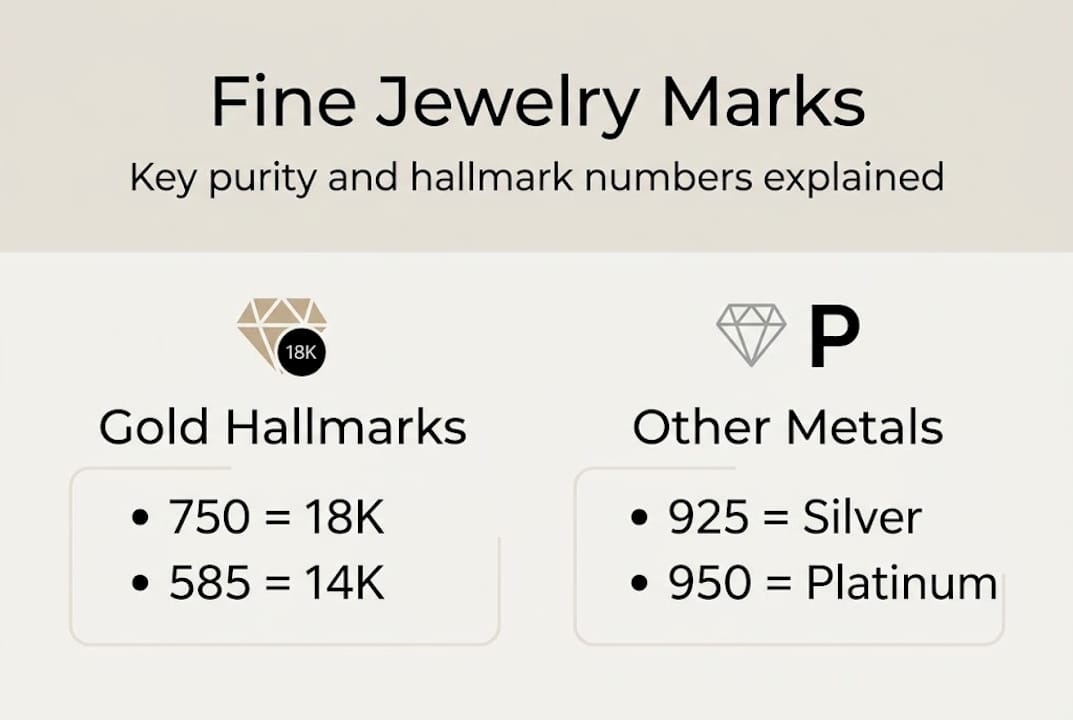
The numbers stamped inside a piece tell you the metal’s fineness, meaning what fraction of the alloy is pure precious metal. Here is a quick reference to the most common marks:
| Mark | Metal | Purity |
|---|---|---|
| 999 | Gold | 24K (99.9% pure) |
| 750 | Gold | 18K (75% pure) |
| 585 | Gold | 14K (58.5% pure) |
| 925 | Silver | Sterling (92.5% pure) |
| 950 | Platinum | 95% pure |
| 900 | Platinum | 90% pure |
Beyond purity marks, you may also notice:
- Maker’s marks: A symbol or set of initials identifying the manufacturer or designer
- Assay office symbols: Used in countries like the UK to indicate where the metal was tested
- Date letters: Found on older European pieces, these indicate the year of hallmarking
To read hallmarks yourself, use a loupe at 10x magnification. This small, handheld magnifier lets you see marks that are invisible to the naked eye. Most jewelers carry one and will let you use it if you ask.
Learning about ethical luxury craftsmanship alongside hallmark reading gives you a fuller picture of what separates a genuinely valuable piece from a cleverly marketed one.
Pro Tip: In Colorado, verifying hallmarks is especially important when shopping estate sales, antique fairs, or small handmade jewelry makers. Not all sellers are required to hallmark under U.S. law, so a missing mark is a red flag worth asking about before you buy.
Gold karat, alloys, and what they mean for buyers
Hallmarks reveal the basics, but gold karat and alloys shape both the look and lifetime of your jewelry. Karat measures gold purity, and alloys influence durability and color, which directly affects how a piece looks and how long it lasts.
Pure gold is 24 karats, meaning 24 out of 24 parts are gold. But pure gold is also extremely soft. Jewelers mix it with other metals called alloys to increase strength and create different colors. Here is how the main karat grades compare:

| Karat | Gold Content | Best Use |
|---|---|---|
| 24K | 99.9% | Bullion, investment bars |
| 18K | 75% | Fine jewelry, heirlooms |
| 14K | 58.5% | Everyday jewelry, engagement rings |
| 10K | 41.7% | Budget jewelry, high-wear pieces |
For most Colorado buyers shopping fine jewelry, 18K and 14K are the two practical choices:
- 14K gold offers the best balance of durability and value. The additional alloy metals make it harder and more scratch-resistant, ideal for rings and bracelets worn daily.
- 18K gold has a richer, deeper color because of its higher gold content. It is softer but still suitable for earrings, pendants, and pieces handled gently.
- Rose gold gets its warm color from a copper alloy. More copper means a deeper rose tone.
- White gold is achieved with nickel or palladium alloys and often finished with rhodium plating for that bright white look.
- Yellow gold uses silver and copper as alloys, keeping the classic gold appearance.
Understanding these differences also matters for investment. Higher karat pieces hold more intrinsic metal value, which plays a role in resale and trade-in scenarios.
Pro Tip: Choose 14K for rings and bracelets you plan to wear every day. Reserve 18K and above for heirloom pieces, pendants, or items you wear only for special occasions. The craftsmanship for ethical luxury that goes into higher karat pieces also reflects their lasting worth.
Diamond shapes and cut styles: What matters most
Now that you know how to spot precious metals, let’s turn to the world’s most coveted gemstone: the diamond. One of the most common points of confusion is the difference between shape and cut. These two terms describe different things entirely.
Shape refers to the outline of the diamond when viewed from above. Cut refers to how the facets (the flat, polished surfaces) are arranged to interact with light. A round diamond can have a brilliant cut or a step cut. Knowing this distinction alone will make you a sharper buyer.
Popular diamond shapes include:
- Round: The most popular, with 57 to 58 facets in a brilliant cut arrangement for maximum sparkle
- Princess: Square shape with brilliant-style faceting
- Oval: Elongates the finger, brilliant faceting
- Cushion: Soft rounded corners, available in both brilliant and modified cuts, like this cushion cut example
- Pear: Teardrop shape, brilliant cut, as seen in this pear cut sample
Cut styles break into two main families:
- Brilliant cut: Triangular and kite-shaped facets designed to maximize light return and sparkle. Best for buyers who want maximum visual impact.
- Step cut: Rectangular facets arranged in parallel rows (think emerald and Asscher cuts). Emphasizes clarity and a glassy, mirror-like luster rather than sparkle.
The round brilliant is the only shape that receives a GIA cut grade, ranging from Excellent to Poor. All other shapes are evaluated by their polish and symmetry, but not an overall cut grade. This matters enormously when comparing prices.
When reviewing a diamond, ask for the grading report and check:
- Cut grade (for round brilliants)
- Polish and symmetry grades
- Depth and table percentages
- Clarity and color grades
Craftsmanship in fine jewelry: Handmade, mass-produced, and Colorado priorities
Understanding gems is key, but the way a piece is built defines how it endures and delights. When a jeweler describes a ring as “handmade,” that term can mean very different things depending on who says it.
Here are the main construction terms you will encounter:
- Handmade or hand fabricated: A craftsperson shapes the metal by hand using hammers, saws, and files. Each piece is unique. Seams may show slight irregularity, which is a feature, not a flaw.
- Cast: Molten metal is poured into a mold. Efficient and consistent, but can result in slightly porous metal that is less durable over decades.
- CAD/CAM: Computer-aided design creates a precise wax or resin model that is then cast. Allows complex, repeatable designs with tight tolerances.
- Bespoke: A fully custom piece designed in collaboration with the client from the ground up, often combining hand fabrication and CAD.
- Mass-produced: High volume factory output using automated casting and minimal hand finishing.
“Handcrafted pieces from established makers consistently offer better longevity and resale value compared to mass-produced alternatives. The investment in construction quality pays dividends for decades.”
Handcrafted jewelry outlasts mass-produced pieces in most real-world wear scenarios. It is also worth noting that modern CAD technology enables designs impossible by hand, bridging the gap between tradition and innovation in meaningful ways.
Longevity aside, craftsmanship also affects the value of bespoke jewelry at resale. Collectors and estate buyers often pay a premium for signed or documented handmade pieces over anonymous cast jewelry.
Pro Tip: Before buying, ask the jeweler to let you inspect the prongs and settings under magnification. Thin, uneven, or repaired prongs are warning signs on any piece, handmade or otherwise.
The truth most jewelry shoppers don’t realize about fine jewelry terminology
Here is what most guides skip entirely: terminology in jewelry retail is often used as a selling tool, not an educational one. When a salesperson uses the word “bespoke” or “handcrafted,” they may mean something very different from its technical definition. That gap between marketing language and genuine craftsmanship standards is where buyers consistently lose money.
We have seen clients walk in with pieces they paid heirloom prices for, only to discover the construction was cast from a stock mold with minimal hand work. The terminology was used correctly in a narrow sense, but the buyer’s interpretation was off.
Real expertise is knowing which details translate to long-term satisfaction versus which are just clever framing. A stone’s cut quality, a metal’s actual karat, and a setting’s construction are the things that determine whether a piece ages beautifully or disappoints. Understanding the value of craftsmanship is not about collecting vocabulary. It is about knowing what questions to ask so no one can bluff you. A little knowledge here saves you thousands and leaves you with pieces you genuinely love for life.
Discover Colorado’s best fine jewelry expertise
You have done the reading. Now it is time to put that knowledge to work with a jeweler who matches your standard. At Eternal Carat, every piece comes with transparent documentation, certified gemstones, and the kind of honest conversation that this article has been modeling.
Whether you are selecting a lab-grown diamond engagement ring or exploring custom design options, our Parker, Colorado studio offers appointment-only consultations where the terminology we covered here is just the starting point. Explore Eternal Carat lab-grown jewelry and discover GIA-certified pieces crafted with full accountability, from hallmark to setting. Your next great jewelry decision starts with the right expertise behind it.
Frequently asked questions
What hallmark numbers should I look for in fine jewelry?
The most common marks are 750 for 18K gold, 585 for 14K gold, 925 for sterling silver, and 950 for platinum. These numbers confirm the metal’s purity level before you buy.
Is 18K or 14K gold better for daily wear?
14K gold is more durable for everyday use due to its higher alloy content, while 18K is softer, purer, and better suited for heirlooms and pieces worn occasionally.
Why does round brilliant cut matter when choosing a diamond?
The round brilliant has 57 to 58 facets engineered for maximum light return and is the only diamond shape assigned an official GIA cut grade, making it the most objectively comparable choice.
How can I quickly check if a piece is handmade or mass-produced?
Look for slight irregularities in hand-finished areas and ask about fabrication method. Handcrafted pieces offer measurably better longevity and typically carry stronger resale value than cast, mass-produced alternatives.
What should I ask a jeweler about craftsmanship before buying?
Ask to inspect prongs and settings under magnification, request any available GIA or IGI reports for diamonds, and confirm whether the piece is hand fabricated, cast, or CAD-produced. These questions reveal true construction quality before you commit.


