

TL;DR:
- Diamond clarity impacts appearance and price, but many eye-clean stones look stunning at lower grades.
- The GIA clarity scale ranges from Flawless to Included 3, with most buyers opting for VS1 to SI1.
- For best value, choose clarity grades based on your setting and prioritize eye-cleanliness over high grades.
Clarity is one of the most misunderstood factors in diamond buying, and it costs shoppers real money when they get it wrong. Many buyers assume only a Flawless diamond is worth owning, while others ignore clarity entirely and end up disappointed. The truth sits somewhere in the middle, and understanding it can save you hundreds of dollars while still getting a stone that looks absolutely stunning. This guide breaks down exactly how diamond clarity works, what the grades actually mean, and how to choose the right clarity level for a lab-grown diamond that fits your style, values, and budget right here in the Denver area.
Table of Contents
- What is diamond clarity and why does it matter?
- Understanding the GIA clarity scale: From Flawless to Included
- How to evaluate diamond clarity in person and online
- Choosing the right clarity grade for your style and budget
- Our expert perspective: What most diamond shoppers miss about clarity
- Find your perfect lab-grown diamond in Denver
- Frequently asked questions
Key Takeaways
| Point | Details |
|---|---|
| Clarity impacts value | Understanding clarity can help you maximize beauty and budget for lab-grown diamonds. |
| GIA scale simplifies choices | The 11-grade GIA clarity scale makes it easy to compare and select the right diamond. |
| Eye-clean is often enough | Most people cannot see minor inclusions, so aim for a stone that looks flawless to the naked eye. |
| Lab-grown offers higher clarity | Lab-grown diamonds often have fewer visible flaws at a better price, especially for Denver buyers. |
What is diamond clarity and why does it matter?
Diamond clarity describes how free a stone is from internal flaws (called inclusions) and external surface flaws (called blemishes). Almost every diamond in existence has some degree of both. These characteristics form during the growth process, whether a diamond grows underground over billions of years or inside a controlled lab environment over a matter of weeks.
Clarity matters because it affects two things directly: how a diamond looks and what it costs. But here is the part most buyers miss: those two things do not always move together. A diamond with a lower clarity grade can look just as beautiful as one graded several levels higher, because most inclusions are completely invisible without magnification.
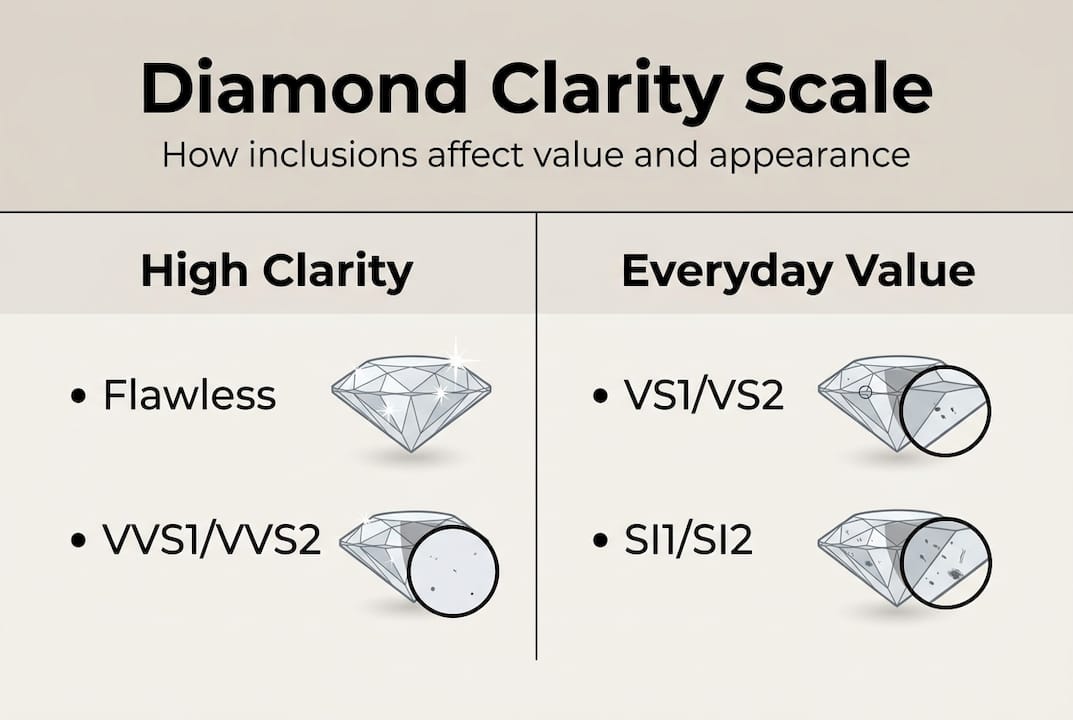
Diamond clarity is graded by the GIA on an 11-grade scale from Flawless (FL) to Included 3 (I3), assessing the size, number, position, nature, relief, and visibility of inclusions and blemishes under 10x magnification. That last detail matters: the standard evaluation happens under a loupe or microscope, not with the naked eye.
Lab-grown diamonds tend to show fewer visible inclusions than mined stones of the same grade. The controlled growth environment reduces the random internal stress fractures common in natural diamonds. If you are exploring lab diamonds for engagement rings, this is one of the reasons they offer exceptional visual quality at a lower price point.
Here is a quick breakdown of the main clarity characteristics you will encounter:
- Pinpoints: Tiny crystal inclusions, often invisible to the naked eye
- Feathers: Small fractures inside the stone
- Clouds: Groups of pinpoints that can create a hazy appearance
- Naturals: Portions of the original rough surface left on the diamond
- Scratches and nicks: Surface blemishes from cutting or handling
Pro Tip: Before focusing on a clarity grade number, ask whether the stone is “eye-clean,” meaning no inclusions are visible without magnification. That single question will guide you better than chasing a higher grade.
Understanding how clarity interacts with other quality factors is also valuable. Reading about diamond cut vs clarity will show you why cut quality often has a bigger visual impact than clarity grade alone.
Understanding the GIA clarity scale: From Flawless to Included
The GIA clarity scale is the industry standard, and once you understand it, reading a diamond certificate becomes straightforward. The 11-grade GIA scale runs from Flawless at the top to Included 3 at the bottom, with each grade defined by what is visible under 10x magnification.
Here is a full breakdown of every grade:
| Grade | Abbreviation | What it means |
|---|---|---|
| Flawless | FL | No inclusions or blemishes under 10x magnification |
| Internally Flawless | IF | No inclusions, minor surface blemishes only |
| Very Very Slightly Included 1 | VVS1 | Inclusions extremely difficult to see under 10x |
| Very Very Slightly Included 2 | VVS2 | Inclusions very difficult to see under 10x |
| Very Slightly Included 1 | VS1 | Inclusions difficult to see under 10x |
| Very Slightly Included 2 | VS2 | Inclusions somewhat easy to see under 10x |
| Slightly Included 1 | SI1 | Inclusions easy to see under 10x, often eye-clean |
| Slightly Included 2 | SI2 | Inclusions very easy to see under 10x, may be visible to eye |
| Included 1 | I1 | Inclusions visible to naked eye |
| Included 2 | I2 | Inclusions obvious to naked eye, may affect brilliance |
| Included 3 | I3 | Inclusions very obvious, affect transparency and brilliance |
Flawless diamonds are extraordinarily rare. Less than 1% of all diamonds ever graded receive an FL or IF designation, which is why they carry such a steep price premium. For most buyers, that premium does not translate into a visible difference in beauty.
The sweet spot for value sits in the VS1 to SI1 range. A VS1 cushion diamond is a perfect example of a stone that delivers near-perfect visual quality without the Flawless price tag. For lab-grown diamonds especially, VS2 and SI1 grades routinely produce eye-clean stones that look stunning in any setting.
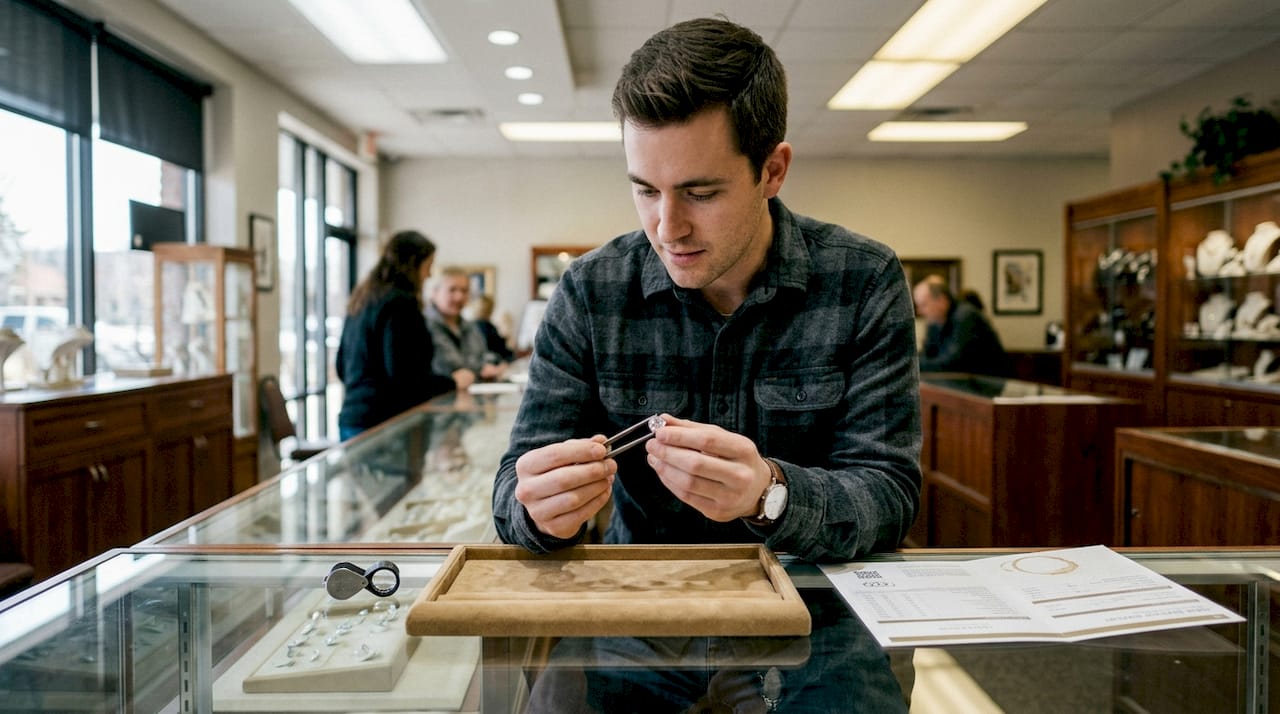
Retailers use GIA or IGI (International Gemological Institute) certificates to verify clarity grades for lab-grown stones. Always ask for a certificate before purchasing. It is your guarantee that the grade is independent and accurate.
How to evaluate diamond clarity in person and online
Knowing the grades is one thing. Actually evaluating a diamond, whether you are sitting across from a jeweler in Denver or scrolling through an online catalog, is a different skill. Here is how to do it well.
Evaluating clarity in person:
- Ask to view the diamond under a 10x loupe. Most jewelers will provide one.
- Look toward the center of the stone first, where inclusions are most likely to affect brilliance.
- Rotate the diamond slowly. Some inclusions are only visible from certain angles.
- Step back and look at the stone with your naked eye from about 12 inches away. If you cannot see anything, it is eye-clean.
- Compare two stones side by side when possible. The difference between VS2 and SI1 is often impossible to see without direct comparison.
Evaluating clarity online:
Reputable online retailers provide high-resolution images, 360-degree video, and clarity plots (diagrams showing the location of inclusions). Use all three. A clarity plot that shows inclusions near the edges or pavilion (bottom) of the stone is much less concerning than one showing a large feather in the center table.
Clarity is assessed under 10x magnification, but online photos are often taken at much higher magnification. What looks dramatic in a product photo may be completely invisible in real life. Keep that in mind when reviewing images.
Lab-grown diamonds generally show cleaner clarity plots than mined diamonds at the same grade level. This is one reason our lab-grown diamond quality checklist recommends focusing on eye-cleanliness over raw grade numbers. For a deeper look at what separates a great stone from a mediocre one, the lab-grown diamond quality guide covers every factor in detail.
Pro Tip: When shopping online, filter by “eye-clean” if the retailer offers that option. If not, stick to VS2 and above for round cuts, and VS1 and above for step cuts like emerald or Asscher, which show inclusions more easily.
You can also use our verifying diamond quality guide to cross-check any stone before you commit.
Choosing the right clarity grade for your style and budget
With a solid understanding of how clarity works, you can now make a choice that actually fits your life. The goal is not the highest grade. The goal is the best-looking stone for your money.
Higher clarity grades do not always translate to greater beauty, especially once a stone is eye-clean. For lab-grown diamonds, this is even more pronounced because the price gap between clarity grades is smaller than with mined stones, making it tempting to overspend on a grade upgrade that delivers no visible benefit.
Here is how to match clarity to your specific situation:
- Solitaire engagement rings: Clarity is more visible in a simple setting, so aim for VS2 or higher.
- Halo or pave settings: The surrounding stones draw the eye, making SI1 a smart and beautiful choice.
- Earrings and pendants: These are viewed from a distance, so SI1 and even SI2 can look excellent.
- Step-cut diamonds (emerald, Asscher): These cuts act like windows into the stone. Stick with VS1 or better.
- Round brilliant cuts: The faceting pattern hides inclusions well, making SI1 a reliable choice for value.
Most buyers who work with us end up very satisfied with VS2 or SI1 clarity for everyday fine jewelry. The savings can be redirected toward a better cut grade, a larger carat weight, or a more intricate setting.
Pro Tip: If you are torn between two clarity grades, choose the lower one and spend the difference on cut quality. A well-cut SI1 diamond will outshine a poorly cut VS1 every single time.
For engagement ring decisions especially, reviewing the full picture of choosing clarity for engagement rings helps you weigh all the factors together rather than optimizing for just one.
Our expert perspective: What most diamond shoppers miss about clarity
After working with hundreds of Denver-area clients on lab-grown diamond purchases, one pattern stands out clearly: buyers consistently overvalue clarity grades and undervalue eye-cleanliness. They chase FL and VVS grades because those labels sound impressive, and they end up spending significantly more for a difference that neither they nor anyone else will ever see.
Here is the harder truth: inclusions are not always a flaw. In some cases, a unique inclusion pattern can actually help you identify your specific diamond if it ever needs to be verified. It is a fingerprint, not a defect.
Lab-grown diamonds have changed this conversation in a meaningful way for Denver shoppers who care about sustainability. You can now get a VS1 or VS2 stone at a price point that would have bought you an SI2 mined diamond five years ago. That shift in value is real, and it rewards buyers who understand what they are actually paying for.
Our recommendation: use our diamond quality checklist as your starting point, then book a consultation so we can walk you through actual stones side by side. Seeing the difference in person changes everything.
Find your perfect lab-grown diamond in Denver
Understanding diamond clarity is the first step. Finding the right stone is where the real excitement begins.
At Eternal Carat, we specialize in helping Denver-area clients find lab-grown diamonds that balance beauty, ethics, and real value. Our appointment-only location in Parker, Colorado gives you a private, pressure-free environment to compare stones, ask questions, and make a confident decision. Whether you are drawn to a classic solitaire or something more distinctive like our marquise diamond earrings, our team will match you with a stone that fits your clarity priorities and your budget. Explore our full lab-grown diamond jewelry collection online, or reach out to schedule your personal consultation today.
Frequently asked questions
What are the most common inclusions found in lab-grown diamonds?
Lab-grown diamonds may show minor pinpoint inclusions or metallic flecks, but these often require 10x magnification to see and rarely affect the stone’s appearance to the naked eye.
How much does clarity affect the value of a lab-grown diamond?
Clarity does influence price, but once a stone is eye-clean, the price difference between upper-mid clarity grades shrinks considerably, making VS2 and SI1 the best value choices for most buyers.
Can an SI1 or SI2 clarity diamond still look flawless?
Yes. Many SI1 and some SI2 lab-grown diamonds appear completely flawless to the naked eye, particularly in smaller sizes or brilliant-cut shapes that naturally mask inclusions through their faceting pattern.
Do clarity grades apply differently to lab-grown versus mined diamonds?
The same 11-grade scale applies to both lab-grown and mined diamonds, though lab-grown stones often display different inclusion types, such as metallic flux inclusions, that are unique to their growth process.


