

TL;DR:
- Truly sustainable jewelry requires verifiable documentation and transparency from retailers.
- Define your priorities such as environmental impact, ethics, and certification before shopping.
- Ask for official certificates, origin statements, and supply chain proof to avoid greenwashing.
Finding truly sustainable luxury jewelry in Denver is harder than it should be. Walk into any jewelry store and you’ll hear words like “eco-friendly,” “responsibly sourced,” and “ethical” thrown around freely. But how many retailers can actually back those claims with documentation? For eco-conscious shoppers in the Denver area, the gap between marketing language and verifiable sustainability can feel overwhelming. This guide gives you a clear, step-by-step workflow to cut through the noise. You’ll learn how to define your priorities, prepare the right questions, execute your purchase with confidence, and verify every claim before you commit.
Table of Contents
- Define your sustainable jewelry priorities
- Prepare for sustainable jewelry shopping
- How to shop for ethical luxury: Step-by-step workflow
- Making the final decision: Verification and resale considerations
- A smarter way to shop: What most guides miss about sustainability
- Shop sustainable luxury with confidence
- Frequently asked questions
Key Takeaways
| Point | Details |
|---|---|
| Clarify your values | Decide which sustainability and luxury factors matter most before you shop. |
| Verify with documentation | Always request certifications and supply chain proof, not just marketing claims. |
| Ask about energy sources | True sustainability for lab-grown diamonds depends on renewable energy use. |
| Consider long-term impact | Factor in repairability and resale to maximize your ethical investment. |
Define your sustainable jewelry priorities
Now that you know what to expect from this guide, let’s start by clarifying your unique values and requirements.
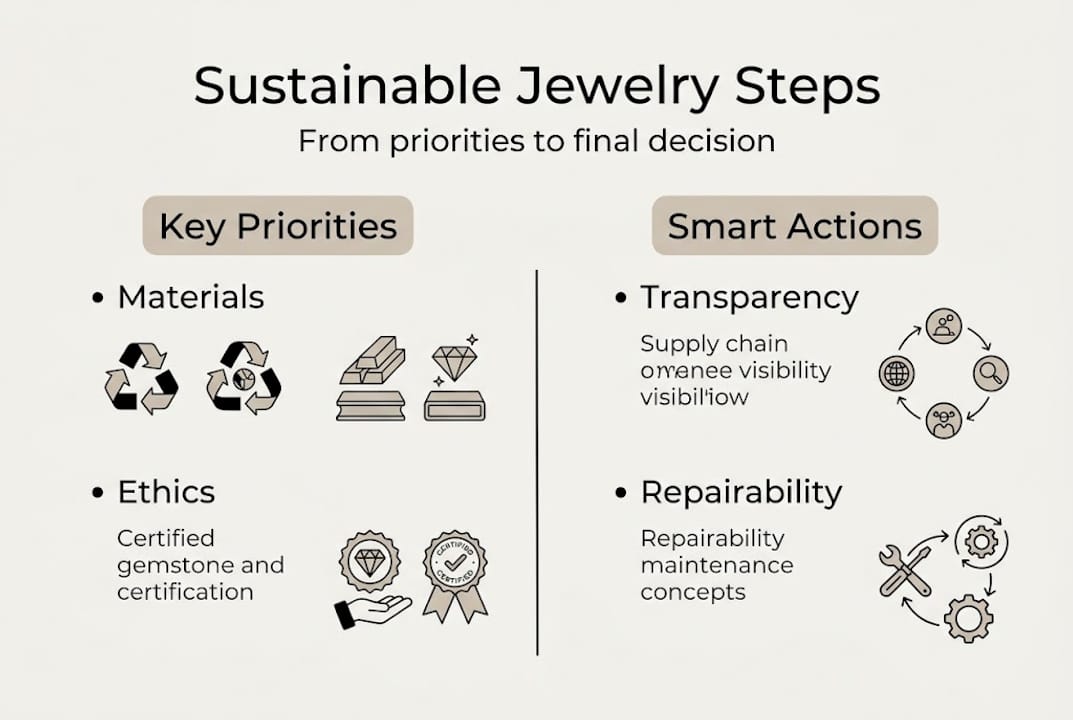
Not every eco-conscious shopper cares about the same things. Some prioritize carbon footprint above all else. Others focus on labor ethics, fair wages in mining communities, or the avoidance of conflict stones. Before you browse a single ring or pendant, you need to know your own hierarchy. As outlined in ethical buying guidance, a sustainable jewelry workflow starts with defining priorities: environmental impact, ethics, budget, style, lab-grown diamonds, recycled metals, and custom designs.
Here’s a simple framework to organize your thinking:
- Environmental impact: Do you want to minimize carbon emissions, water use, or land disruption from mining?
- Labor ethics: Are fair wages and safe working conditions for miners or manufacturers a dealbreaker?
- Design preferences: Are you drawn to custom one-of-a-kind pieces, vintage styles, or ready-made collections?
- Budget: Lab-grown diamonds typically cost 60 to 80 percent less than mined stones of equivalent size and quality, which opens up design possibilities.
- Certifications: GIA (Gemological Institute of America) and IGI (International Gemological Institute) are the two most respected grading bodies for diamonds, including lab-grown stones.
Once you know what matters most, you can filter retailers and designs much faster. Our sustainable jewelry guide walks through how to apply these filters in practice.
| Priority | Key question to ask | What to look for |
|---|---|---|
| Environmental impact | How was this stone or metal produced? | Renewable energy use, recycled metals |
| Labor ethics | Where were workers involved in production? | Fair trade certifications, origin reports |
| Certifications | Is this diamond graded by GIA or IGI? | Official grading report with stone ID |
| Supply chain | Can you trace this piece from source to shelf? | Written documentation, not verbal claims |
Supply chain transparency is worth calling out specifically. A retailer who genuinely prioritizes sustainability should be able to hand you a document, not just a story. If they can’t show you where a metal was refined or where a stone was grown, that’s a signal worth noting.
Pro Tip: Write your top three priorities on your phone before you shop. When a salesperson presents options, use your list to redirect the conversation back to what actually matters to you.
Prepare for sustainable jewelry shopping
With your priorities clear, the next step is gathering what you need to confidently begin shopping.
Preparation separates confident buyers from confused ones. Before you visit a retailer or browse online, know exactly what documents to request and what red flags to watch for. GIA and IGI certifications are the baseline for diamonds, and supply chain transparency should be non-negotiable.
Here’s a numbered checklist to work through before you shop:
- Request a grading report. For any diamond, lab-grown or mined, ask for the official GIA or IGI certificate. This document includes the stone’s cut, color, clarity, and carat weight, plus a unique ID number.
- Ask for an origin statement. For metals, request written confirmation that gold or platinum is recycled or responsibly mined. Verbal assurances are not enough.
- Research the retailer’s energy practices. For lab-grown diamonds specifically, ask whether the growing facility uses renewable energy. This matters more than most shoppers realize.
- Check for third-party audits. Retailers who participate in programs like the Responsible Jewellery Council (RJC) or SCS Global Services certification have been independently verified.
- Search for reviews that mention transparency. Look for customer feedback that specifically mentions documentation, not just product quality.
Greenwashing is real in the jewelry industry. A retailer who uses the word “sustainable” on their website but can’t produce a single document to support it is a retailer to avoid. Use the comparison below to tell the difference:
| Genuine sustainability | Greenwashing |
|---|---|
| Provides written certification on request | Uses vague terms like “eco-conscious” without proof |
| Discloses energy source for lab-grown production | Claims “green” without third-party verification |
| Offers traceable metal sourcing documentation | Cannot name the refinery or mine of origin |
| Welcomes detailed questions about supply chain | Deflects or gives generic answers |
“The single most important thing you can do before buying is ask for paperwork. If a retailer hesitates, that tells you everything.” — Eternal Carat
For Denver-area shoppers, our Denver jewelry certification tips outline exactly what local and online retailers should be able to provide.
How to shop for ethical luxury: Step-by-step workflow
Once you have your toolkit and checklist, here’s exactly how to carry out a truly sustainable, transparent shopping experience.
This is where preparation meets action. Follow these steps in order to keep the process focused and efficient.
- Shortlist retailers based on transparency. Before visiting anyone, check their website for specific sustainability claims backed by certifications or named third-party programs. Vague mission statements are not evidence. Our lab-grown diamond shopping guide includes a breakdown of what strong retailer transparency looks like.
- Evaluate your design and style options. Decide whether you want a custom piece, a ready-made design, a vintage find, or a lab-grown stone set in recycled metal. Each path has different sustainability implications and timelines. Custom work through our custom jewelry design workflow lets you control every material decision from the start.
- Request and review certifications in person or via documentation. Don’t just glance at a certificate. Read the stone ID, confirm the grading body (GIA or IGI), and cross-reference it on the grading body’s official website if possible.
- Compare documentation side by side. If you’re choosing between two stones or two retailers, lay the paperwork next to each other. Differences in detail level are revealing.
- Ask about recycled metal content and repairability. A piece made with recycled gold is more sustainable, but only if it’s also built to last. Ask whether the setting can be repaired locally and whether the retailer offers ongoing maintenance.
One critical factor that many shoppers overlook: energy sources matter for lab-grown diamonds, and fossil-fuel energy can undermine sustainability claims entirely. A lab diamond grown in a facility powered by coal is not necessarily more sustainable than a responsibly mined natural stone. Ask the question directly.
Pro Tip: When comparing two lab-grown diamonds at similar price points, ask each retailer where the stone was grown and what energy powers that facility. The answer will tell you more than any marketing brochure.
Making the final decision: Verification and resale considerations
After executing the workflow, close the loop with these final verification and purchase steps.
You’ve done the research, reviewed the certifications, and narrowed your options. Now it’s time to verify one last time before you pay. Here’s what to confirm before the transaction closes:
- Does the grading report match the stone in front of you? Cross-check the ID number.
- Is the metal sourcing documented in writing, not just verbally confirmed?
- Does the retailer offer a repair or maintenance program for the piece?
- What is the retailer’s return or exchange policy if you discover a discrepancy later?
- Have you received a written receipt that includes the stone’s certificate number?
Resale value is a topic worth understanding clearly. Lab-grown diamonds have lower resale value compared to mined stones, but they make larger carats far more feasible at the same budget. A two-carat lab-grown diamond might cost what a one-carat mined stone costs, which is a meaningful difference if size matters to you.
For a direct comparison of long-term value and sustainability trade-offs, our lab vs. natural diamonds comparison breaks down the numbers honestly. If you want a deeper look at the ethical dimension, our ethical luxury comparison guide covers the full picture for 2026.
Resale reality check: Lab-grown diamond prices have dropped significantly as production scales up. If you plan to resell within five to ten years, factor this into your decision. If you’re buying for a lifetime, the lower entry cost and larger size options may outweigh resale concerns.
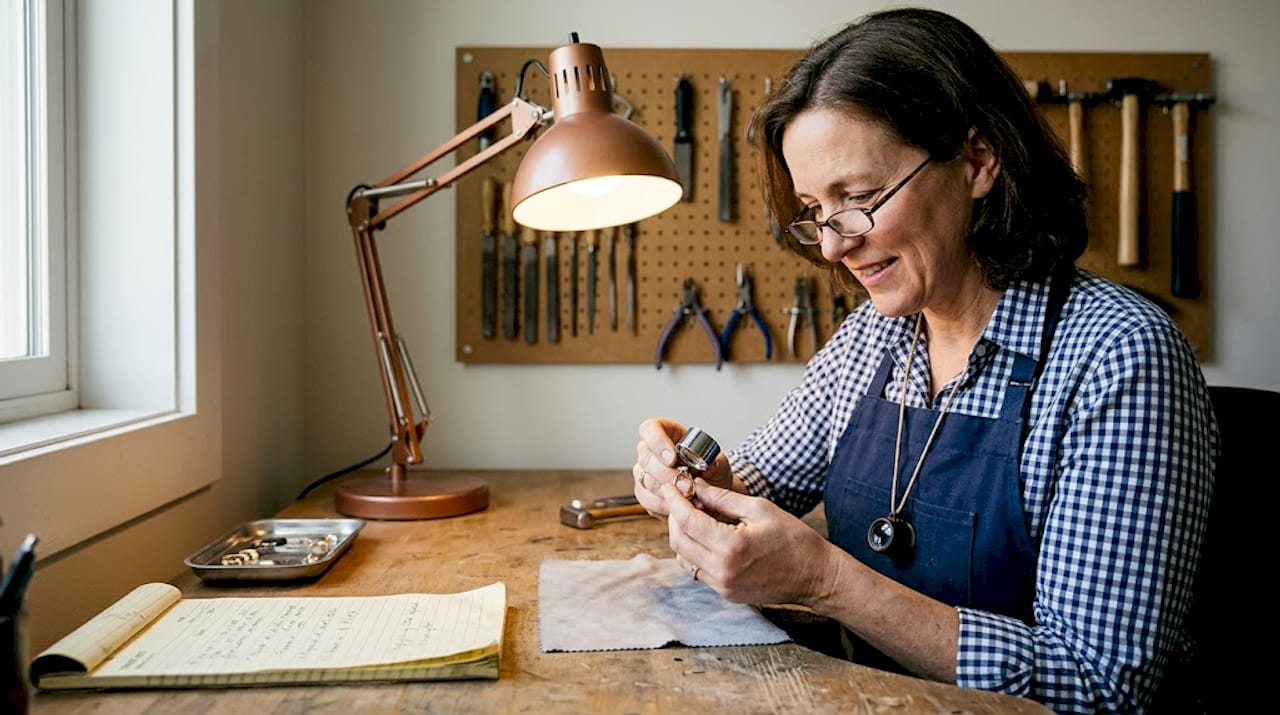
Durability and repairability are also part of long-term sustainability. A piece that lasts decades and can be repaired locally creates far less waste than one that ends up in a drawer after a prong breaks.
A smarter way to shop: What most guides miss about sustainability
Most sustainability guides for jewelry stop at the point of purchase. They tell you to buy lab-grown, choose recycled metals, and look for certifications. That’s all good advice. But there’s an even deeper layer when it comes to truly sustainable jewelry.
The word “sustainable” has become so common in retail that it’s nearly lost its meaning. We see it on packaging, in store names, and in ad copy. But verifiable documentation over marketing is what separates real sustainability from a branding exercise. A lab-grown diamond is not automatically a sustainable diamond if it was grown using coal-powered electricity. The carbon footprint of that stone could rival or exceed a carefully mined natural diamond.
Real sustainability also extends past the sale. Can you get the piece repaired without shipping it across the country? Does the retailer buy back or trade in pieces when your needs change? Will they tell you, years from now, exactly what’s in the metal alloy? Our perspective at Eternal Carat is that ethical lab-created diamonds are a strong choice when paired with full transparency, renewable energy sourcing, and a long-term relationship with a jeweler who stands behind their work.
Shop sustainable luxury with confidence
Armed with a smarter workflow and a sharp perspective, here’s how to take the next step with a trusted, sustainable jeweler.
At Eternal Carat, we built our entire model around the kind of transparency this guide describes. Every lab-grown diamond we offer comes with GIA or IGI certification. Every consultation, whether online or at our appointment-only Parker, Colorado location, is designed to answer exactly the questions this guide raised.
We also offer lab diamonds and sustainability resources to help you understand the full picture before you buy. Whether you’re designing a custom engagement ring, upgrading a stone, or trading in estate jewelry toward something new, we’re here to make the process clear, documented, and genuinely sustainable. Browse our collection or book a private consultation to get started.
Frequently asked questions
What certifications should I look for when buying sustainable jewelry?
Look for GIA or IGI certifications for lab-grown diamonds, and always ask for proof of recycled metal and ethical sourcing. GIA and IGI are the most trusted grading bodies and their reports are verifiable online.
Are lab-grown diamonds always a more sustainable choice?
Lab-grown diamonds can be more sustainable, but only if produced with renewable energy and transparent supply chains. Fossil-fuel energy use can eliminate the environmental advantage entirely.
How can I avoid greenwashing in jewelry stores?
Insist on verifiable documentation for sourcing and manufacturing rather than marketing claims or vague badges. Prioritizing documentation over buzzwords is the single most effective filter.
Is resale value different for lab-grown and mined diamonds?
Yes, lab-grown resale value is typically lower than mined diamonds, but the lower purchase price often allows for a significantly larger stone at the same budget.
Recommended
- Ethical Jewelry Buying Workflow for Denver: Sustainable Luxury Guide – Eternal Carat
- Why sustainable jewelry matters: ethical luxury buyers guide – Eternal Carat
- Custom Jewelry Design Process: Creating Ethical Luxury – Eternal Carat
- Sustainable jewelry explained: ethical luxury guide 2026 – Eternal Carat


