

Choosing the perfect engagement ring in Denver often sparks a lively discussion about style, sustainability, and lasting value. For couples who want ethical luxury, understanding the true difference between lab diamonds and moissanite matters. Both stones are lab-created, yet only lab diamonds share the exact chemical and physical properties of natural diamonds, while moissanite is made from silicon carbide and behaves differently in brilliance and durability. This guide clarifies which option aligns best with your values and vision.
Table of Contents
- Lab Diamonds And Moissanite Defined
- How They’re Made: Creation And Chemistry
- Brilliance, Durability, And Grading Standards
- Pricing, Resale, And Value Differences
- Ethics, Environmental Impact, And Sustainability
Key Takeaways
| Point | Details |
|---|---|
| Lab Diamonds vs. Moissanite | Lab diamonds are real diamonds created in labs, while moissanite is a diamond simulant. This distinction impacts value and authenticity. |
| Value Retention | Lab diamonds retain significant resale value (50-70%), whereas moissanite only recovers about 10-20%. Choose based on long-term intentions. |
| Environmental Impact | Lab diamonds offer a more sustainable option, using minimal resources compared to mined diamonds. Moissanite manufacturing can be energy-intensive despite being lab-created. |
| Durability & Appearance | Lab diamonds score a 10 on the Mohs scale for hardness, ideal for daily wear, while moissanite scores 9.25 and may wear over time. Consider durability in your choice. |
Lab diamonds and moissanite defined
If you’re comparing engagement ring options in the Denver area, you’ll encounter two lab-created alternatives to mined diamonds: lab diamonds and moissanite. Understanding what each actually is matters before making your choice.
Lab diamonds are real diamonds created in controlled laboratory environments rather than formed over billions of years underground. They possess the identical chemical, optical, and physical properties as natural diamonds because they’re made from carbon atoms arranged in the same crystalline structure. The only meaningful difference is origin—not quality or appearance.
Laboratories create lab diamonds using two primary methods:
- HPHT (High Pressure, High Temperature): Mimics Earth’s natural diamond-forming conditions by applying extreme pressure and heat to carbon seed material
- CVD (Chemical Vapor Deposition): Builds diamonds layer by layer by depositing carbon atoms in a vacuum chamber
Both methods produce diamonds indistinguishable from mined ones to the naked eye and certified through the same grading standards.
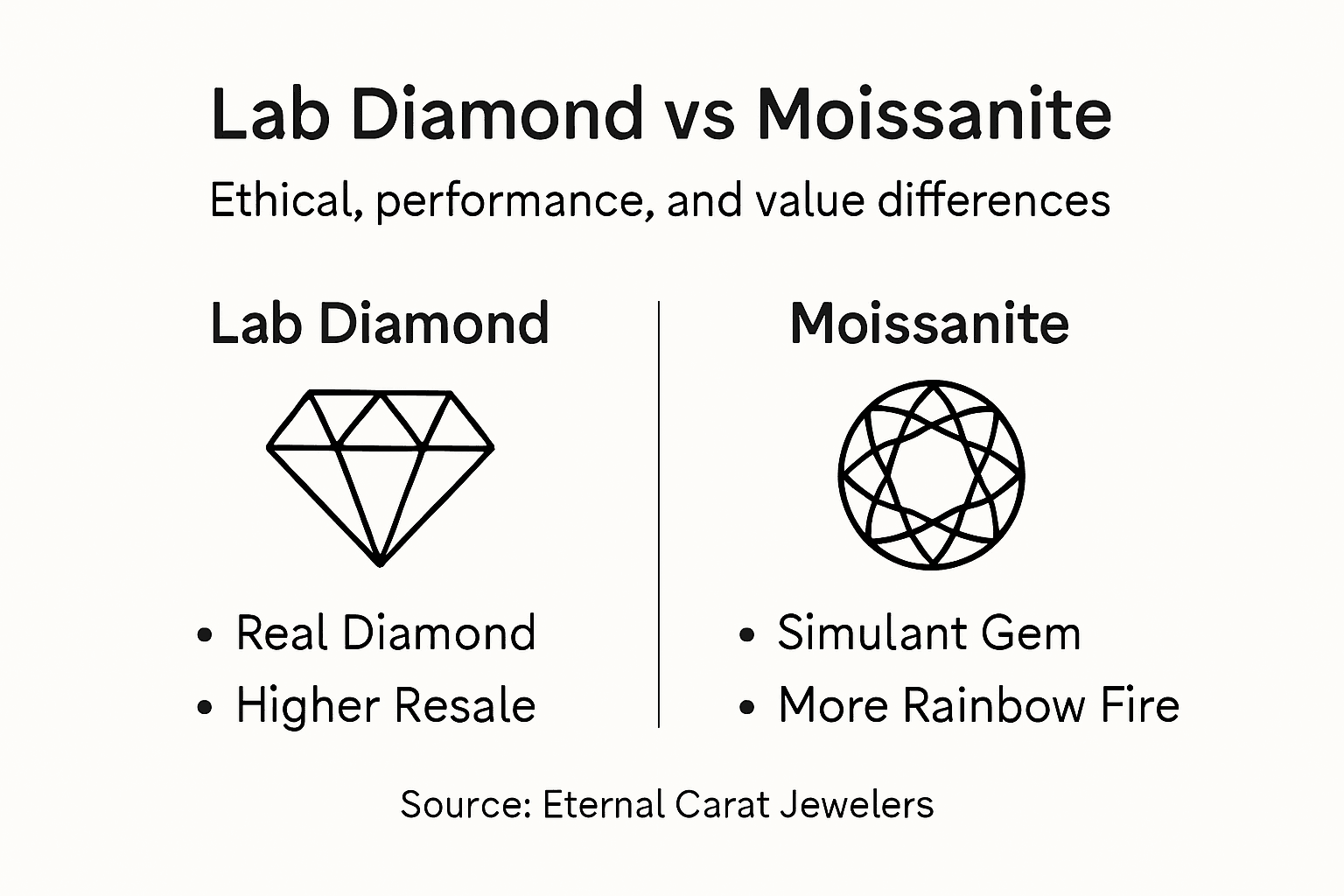
Moissanite, by contrast, is a diamond simulant—meaning it mimics a diamond’s appearance but isn’t actually diamond. Silicon carbide comprises moissanite’s structure, giving it distinctly different chemical and physical properties than diamonds.
The key distinction: moissanite is engineered to look like a diamond, while lab diamonds are diamonds.
Why the distinction matters
For Denver couples prioritizing sustainability and ethics, this difference shapes your entire decision. Lab-grown diamonds maintain value in ways moissanite doesn’t, primarily because they’re genuine diamonds with resale potential and universal recognition.
Moissanite offers budget-friendly sparkle but comes with trade-offs:
- Displays rainbow fire (colorful sparkles) that differs noticeably from diamond brilliance
- Shows directional light patterns some find distinctive, others find distracting
- Creates less durable engagement rings in daily wear
- Holds minimal resale value
Lab diamonds deliver the luxury experience you’d expect from an engagement ring without the environmental impact of mining.
Here’s a side-by-side comparison of lab diamonds and moissanite across key attributes:
| Attribute | Lab Diamond | Moissanite |
|---|---|---|
| Core Material | Pure carbon | Silicon carbide |
| Hardness (Mohs) | 10 | 9.25 |
| Light Performance | White, classic brilliance | Rainbow fire, bold sparkle |
| Grading Standards | GIA 4Cs, universal | No industry-wide standard |
| Resale Value | 50–70% of purchase price | 10–20% of purchase price |
| Environmental Impact | Minimal, highly sustainable | Moderate, energy intensive |
| Jewelry Status | Genuine diamond, heirloom | Realistic substitute, fashion |
Both are lab-created, but lab diamonds are real diamonds—moissanite is a realistic substitute that behaves differently in light and durability.
Pro tip: Visit our Parker showroom by appointment to see both side-by-side under natural light—this five-minute comparison clarifies which stone resonates with your vision for your ring.
How they’re made: creation and chemistry
The way a stone is created fundamentally shapes its performance, durability, and value. Lab diamonds and moissanite follow completely different manufacturing processes that explain why they behave so differently in your engagement ring.
Lab diamond creation
Lab diamonds grow through two scientifically distinct methods. HPHT and CVD processes both produce genuine diamonds, but they operate on completely different principles.
HPHT (High Pressure, High Temperature) replicates what happens naturally deep within Earth. The process works like this:
- A carbon seed sits in a press that generates extreme pressure (over 50,000 atmospheres) and heat (around 1,400 degrees Celsius)
- Pressure forces carbon atoms to crystallize onto the seed
- The diamond grows layer by layer in just days or weeks
- The result is chemically identical to mined diamonds
CVD (Chemical Vapor Deposition) builds diamonds from the ground up using a completely different approach:
- A carbon-rich gas enters a vacuum chamber where heat breaks it down
- Carbon atoms deposit directly onto a diamond seed
- The diamond grows slowly and precisely, atom by atom
- This method typically produces larger stones with fewer impurities
Both methods create diamonds with the same crystal structure, hardness, and optical properties as natural stones. Jewelers and gemologists cannot distinguish them visually.
The two main lab diamond creation methods differ in process and outcomes:
| Creation Method | Process Summary | Common Resulting Qualities |
|---|---|---|
| HPHT | High pressure & temperature to grow stone | Common sizes, possible metallic inclusions |
| CVD | Carbon vapor deposits onto seed crystal | Larger stones, fewer visible imperfections |
Moissanite synthesis
Moissanite production starts with an entirely different material: silicon carbide. Since natural moissanite is far too rare for jewelry, all commercial moissanite is lab-synthesized through specialized industrial processes.
The synthesis creates a substance with fundamentally different chemistry:
- Silicon carbide has a different crystal lattice than diamond
- This different structure changes how light travels through it
- The result displays rainbow fire and directional sparkle patterns
- Moissanite is harder than all gemstones except diamond, but still rates lower on the Mohs scale
Lab diamonds are carbon—moissanite is silicon carbide. Same creation environment, completely different chemistry and performance.
For Denver couples, this chemistry difference matters practically. When you wear your engagement ring daily, how lab-grown diamonds are made affects longevity, light performance, and long-term value preservation.
Modern grading laboratories can identify which creation method produced a lab diamond (HPHT or CVD), but both rank identically in quality and durability standards.
Pro tip: Ask your jeweler whether a lab diamond was created via HPHT or CVD—CVD stones often command slightly higher prices due to larger average sizes and fewer visible inclusions, which matters if you’re prioritizing clarity.
Brilliance, durability, and grading standards
When comparing lab diamonds and moissanite, the numbers tell a revealing story. Optical properties, hardness ratings, and grading systems differ significantly—and these differences directly affect how your engagement ring will look and perform over decades.
How they sparkle differently
Lab diamonds and moissanite bend light in fundamentally different ways. Lab diamonds share the same refractive index as natural diamonds at 2.42, creating that classic, cool sparkle you expect from an engagement ring.
Moissanite measures significantly higher at 2.65 refractive index. This creates visible rainbow fire—colorful flashes that some find stunning and others find distracting. The effect becomes especially noticeable in bright sunlight or under indoor lighting.
Think of it this way: lab diamonds deliver understated brilliance, while moissanite delivers intentional sparkle with personality.
Durability on the Mohs scale
Lab diamonds rank at 10 on the Mohs hardness scale—the highest possible rating. This means only another diamond can scratch them, making them perfect for daily wear engagement rings.
Moissanite rates at 9.25 on the Mohs scale. This sounds close to diamonds, but hardness doesn’t scale linearly. The difference between 9.25 and 10 is more significant than between 8 and 9.
For engagement rings worn constantly:
- Lab diamonds resist scratching indefinitely
- Moissanite resists most daily wear but can show microscopic wear over 10+ years
- Both outperform traditional gemstones like sapphires and rubies
Grading standards matter for value
Here’s where things get complicated. Lab diamonds follow the same grading system as natural diamonds—the 4Cs: Cut, Color, Clarity, and Carat weight. Any GIA-certified lab diamond receives identical grading standards.
Moissanite uses different grading criteria altogether:
- No universal grading standard exists across all moissanite producers
- Different manufacturers grade color and clarity differently
- Comparison shopping becomes difficult without consistent benchmarks
- Resale value remains unpredictable
For Denver couples building heirloom pieces, this distinction matters. Lab diamonds carry universally recognized grading that preserves value if you ever trade up or pass the ring to future generations.
Lab diamonds use the same 4Cs grading as natural diamonds, while moissanite lacks standardized grading—this affects both comparability and resale value.
When examining lab-grown diamond quality options, you’re working with established benchmarks that jewelers worldwide recognize and respect.
Pro tip: Request GIA certification for any lab diamond you consider—it guarantees consistent grading and significantly strengthens resale value if you ever decide to upgrade or modify your ring.
Pricing, resale, and value differences
Engagement rings represent significant financial commitments. Understanding the pricing landscape and long-term value trajectories helps Denver couples make decisions that align with both their budgets and their vision for the future.
Initial pricing differences
Lab diamonds typically cost 40 to 60 percent less than comparable mined diamonds of identical quality. A one-carat lab diamond with excellent cut and color might cost $2,500 to $4,000, while moissanite in the same size often runs $800 to $1,500.
This pricing advantage appeals to budget-conscious couples. But the lowest price tag doesn’t always deliver the best long-term value.
Moissanite’s lower cost reflects its status as a simulant. You’re purchasing a substitute product designed to approximate diamond appearance, not an actual diamond.
The resale value gap
Here’s where the comparison becomes crucial. Lab diamonds maintain resale value because they’re genuine diamonds with universal recognition and standardized grading.
Moissanite resale presents challenges:
- No established secondary market exists for moissanite rings
- Jewelers rarely accept moissanite trade-ins
- If you need to sell, you’ll find minimal buyer interest
- Resale prices typically recover only 10 to 20 percent of original purchase price
Lab diamonds, by contrast, retain approximately 50 to 70 percent of retail value when sold through reputable dealers. This matters significantly if life circumstances change or you want to upgrade your ring later.
Thinking long-term
Consider your timeline and intentions. If you’re purchasing an heirloom piece meant to endure generations, lab diamonds preserve value and emotional significance.
If you’re seeking an affordable fashion-forward ring you might replace in 5 to 10 years, moissanite delivers immediate sparkle without the long-term financial commitment.
At Eternal Carat, we offer both options because we recognize different priorities matter to different couples. Some prioritize sustainability and genuine diamonds. Others prioritize budget flexibility.
The critical question: Are you buying a forever ring or a right-now ring?
Lab diamonds cost less than mined diamonds but retain meaningful resale value; moissanite costs least upfront but offers minimal recovery if you sell.
When examining your budget, factor in potential future scenarios. Will you want to trade this ring for something different? Might you pass it to your daughter someday? These questions shape whether the lower moissanite price delivers genuine value or creates future regret.
Pro tip: If budget matters most, explore lab diamonds in slightly lower clarity or color grades rather than choosing moissanite—you’ll spend marginally more initially but gain resale flexibility and genuine diamond status that pays dividends if circumstances change.
Ethics, environmental impact, and sustainability
For affluent Denver couples, the choice between lab diamonds and moissanite often comes down to values. Where your stone comes from and how it’s produced matters as much as how it looks on your hand.
The mining impact reality
Traditional diamond mining extracts roughly one ton of earth to recover one carat of diamond. This creates significant environmental disruption: habitat destruction, water contamination, and carbon emissions from heavy equipment operation across decades-long mining operations.
Beyond environment, mining raises ethical concerns. Some mined diamonds originate from regions with problematic labor practices and human rights records.
Lab diamonds eliminate these concerns entirely. They’re created in controlled facilities using significantly less land, water, and energy than mining operations require.
Lab diamonds: the sustainability advantage
Lab diamond production requires minimal environmental footprint compared to extraction:
- Uses 99 percent less water than traditional diamond mining
- Occupies controlled facilities rather than large mining sites
- Produces diamonds in weeks rather than waiting billions of years
- Eliminates supply chain complications tied to conflict regions
- Generates no mining waste or habitat disruption
For couples prioritizing environmental responsibility, sustainable engagement rings offer genuine peace of mind. You’re wearing a beautiful stone created without environmental cost.
What about moissanite?
Moissanite carries its own sustainability story. Lab-created moissanite doesn’t require mining, which initially sounds appealing.
However, the manufacturing process demands significant energy:
- Silicon carbide synthesis requires extremely high temperatures
- The production process generates industrial byproducts
- Energy consumption per carat often exceeds lab diamond creation
- Manufacturing happens in industrial facilities, not controlled lab environments
Moissanite isn’t inherently unethical—it simply doesn’t deliver the sustainability advantages many couples imagine.
The ethical luxury perspective
Choosing a lab diamond aligns ethical values with luxury. You get a genuine diamond with heirloom quality and long-term value, created through sustainable methods.
This resonates strongly with the Denver market. Affluent couples increasingly want their most meaningful purchases to reflect their values.
Lab diamonds offer genuine sustainability: no mining, minimal environmental impact, ethical sourcing, and authentic luxury status combined.
When you’re making a decision that affects your engagement story for decades, sustainability matters. Your ring becomes a tangible expression of environmental responsibility.
Pro tip: Ask your jeweler for detailed information about lab diamond origin and production method—Eternal Carat can trace our stones’ creation through HPHT or CVD processes, providing complete transparency about your ring’s ethical journey.
Discover Ethical Luxury With Lab-Grown Diamonds at Eternal Carat
Choosing between lab diamonds and moissanite can feel overwhelming when you want the perfect balance of beauty, sustainability, and lasting value. If you seek a genuine diamond that reflects your ethical values and holds its brilliance through a lifetime of wear, Eternal Carat is your trusted partner. Our focus on lab-grown diamonds offers you a true diamond experience with exceptional sparkle, durability, and certified quality standards.

Experience a personalized and private shopping journey either online or by appointment at our Parker office. Learn more about our commitment to ethical luxury and how our expert consultation and custom design services help you craft a timeless engagement ring with lasting value. Don’t settle for a compromise—choose a ring that matches your vision and values today with Eternal Carat.
Frequently Asked Questions
What is the difference between lab diamonds and moissanite?
Lab diamonds are real diamonds created in a lab with the same chemical and physical properties as mined diamonds, while moissanite is a diamond simulant made from silicon carbide that mimics a diamond’s appearance but is not a true diamond.
How are lab diamonds manufactured?
Lab diamonds are created using two main processes: High Pressure High Temperature (HPHT) and Chemical Vapor Deposition (CVD), both of which replicate the natural diamond formation process in controlled environments.
Is moissanite a sustainable choice?
While moissanite is lab-created and does not require mining, its production involves significant energy consumption and industrial processes. Lab diamonds, on the other hand, are produced with a significantly lower environmental impact and contribute less to resource depletion.
What are the grading standards for lab diamonds and moissanite?
Lab diamonds follow the same grading standards as natural diamonds, specifically the 4Cs: Cut, Color, Clarity, and Carat weight. Moissanite lacks a universal grading standard, making it harder to compare and evaluate across different producers.


