

Searching for the perfect engagement ring in Denver can raise new questions when you want both sustainable sourcing and a truly personalized design. Choosing a lab-grown diamond means you are part of a growing movement that values ethical practices and environmental responsibility. With lab-created diamonds offering substantially lower greenhouse gas emissions and resource use compared to mined stones, today’s couples have more opportunity than ever to own jewelry that matches both their aesthetic and their values.
Table of Contents
- Lab Diamonds Defined and Debunking Myths
- How Lab Diamonds Are Created Today
- Ethical Sourcing and Environmental Impact
- Modern Design Trends and Buyer Choices
- Comparing Lab and Mined Diamonds in 2026
Key Takeaways
| Point | Details |
|---|---|
| Lab Diamonds are Genuine | Lab diamonds are 100% real diamonds, chemically and physically identical to mined diamonds, produced in controlled environments. |
| Sustainable and Ethical | Lab diamonds mitigate environmental damage associated with mining and ensure transparency in sourcing, appealing to ethical consumers. |
| Cost-Effective Luxury | Lab diamonds are typically 30-50% cheaper than mined diamonds while offering superior quality and consistency. |
| Innovative Design Options | Advances in technology allow for unique designs and customization, empowering consumers to select diamonds that reflect their personal style and values. |
Lab Diamonds Defined and Debunking Myths
A lab diamond represents a scientifically engineered gemstone created through advanced technological processes that precisely replicate the natural diamond formation conditions. These diamonds are chemically, physically, and optically identical to mined diamonds - with one critical difference: they are produced in controlled laboratory environments instead of being extracted from underground mines.
Understanding lab diamonds requires dispelling several persistent myths. Many consumers mistakenly believe lab diamonds are somehow inferior or “fake” compared to natural stones. However, lab-grown diamond technology demonstrates that these gems are 100% genuine diamonds, possessing identical crystal structures and optical properties as their mined counterparts. Gemological experts utilize the same grading standards for lab and natural diamonds, evaluating them based on cut, clarity, color, and carat weight.
The primary production methods for lab diamonds involve two sophisticated techniques: Chemical Vapor Deposition (CVD) and High Pressure High Temperature (HPHT). In the CVD method, carbon atoms are systematically deposited onto a diamond seed in a vacuum chamber, gradually building a crystalline structure. The HPHT process mimics Earth’s natural diamond-forming conditions by subjecting carbon to extreme temperatures and pressures. Both methods result in diamonds that are molecularly indistinguishable from those formed deep underground over millions of years.
Pro Tip: When evaluating lab diamonds, request a detailed gemological certification to understand the specific characteristics and production method of your chosen stone.
How Lab Diamonds Are Created Today
Lab diamonds are engineered through two groundbreaking technological processes that transform carbon into stunning gemstones: Chemical Vapor Deposition (CVD) and High Pressure High Temperature (HPHT) methods. Advanced diamond creation techniques have revolutionized how these precious stones are produced, offering a sustainable and precise alternative to traditional mining.
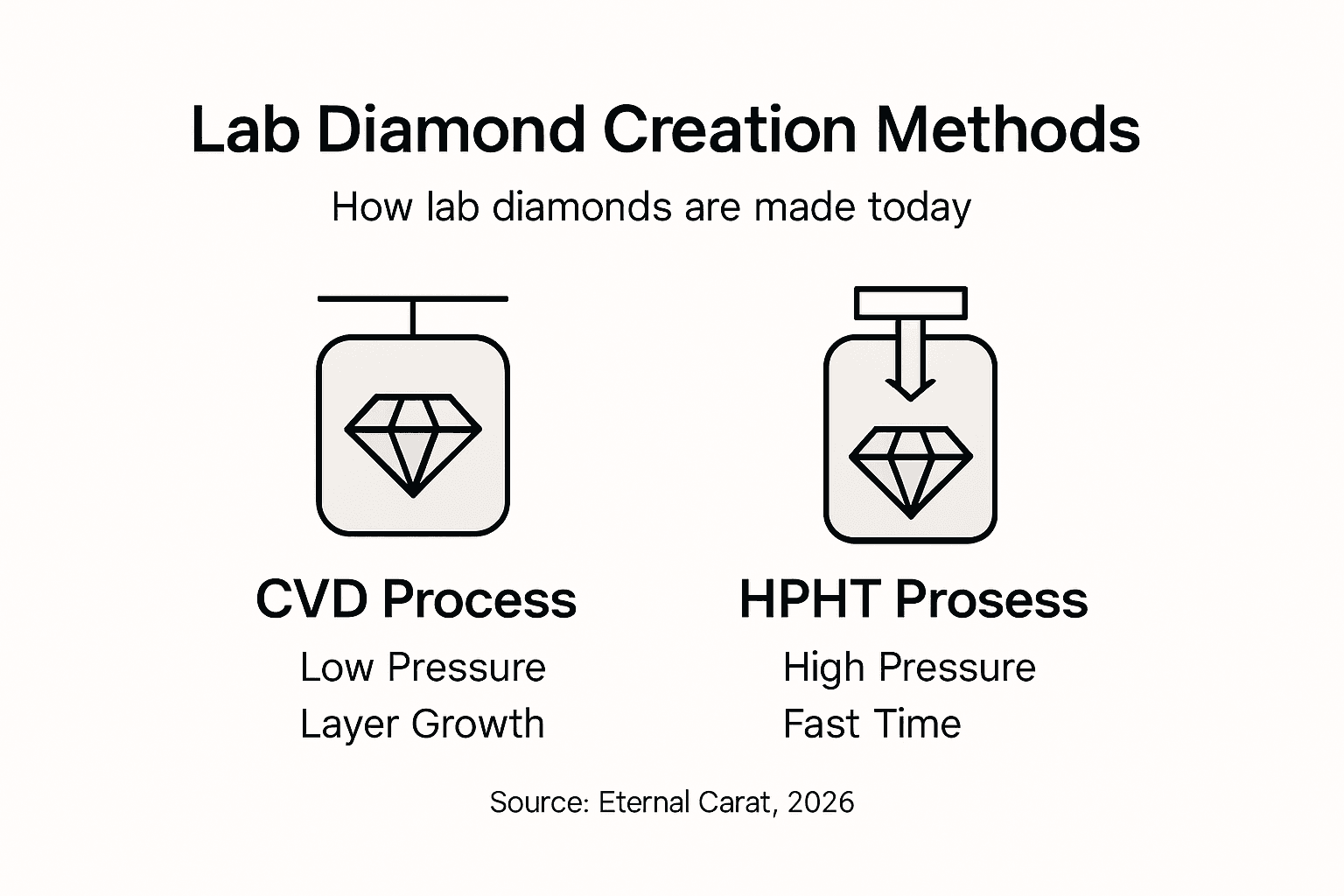
In the Chemical Vapor Deposition process, diamond growth occurs through a meticulously controlled molecular assembly. A small diamond seed is placed in a sealed chamber where carbon-rich gas is heated to extremely high temperatures. The gas breaks down, allowing pure carbon atoms to gradually deposit and crystallize onto the seed, building a diamond layer by layer. This method allows for exceptional purity and control, enabling manufacturers to create diamonds with minimal structural imperfections.
The High Pressure High Temperature method more directly mimics Earth’s natural diamond formation conditions. Graphite carbon is subjected to temperatures around 2,700 degrees Fahrenheit and pressures equivalent to 1.5 million pounds per square inch. Under these extreme conditions, carbon atoms reorganize into the characteristic diamond crystal structure. Unlike traditional mining, which can take millions of years, lab diamond production can create a fully formed gem within several weeks, dramatically reducing environmental impact and resource consumption.
Pro Tip: Request documentation showing the specific production method of your lab diamond to understand its unique creation process and verify its origin.
Here is a concise comparison of lab diamond production methods:
| Method | Growth Environment | Key Benefit | Typical Timeframe |
|---|---|---|---|
| Chemical Vapor Deposition (CVD) | Vacuum chamber, carbon-rich gas | Exceptional purity and control | Several weeks |
| High Pressure High Temperature (HPHT) | High temperature and pressure | Closely mimics natural process | Several weeks |
Ethical Sourcing and Environmental Impact
The diamond industry has long been plagued by complex ethical challenges, but sustainable diamond production represents a transformative solution for conscientious consumers. Lab-grown diamonds eliminate the most problematic aspects of traditional diamond mining, including land disruption, ecosystem damage, and the risk of conflict diamonds that have historically funded armed conflicts in developing regions.
Environmental considerations reveal a stark contrast between mined and lab-created diamonds. Traditional diamond mining requires extensive land excavation, often destroying natural habitats and producing significant mineral waste. Laboratory-created diamonds, by contrast, dramatically reduce environmental impact. Research indicates that lab diamonds generate substantially lower greenhouse gas emissions, consume minimal water resources, and can be produced using renewable energy technologies, making them a substantially more sustainable luxury option.
Beyond environmental benefits, lab diamonds offer unprecedented transparency in sourcing. Unlike mined diamonds, which can have complex and often opaque supply chains, lab-created stones provide complete traceability. Consumers can know exactly where and how their diamond was produced, eliminating concerns about human rights violations, child labor, or unethical working conditions that have historically plagued the diamond mining industry. This transparency allows buyers to make purchases aligned with their personal values of social responsibility and ethical consumption.
Pro Tip: Always request detailed documentation about your diamond’s origin and production method to ensure full transparency and ethical integrity.
Modern Design Trends and Buyer Choices
Lab-grown diamonds have transformed contemporary jewelry design, offering unprecedented creative possibilities for discerning buyers. Emerging jewelry trends demonstrate a dramatic shift towards personalization, with Millennial and Gen Z consumers driving demand for unique, ethically sourced engagement rings that reflect individual style and values.
Modern design preferences are expanding beyond traditional round brilliant cuts, embracing sophisticated alternative shapes like oval, pear, and cushion cut diamonds. Colored lab diamonds have also emerged as a game-changing trend, allowing couples to select stones in soft pink, vibrant blue, or warm yellow hues that were previously rare and prohibitively expensive in natural diamond markets. These innovative options provide buyers with unprecedented freedom to create truly personalized, meaningful jewelry pieces that tell their unique love stories.
Customization has become the hallmark of contemporary lab diamond jewelry. Advanced technological processes enable precise cuts, intricate settings, and bespoke designs that were impossible with traditional mining techniques. Buyers now expect more than just a beautiful stone - they want a meaningful artifact that represents their personal aesthetic, ethical standards, and commitment to sustainable luxury. This trend reflects a broader cultural shift towards conscious consumption, where the provenance and production method of a piece are as important as its visual appeal.
Pro Tip: Schedule a personalized consultation to explore custom design options that reflect your individual style and ethical priorities.
Comparing Lab and Mined Diamonds in 2026
Diamonds have traditionally been sourced through mining, but technological advancements are dramatically reshaping consumer perceptions. Ethical luxury investments now prioritize lab-grown diamonds as a superior alternative to traditional mined stones, driven by significant improvements in quality, sustainability, and manufacturing precision.
The fundamental differences between lab and mined diamonds are increasingly nuanced. While both share identical chemical compositions and optical properties, lab diamonds offer remarkable consistency in quality that natural stones cannot match. Mined diamonds are subject to geological variations that create unpredictable inclusions and color variations, whereas lab-created diamonds can be engineered with exceptional control, allowing for more uniform clarity, color, and structural integrity.
Economically, lab diamonds represent a transformative shift in the luxury market. They typically cost 30-50% less than comparable mined diamonds, without compromising on visual brilliance or durability. This price advantage, combined with complete traceability and reduced environmental impact, makes lab diamonds particularly attractive to younger consumers who value transparency and ethical production. The technological precision of lab diamond creation means buyers can access higher-quality stones at more accessible price points, democratizing what was once an exclusive luxury market.
This table summarizes the main differentiators between lab and mined diamonds in 2026:
| Aspect | Lab-Grown Diamonds | Mined Diamonds |
|---|---|---|
| Price | 30-50% lower | Significantly higher |
| Environmental Footprint | Minimal, less land and water used | Large, with habitat disruption |
| Clarity and Color | Highly consistent | Subject to natural variation |
| Supply Chain Transparency | Fully traceable | Often opaque |
Pro Tip: Request a side-by-side comparison of lab and mined diamonds during your consultation to understand the nuanced differences in quality and value.
Discover Ethical Luxury with Lab-Grown Diamonds at Eternal Carat
The article highlights the critical challenge many buyers face today balancing luxury with ethical responsibility and environmental stewardship. Consumers want dazzling, high-quality diamonds without supporting destructive mining practices or opaque supply chains. The goals are clear—choose genuine, traceable stones that align with personal values and embrace sustainable craftsmanship. Terms like “lab-grown diamonds,” “ethical sourcing,” and “transparency” echo the modern desire for conscious luxury that does not compromise brilliance or beauty.
At Eternal Carat, we turn these ambitions into reality. Specializing in exquisite lab-grown diamonds and custom fine jewelry, we offer a seamless blend of sustainability and sophistication. Our expert team provides personalized consultations in a private Parker, Colorado setting or online, guiding you to select the perfect ethically sourced gem or design a one-of-a-kind piece that reflects your story. From superior lab diamond quality verified by certification to unparalleled creative freedom, every detail is crafted with care and integrity.
Explore our commitment to ethical luxury and browse our collection of custom design & fine jewelry that embodies transparency and environmental respect.
Ready to redefine what luxury means for you?
Elevate your jewelry experience with Eternal Carat today.
Discover how lab diamonds transform ethical luxury.

Start your journey now by visiting Eternal Carat or schedule your private consultation to find or create the diamond that matches your values and vision.
Frequently Asked Questions
What are lab diamonds, and how do they differ from mined diamonds?
Lab diamonds are scientifically engineered gems created in controlled environments, mirroring natural diamond formation. They are chemically and optically identical to mined diamonds but are produced using advanced technology, eliminating the ethical and environmental concerns associated with mining.
Are lab diamonds considered real diamonds?
Yes, lab diamonds are 100% genuine diamonds. They possess the same crystal structure and grading standards as mined diamonds, evaluated on cut, clarity, color, and carat weight, making them a legitimate and valuable alternative.
What are the environmental benefits of choosing lab diamonds over mined diamonds?
Lab diamonds have a significantly lower environmental impact as they do not require extensive land excavation or create habitat destruction. They produce fewer greenhouse gas emissions, consume less water, and can often be made using renewable energy, positioning them as a more sustainable luxury option.
How do I ensure that my lab diamond is ethically sourced?
To confirm the ethical sourcing of your lab diamond, always request documentation detailing its origin and production method. This transparency ensures your diamond aligns with your values regarding social responsibility and ethical consumption.


