

TL;DR:
- Solitaire rings feature a single, central diamond designed to showcase quality and brilliance.
- Lab-grown diamonds offer a cost-effective, ethical alternative, allowing for larger or higher-grade stones.
- Customizable settings and metals enable a personalized, timeless engagement ring that aligns with individual values.
Most people assume a solitaire engagement ring is the “safe” choice, the default pick for someone who couldn’t decide on anything more interesting. That assumption is completely wrong. The solitaire is arguably the most deliberate, confident statement you can make when choosing an engagement ring. Popularized by Tiffany & Co. in 1886, this single-stone design has outlasted every trend in jewelry history. For couples in the Denver metro area, especially those exploring lab-grown diamonds, understanding what makes a solitaire ring special changes everything about how you shop.
Table of Contents
- What defines a solitaire ring?
- The history and meaning of solitaire rings
- Why consider lab-grown diamonds for solitaire rings?
- Solitaire ring settings and customization options
- Our take: Why ‘simple’ isn’t basic — what most ring guides miss
- Find your perfect solitaire ring with Eternal Carat
- Frequently asked questions
Key Takeaways
| Point | Details |
|---|---|
| Simplicity shines | A solitaire ring’s focused design puts the spotlight on one stunning stone, symbolizing unity and enduring style. |
| Lab diamonds excel | Lab-grown diamonds offer affordable brilliance and ethical appeal, making them a top choice for today’s buyers. |
| Customization matters | Personalizing your solitaire setting lets you express individuality without sacrificing elegance or durability. |
| Setting impacts style | Choosing the right setting enhances both the diamond’s appearance and everyday comfort. |
What defines a solitaire ring?
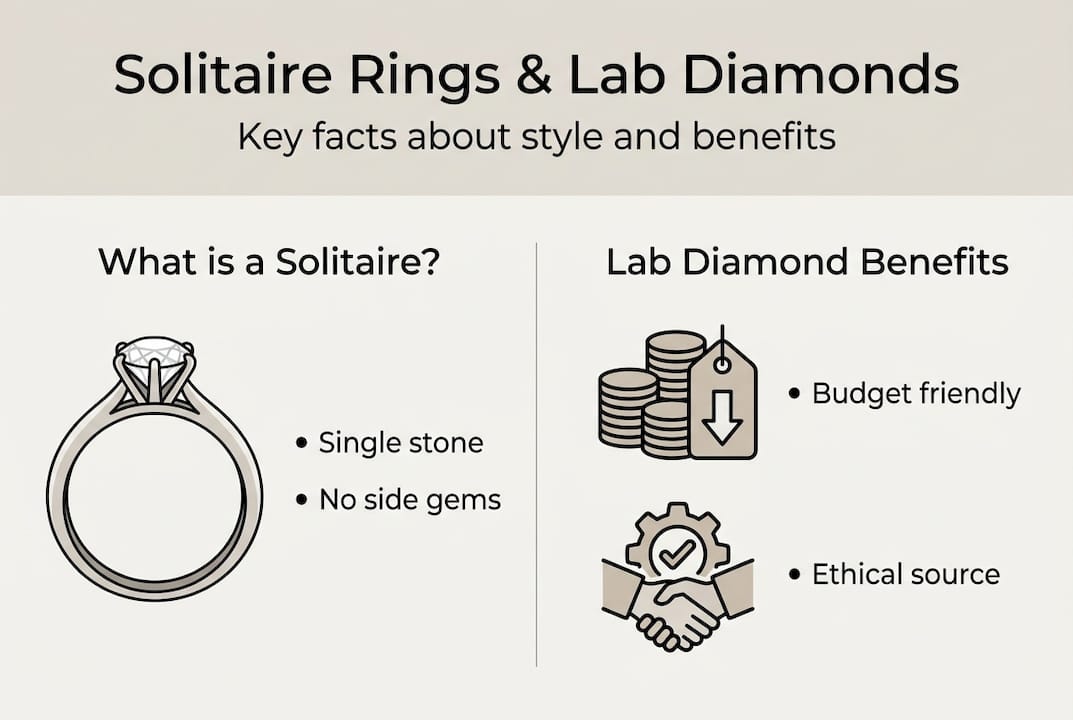
A solitaire ring is defined by one thing: a single center stone, typically a diamond, set without side stones, halos, or decorative clusters. The entire design exists to showcase that one stone. Nothing competes with it. Nothing distracts from it.
The Tiffany Setting history tells us that before 1886, diamonds in rings were set flush against the band, trapping light and dulling brilliance. Tiffany & Co. changed that by elevating the stone on six prongs, allowing light to enter from every angle. That single design decision transformed how diamonds looked and how people valued them.
Here’s what makes a solitaire ring distinct:
- Single center stone: No side diamonds, no accent stones, no halo
- Elevated setting: Prongs or bezel lift the stone to maximize light return
- Clean band: Simple metal band, often plain or lightly tapered
- Variety of metals: White gold, yellow gold, rose gold, and platinum are all common
- Flexible stone shapes: Round brilliant, oval, cushion, princess, and emerald cuts all work beautifully
“Simplicity is the ultimate sophistication.” That principle applies perfectly to solitaire design. When there’s nothing to hide behind, the quality of the stone speaks for itself.
The solitaire has been the most popular engagement ring style for over a century. That’s not inertia. That’s a design that genuinely works for everyday wear, long-term satisfaction, and visual impact.
For couples exploring engagement ring buying tips, the solitaire is often the benchmark against which every other style gets compared. It’s the reference point of fine jewelry design. Understanding it first makes every other ring choice clearer.
The prong count matters more than most buyers realize. Four prongs give a slightly more modern, geometric look and expose more of the stone. Six prongs offer stronger security and a rounder visual profile. Both are excellent choices, and the right one depends on your partner’s lifestyle and aesthetic preferences.
The history and meaning of solitaire rings
The solitaire ring’s story begins in the Victorian era, a period defined by romantic symbolism and ornate jewelry. As diamond mining expanded in South Africa during the 1860s and 1870s, diamonds became more accessible to the growing middle class. Jewelers began designing rings that put the diamond front and center rather than surrounding it with colored gemstones.
The turning point came in 1886. Solitaire rings originated in the 19th century and have carried the symbolism of enduring love ever since. Tiffany & Co.'s six-prong setting gave the world a new visual language for commitment: one stone, one person, one promise.
Here are four reasons the solitaire has stayed culturally relevant for over 130 years:
- Unity: A single stone represents an unbroken bond. There’s no distraction, no division.
- Minimalism: The design aligns with the principle that less is more, a value that resonates strongly with modern buyers.
- Timelessness: Unlike trend-driven styles, a solitaire never looks dated. It looked elegant in 1920 and still does in 2026.
- Versatility: It pairs with any wedding band, works with any fashion style, and transitions from casual to formal effortlessly.
“The solitaire is the purest expression of what an engagement ring is supposed to be: a single, unwavering commitment.”
For modern engagement ring trends in Denver and across the country, solitaires are experiencing a genuine resurgence. Gen Z buyers in particular are drawn to clean aesthetics and intentional design. They’re moving away from maximalist styles and toward pieces that reflect personal values rather than social performance.
The solitaire fits that shift perfectly. It’s not about showing off. It’s about meaning something. That quiet confidence is exactly what makes the solitaire feel modern again, even after more than a century.

Why consider lab-grown diamonds for solitaire rings?
Here’s where the solitaire gets even more interesting for today’s buyers. Lab-grown diamonds are chemically, physically, and optically identical to natural diamonds and cost 60 to 85% less. That’s not a compromise. That’s a structural advantage.
For a solitaire ring specifically, this matters enormously. The entire design is built around one stone. A larger, higher-quality stone makes a dramatically bigger visual impact in a solitaire than in a halo or cluster setting. Lab-grown diamonds let you buy more stone for the same budget.
Here’s a quick comparison for Denver buyers considering a 1.5-carat round brilliant:
| Diamond type | Approximate cost | Visual quality | Ethical sourcing |
|---|---|---|---|
| Natural mined | $8,000 to $14,000 | Excellent | Variable |
| Lab-grown | $1,200 to $3,500 | Identical | Controlled |
Why are lab diamonds growing in popularity?
- Cost: You get a significantly larger or higher-grade stone for the same price
- Ethics: No mining means no conflict sourcing concerns
- Sustainability: Lab production uses far fewer natural resources
- Quality control: Lab conditions produce consistent clarity and color grades
- Size advantage: Most buyers can upgrade one full carat or more within the same budget
The lab diamond cost comparison shows prices have declined 15 to 30% per year in recent years, making now an excellent time to buy. You get more stone today than you would have two years ago at the same price point.
Pro Tip: When shopping for a lab-grown solitaire, prioritize cut quality above all else. A well-cut lab diamond will outshine a poorly cut natural diamond every time. Focus your budget on an Excellent or Ideal cut grade before upgrading carat weight.
For a deeper look at how these options stack up, the lab-grown vs natural diamonds comparison breaks down the real differences. And if you want to see specific styles, browsing top lab-grown diamond rings gives you a strong visual reference for what’s possible.
Solitaire ring settings and customization options
Choosing your diamond is only half the decision. The setting determines how that stone sits on the hand, how secure it is, and how the overall ring looks day to day. Solitaire settings offer more variety than most buyers expect.
| Setting type | Security level | Visual style | Maintenance needs |
|---|---|---|---|
| Prong (4 or 6) | High | Classic, open | Prong checks every 1 to 2 years |
| Bezel | Very high | Modern, sleek | Minimal |
| Cathedral | High | Elevated, dramatic | Moderate |
| Tension | Moderate | Contemporary, bold | Professional inspection needed |
Here’s how to personalize your solitaire step by step:
- Choose your metal: White gold and platinum suit cool-toned skin; yellow gold and rose gold complement warmer tones. Yellow gold is trending strongly in Denver right now.
- Select prong count: Four prongs for a modern look, six for a more traditional and secure feel.
- Pick your stone shape: Round brilliant maximizes sparkle; oval and elongated cushion create a flattering, finger-lengthening effect.
- Decide on band profile: Flat, comfort-fit, or knife-edge bands each change how the ring feels and looks.
- Consider eco-friendly metals: Recycled gold and platinum are widely available and reduce environmental impact without any quality trade-off.
Pro Tip: Avoid tension settings if your partner works with their hands frequently. While visually striking, tension settings require more maintenance and are harder to resize. A four-prong or bezel setting offers better long-term practicality for active lifestyles.
Denver buyers tend to favor clean, understated profiles that work with outdoor and active lifestyles. The modern engagement ring styles guide covers current trends in detail. For couples prioritizing environmental values, sustainable engagement rings explains how metal sourcing and lab diamonds work together.
Solitaire rings are highly customizable from metal to setting style, which means your “simple” ring can still be completely unique to you.
Our take: Why ‘simple’ isn’t basic — what most ring guides miss
Most engagement ring guides treat the solitaire as the starting point before moving on to the “more interesting” options. We think that’s backwards.
The solitaire is actually the hardest ring to get right. When there’s no halo to add sparkle and no side stones to fill visual space, every single element has to be perfect. The cut has to be excellent. The setting has to be proportional. The metal has to complement the stone. There’s nowhere to hide a mediocre choice.
That’s exactly why couples who spend time understanding the solitaire end up more satisfied with their purchase. They made an informed, intentional decision rather than defaulting to something flashier to avoid the work of really choosing.
We also see a clear values shift in our Denver clients. The contrasting views on lab-grown versus natural diamonds show that buyers favor lab diamonds for ethics while natural diamonds retain appeal for heirloom status. Neither answer is wrong. But knowing which matters more to you leads to a ring you’ll feel genuinely proud of.
The solitaire, especially with a lab-grown center stone, is where ethical diamond practices and lasting elegance meet. That’s not a compromise. That’s a clear-eyed choice.
Find your perfect solitaire ring with Eternal Carat
If this article has done one thing, we hope it’s shown you that a solitaire ring is anything but ordinary. It’s a deliberate, sophisticated choice that rewards careful selection.
At Eternal Carat, we specialize in exactly this kind of intentional jewelry experience. Our custom solitaire rings are crafted with lab-grown diamonds selected for cut, clarity, and brilliance. Based in Parker, Colorado, we serve Denver metro couples through our e-commerce platform and private, appointment-only consultations. Whether you want to design from scratch or explore ready-to-ship options, our team walks you through every decision. Explore our collection of eco-friendly engagement rings or book a consultation to start building your perfect ring today.
Frequently asked questions
How is a solitaire ring different from other engagement ring styles?
A solitaire ring features a single center stone without side stones or halos, so the entire design focuses on showcasing the main diamond’s brilliance and cut quality.
Are lab-grown diamonds suitable for solitaire rings?
Absolutely. Since solitaires highlight one stone above everything else, the fact that lab-grown diamonds are optically identical to natural diamonds means you get the same visual impact at a fraction of the cost, often allowing you to choose a larger or higher-grade stone.
Do solitaire rings hold their value?
Natural diamonds hold 20 to 60% resale value compared to lab diamonds at 10 to 40%, but most buyers today prioritize the ethical sourcing and size advantages of lab diamonds over long-term resale potential.
What are the most popular solitaire settings?
The six-prong Tiffany Setting remains the most recognized solitaire style, but bezel and cathedral settings are also widely chosen for their modern look and added stone security.


