
You see a stunning diamond ring online, the price is right, and the photos look flawless. But how do you know the diamond is actually what the seller claims? Without independent certification by gemological labs, you’re relying on trust alone. Diamond certification removes guesswork by providing third-party verification of quality, authenticity, and characteristics. This guide walks you through certification processes, lab standards, ethical considerations, and how to use certification reports confidently when buying natural or lab-grown diamonds.
Table of Contents
- Key takeaways
- What diamond certification means: the grading essentials
- Leading diamond certification labs and their standards
- Ethical and quality implications of diamond certification
- Applying diamond certification: what to know when buying your diamond
- Explore quality and ethical lab-grown diamonds at Eternal Carat
- Frequently asked questions about diamond certification
Key Takeaways
| Point | Details |
|---|---|
| Independent certification | Certification provides objective, third party data on quality and characteristics. |
| GIA vs IGI | GIA is the strictest lab for natural diamonds, while IGI leads in lab grown certification. |
| Ethical sourcing separate | Ethical sourcing is separate from certification, with the Kimberley Process focusing on conflict free origins. |
| Resale value impact | Certification affects resale value, insurance, and buyer confidence. |
| Lab grown grading updates | Lab grown grading may be simplified after 2025, with ethical and cost advantages. |
What diamond certification means: the grading essentials
Diamond certification is an independent grading process by gemological labs assessing diamonds on the 4Cs: carat, cut, color, clarity, plus other traits like fluorescence, polish, symmetry. Think of it as a report card for your diamond, prepared by an unbiased expert who has no financial interest in the sale. The lab examines your stone using specialized equipment and decades of standardized methodology, then issues a certificate detailing every measurable quality attribute.
The 4Cs form the foundation of every certification report. Carat measures weight, with one carat equaling 200 milligrams. Cut evaluates how well the diamond’s facets interact with light, ranging from Excellent to Poor. Color grades the absence of color in white diamonds, with D being colorless and Z showing noticeable yellow or brown tint. Clarity assesses internal inclusions and external blemishes visible under 10x magnification, from Flawless to Included.
Beyond the 4Cs, labs use magnification, master stones, precise measurements, and reports include diagrams showing inclusion locations and may feature laser inscriptions for traceability. Fluorescence describes how a diamond reacts under ultraviolet light, which can affect appearance in certain lighting conditions. Polish and symmetry evaluate the quality of the diamond’s surface finish and the precision of its facet alignment. These details matter because two diamonds with identical 4C grades can perform differently based on these secondary characteristics.
Key certification elements include:
- Detailed inclusion mapping showing exact locations of clarity characteristics
- Proportions and measurements to verify cut quality claims
- Security features like holograms, microprint, and QR codes linking to online verification
- Laser inscription of the report number on the diamond’s girdle for stones over 0.30 carats
Pro Tip: When reviewing a diamond carat specification, remember that two diamonds of identical carat weight can have vastly different visual sizes depending on cut quality and depth proportions. A well-cut 0.90 carat diamond often appears larger than a poorly cut 1.00 carat stone.
Independent certification protects you from misrepresentation and provides objective data for insurance, resale, and comparison shopping. Without it, you’re accepting the seller’s word about quality characteristics that require expert equipment to evaluate accurately.
Leading diamond certification labs and their standards
Not all certification labs apply the same standards, and understanding these differences directly impacts what you pay and what you get. Leading labs include GIA, IGI, HRD, and AGS, with GIA being the strictest and most trusted for natural diamonds while IGI leads in lab-grown certification with faster service.
The Gemological Institute of America (GIA) established the 4Cs grading system in the 1950s and maintains the most conservative grading standards. A GIA-certified diamond typically commands higher resale value because buyers trust the consistency and rigor of GIA reports. However, GIA certification costs more and takes longer, sometimes 2-3 weeks for standard service.
The International Gemological Institute (IGI) has become the preferred lab for lab-grown diamonds, certifying roughly 80% of all lab-grown stones globally. IGI offers faster turnaround, often 5-7 business days, and charges lower fees. Starting in October 2025, GIA uses full 4Cs for natural diamonds but simplified Premium or Standard designations for lab-grown diamonds since 95% cluster in a narrow quality range, making detailed grading less meaningful for consumers.
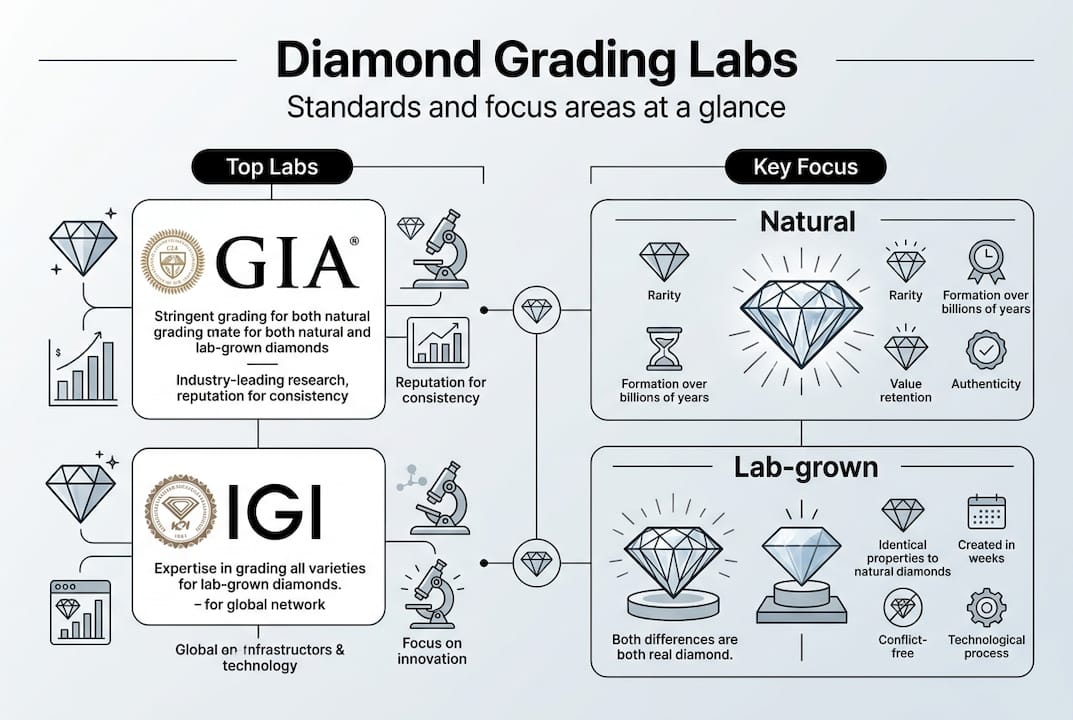
Grading strictness varies measurably between labs. Independent blind testing shows IGI sometimes grades natural diamonds 1-3 steps higher in clarity or color compared to GIA for the same stone. This doesn’t mean IGI is wrong, it reflects different interpretation thresholds for borderline cases. For lab-grown diamonds, IGI maintains consistent standards and provides detailed reports that rival GIA’s traditional approach.
| Lab | Best for | Typical cost | Turnaround | Grading approach |
|---|---|---|---|---|
| GIA | Natural diamonds, maximum resale value | 1-3% of diamond value | 2-3 weeks | Strictest, most conservative |
| IGI | Lab-grown diamonds, faster service | 0.5-2% of diamond value | 5-7 days | Slightly more lenient on natural, rigorous on lab-grown |
| AGS | Cut quality focus, ideal cuts | Similar to GIA | 2-3 weeks | Proprietary cut grading system |
| HRD | European market preference | Similar to GIA | 2-4 weeks | Comparable to GIA standards |
Certification typically costs 1-3% of the diamond’s value, a worthwhile investment considering it affects insurance coverage, resale potential, and purchase confidence. The diamond grading process involves intake, screening to verify natural versus lab-grown or simulant using specialized technology, comprehensive 4Cs analysis, and application of security features on reports.
Security features have become sophisticated to prevent fraud. Modern certificates include holograms, microprint borders, QR codes for online verification, and unique report numbers. Diamonds over 0.30 carats typically receive laser inscriptions of the report number on the girdle, invisible to the naked eye but readable under magnification.
Pro Tip: Always verify a certificate’s authenticity by checking the report number on the lab’s official website. Counterfeit certificates exist, and this simple step confirms your diamond matches the documented stone.
When you’re ready to sell or insure your diamond, the lab matters. Insurance companies often require GIA or AGS certification for high-value natural diamonds. Lab-grown versus natural diamonds have different market dynamics, with lab-grown stones depreciating faster but offering 40-60% lower initial costs for comparable quality.
Ethical and quality implications of diamond certification
Certification tells you about a diamond’s physical characteristics, but it doesn’t automatically guarantee ethical sourcing. These are separate verification systems, and understanding both protects you from supporting harmful practices while ensuring quality.

The Kimberley Process certifies rough diamonds as conflict-free, meaning they don’t fund rebel movements or civil wars. Launched in 2003, the Kimberley Process reduced conflict diamonds from 4% of global production to less than 0.1% today. However, it doesn’t address labor conditions, environmental damage, or human rights abuses in mining operations. Nearly all diamonds sold legally carry Kimberley Process certification, but this baseline doesn’t differentiate between minimally compliant and truly ethical operations.
Quality certification from GIA or IGI verifies the 4Cs and authenticity but makes no claims about where or how the diamond was sourced. You need to ask separate questions about origin, mining practices, and supply chain transparency if ethics matter to your purchase decision.
Lab-grown diamonds eliminate mining-related ethical concerns entirely. They’re ethically superior alternatives with no environmental destruction, no worker exploitation in mines, and complete supply chain transparency. Lab-grown diamonds receive the same rigorous certification as natural stones, though GIA simplified grading post-2025 because 95% of lab-grown diamonds cluster in VS1-VVS2 clarity and F-H color ranges, making granular distinctions less meaningful.
Key ethical considerations:
- Kimberley Process certification covers conflict-free status but not environmental or labor standards
- Quality certification verifies characteristics but not sourcing ethics
- Lab-grown diamonds offer inherent ethical advantages by avoiding mining entirely
- Transparency varies widely among natural diamond suppliers, even with KP certification
- Blockchain tracking and additional certifications like Fairtrade Gold provide deeper ethical assurance
“The Kimberley Process has reduced conflict diamonds from 4% of global production in 2003 to less than 0.1% today, but it doesn’t address labor conditions or environmental impact, leaving significant ethical gaps.”
When evaluating ethical sourcing in jewelry, ask sellers about specific practices beyond basic KP compliance. Responsible suppliers can trace diamonds to specific mines, demonstrate environmental remediation efforts, and verify fair labor practices through third-party audits.
Lab-grown versus natural diamonds from an ethical perspective reveals clear advantages for lab-grown stones. They require significantly less energy per carat than mining, produce no land disruption, generate minimal waste, and offer complete transparency about production conditions. IGI remains the preferred certification lab for lab-grown diamonds, providing detailed reports that help you make informed quality decisions alongside your ethical preferences.
For consumers prioritizing both quality and ethics, lab-grown diamond quality selection offers the best of both worlds: certified excellence without the ethical compromises inherent in mining.
Applying diamond certification: what to know when buying your diamond
You’ve learned what certification means and which labs to trust. Now let’s make that knowledge practical with a step-by-step approach to using certification reports when evaluating diamonds.
- Request the full certification report before committing to purchase, not just a summary or grade listing
- Verify the report number on the issuing lab’s official website to confirm authenticity and match the diamond
- Check for a laser inscription on diamonds over 0.30 carats using a jeweler’s loupe or ask the seller to demonstrate it
- Compare the plotted diagram on the certificate with the actual diamond’s inclusions under magnification
- Evaluate whether the certification lab matches your priorities: GIA for maximum resale value in natural diamonds, IGI for lab-grown stones
- Cross-reference the 4Cs grades with current market prices to ensure you’re paying fairly for the certified quality
- Look beyond the letter grades to proportions, fluorescence, and other details that affect appearance and value
Understanding grading variances between labs helps you interpret certificates accurately. Independent testing shows IGI may grade natural diamonds 1-3 steps more generously in clarity or color compared to GIA for borderline cases. This means an IGI VS2 might receive a SI1 grade from GIA. For lab-grown diamonds, IGI maintains rigorous standards and provides the detailed reporting that GIA has now simplified.
Certification reports don’t include monetary valuations. That’s the job of an appraisal, which estimates market value for insurance or resale purposes. A certificate states facts about the diamond’s characteristics; an appraisal interprets those facts in financial terms. You need both documents for complete protection: certification for quality verification and appraisal for insurance coverage.
Verifying that your physical diamond matches the certificate is critical. Examine the laser inscription under 10x magnification and confirm it matches the report number exactly. Review the inclusion plot on the certificate and compare it to what you see in the diamond under magnification. Inclusions are like fingerprints, unique to each stone, and this comparison proves you’re looking at the certified diamond.
| Diamond type | Certification lab | Typical price (1ct, VS2, G, Excellent) | Resale premium | Best for |
|---|---|---|---|---|
| Natural | GIA | $6,200-$7,400 | 15-25% higher | Maximum resale value, investment |
| Natural | IGI | $5,800-$6,900 | 5-10% higher | Budget-conscious buyers |
| Lab-grown | IGI | $1,200-$1,800 | 0-5% higher | Ethical sourcing, value |
| Lab-grown | GIA (pre-2025) | $1,300-$1,900 | 5-10% higher | Traditional preference |
Pro Tip: Two diamonds with identical grades from the same lab can look noticeably different based on how inclusions are distributed. A VS2 with inclusions concentrated at the edge appears cleaner than a VS2 with a central inclusion, even though both receive the same clarity grade. Always view the actual diamond, not just the certificate.
Using certification to assess fit with your quality and ethical preferences means weighing multiple factors. Lab-grown diamond buying tips emphasize prioritizing cut quality over clarity or color, since excellent cut maximizes brilliance regardless of minor clarity differences invisible to the naked eye.
Comparing lab-grown gemstones beyond diamonds reveals similar certification benefits for sapphires, emeralds, and other stones. The same principles apply: independent verification, standardized grading, and documentation for insurance and resale.
When you understand how to read and verify certification reports, you transform from a vulnerable buyer into an informed consumer who can negotiate confidently and avoid misrepresentation.
Explore quality and ethical lab-grown diamonds at Eternal Carat
Now that you understand certification, you can shop with confidence for diamonds that meet both your quality standards and ethical values. Eternal Carat specializes in certified lab-grown diamond jewelry that combines rigorous grading with transparent, sustainable sourcing. Every piece comes with detailed certification from leading labs, giving you the documentation you need for insurance, resale, and peace of mind.

Our custom engagement ring services let you design one-of-a-kind pieces tailored to your exact specifications and certification preferences. Whether you prioritize a specific clarity grade, prefer IGI certification for lab-grown stones, or want expert guidance interpreting reports, our team provides personalized consultation to ensure your investment matches your expectations. Browse our lab-grown marquise diamond stud earrings and other certified pieces, each accompanied by accessible grading reports that make informed choices simple.
Frequently asked questions about diamond certification
What information does a diamond certification report include?
Certification reports detail the 4Cs (carat weight, cut grade, color grade, clarity grade), plus fluorescence intensity, polish quality, symmetry rating, exact measurements, and a plotted diagram showing inclusion locations. Most reports include a photograph of the diamond and security features like holograms or QR codes for online verification.
How do I confirm my diamond matches the certification?
Check the laser inscription on the diamond’s girdle under 10x magnification to verify it matches the report number. Compare the inclusion plot on the certificate with the actual inclusions visible in your diamond under magnification, as these patterns are unique to each stone.
Does certification guarantee a diamond’s value?
No, certification verifies physical characteristics but doesn’t assign monetary value. You need a separate appraisal for insurance or resale purposes. Certification provides the factual foundation that appraisers use to estimate market value.
What’s the difference between natural and lab-grown diamond certificates?
Both receive detailed grading on the same 4Cs criteria, though GIA simplified lab-grown grading to Premium or Standard designations after October 2025 due to tight quality clustering. IGI provides full detailed reports for lab-grown diamonds comparable to natural diamond certifications. Reports clearly state whether a diamond is natural or lab-grown.
How does ethical sourcing relate to diamond certification?
Certification verifies quality characteristics, while ethical sourcing addresses origin and production practices. The Kimberley Process certifies conflict-free status separately from quality grading. Lab-grown diamonds offer inherent ethical advantages by eliminating mining-related concerns entirely, though both natural and lab-grown stones receive similar quality certification.


