

Choosing a custom engagement ring should feel as exceptional as your relationship, not a generic trip down a crowded jewelry aisle. As Denver couples become more intentional about their choices, making every detail personal and sustainable becomes a top priority. This guide will help you define your vision, select eco-friendly materials like lab-grown diamonds, and collaborate directly with expert designers, setting the stage for a truly meaningful and luxurious custom ring experience.
Table of Contents
- Step 1: Define Your Vision and Preferences
- Step 2: Select Materials and Lab-Grown Diamonds
- Step 3: Collaborate on Design Sketches and 3D Models
- Step 4: Approve the Final Design and Begin Crafting
- Step 5: Review and Verify Your Finished Jewelry
Quick Summary
| Key Point | Explanation |
|---|---|
| 1. Define Your Vision First | Know your style and preferences before consulting with a designer. Inspiration boards help convey your ideas. |
| 2. Choose Lab-Grown Diamonds | Opt for lab-grown diamonds for ethical, high-quality options at better value compared to mined diamonds. |
| 3. Collaborate on Design | Work closely with your designer on sketches and 3D models to ensure the final product matches your vision. |
| 4. Inspect the Finished Ring | Carefully examine your ring upon arrival for stone security and craftsmanship quality before acceptance. |
| 5. Document Your Creation | Take professional photos of your ring for insurance and personal memories, capturing its unique beauty. |
Step 1: Define Your Vision and Preferences
Before you sit down with a designer, you need to know what you actually want. This isn’t about having all the answers—it’s about understanding your style, values, and what makes a ring feel like “yours.”
Start by gathering inspiration. Scroll through jewelry websites, save Instagram posts, visit Pinterest boards. Don’t overthink it. When you see something that makes you pause, save it. You’re building a visual language that your designer can interpret.
Think about your lifestyle and daily wear. Are you someone who’s constantly moving, working with your hands, hiking on weekends? A delicate solitaire might get caught on things, while a bezel-set stone sits lower and stays secure. Your ring needs to work for your actual life, not just look stunning in photos.
Consider your metal preferences. Do you prefer warm tones like yellow or rose gold, or cool tones like white gold or platinum? Some people have strong reactions to certain metals—maybe rose gold feels more personal to you, or platinum appeals to your sustainability values. This choice matters because you’ll wear it every day.
Think about your values. At Eternal Carat, many Denver-area clients choose lab-grown diamonds because they align with environmental consciousness without sacrificing quality or brilliance. Understanding design conceptually and materially helps your designer create something that truly reflects who you are.
Now think about the details:
- Stone shape: Round, oval, emerald, cushion, marquise? Each changes how the ring catches light and looks on your hand.
- Setting style: Solitaire, three-stone, halo, vintage-inspired, modern? Your setting frames your stone.
- Band width and design: Thin and delicate, thick and substantial, plain, textured, or engraved?
- Size and carat weight: Bigger isn’t always better. What matters is the combination of cut quality, color, and clarity.
Your vision isn’t final—it’s a starting point that your designer will refine and enhance with their expertise.
Write down your preferences. Seriously. Create a simple list or Pinterest board to share with your designer. This removes guesswork and makes your consultation far more productive.
Pro tip: Take a photo of your hand and wrist wearing similar rings at jewelry stores. This shows scale and how different styles actually look on you, not just in stock photos.
Step 2: Select Materials and Lab-Grown Diamonds
Now that you know your style, it’s time to choose the actual materials for your ring. This decision combines practical considerations with your values, and it’s more flexible than you might think.
Start with the stone itself. Lab-grown diamonds offer the same physical properties and brilliance as mined diamonds, but without the environmental and ethical concerns. Lab-grown diamonds represent sustainable alternatives that deliver high-quality gems in virtually any size and color you want. They’re not “fake”—they’re chemically identical to mined stones, just created in a controlled lab environment instead of deep underground.
The advantage? You get more options and better value. With lab-grown diamonds, you can invest in a larger stone, higher clarity grade, or a more impressive color without the premium price tag of mined diamonds. For Denver-area couples focused on sustainability, this choice aligns perfectly with your values.
Next, consider your metal choice. This frames everything else and affects daily wear durability.
- Platinum: Extremely durable, naturally white, hypoallergenic. Premium pricing but lasts a lifetime with minimal maintenance.
- White gold: Classic look, durable, more affordable than platinum. Requires occasional rhodium replating to maintain shine.
- Yellow gold: Warm tone, timeless appeal, naturally hypoallergenic. Softer than white gold but equally beautiful.
- Rose gold: Trendy, warm undertones, pairs beautifully with lab-grown diamonds. Growing popularity among younger couples.
You can also blend metals. A two-tone or mixed-metal design adds visual interest and lets you combine qualities you love from different metals.
Here’s a quick overview of popular metal options and how they compare:
| Metal Type | Durability | Maintenance Needs | Visual Tone |
|---|---|---|---|
| Platinum | Extremely high | Minimal maintenance | Naturally white |
| White Gold | High | Occasional replating | Cool, bright white |
| Yellow Gold | Moderate | Minimal maintenance | Warm, classic hue |
| Rose Gold | Moderate | Minimal maintenance | Pinkish, romantic |
Lab-grown diamonds enable personalized designs that reflect your unique style. Think about accent stones too. Smaller diamonds, sapphires, or other gemstones can enhance your main stone without overwhelming it.
The best material choice is one you’ll feel confident wearing every single day for decades.
Don’t rush this decision. Feel samples in your hands at your consultation. See how white gold looks against your skin tone. Touch platinum and feel its weight. Your designer will guide you based on your lifestyle, budget, and aesthetic preferences.
Pro tip: Request samples of metals and stones during your consultation so you can see how they interact with your skin tone and natural lighting before making final decisions.
Step 3: Collaborate on Design Sketches and 3D Models
This is where your vision becomes real. Your designer will create initial sketches and 3D digital models so you can see exactly what your ring will look like before it’s made.
Your designer starts with hand sketches based on your inspiration photos and preferences. These rough drawings capture the overall feel and proportions. Don’t worry if they look basic—they’re conversation starters, not finished products.
Next comes the digital phase. Your designer uses specialized software to create a detailed 3D model of your ring. This is where precision matters. You can see the exact angles, how light hits the stone, and how the band sits on your finger.
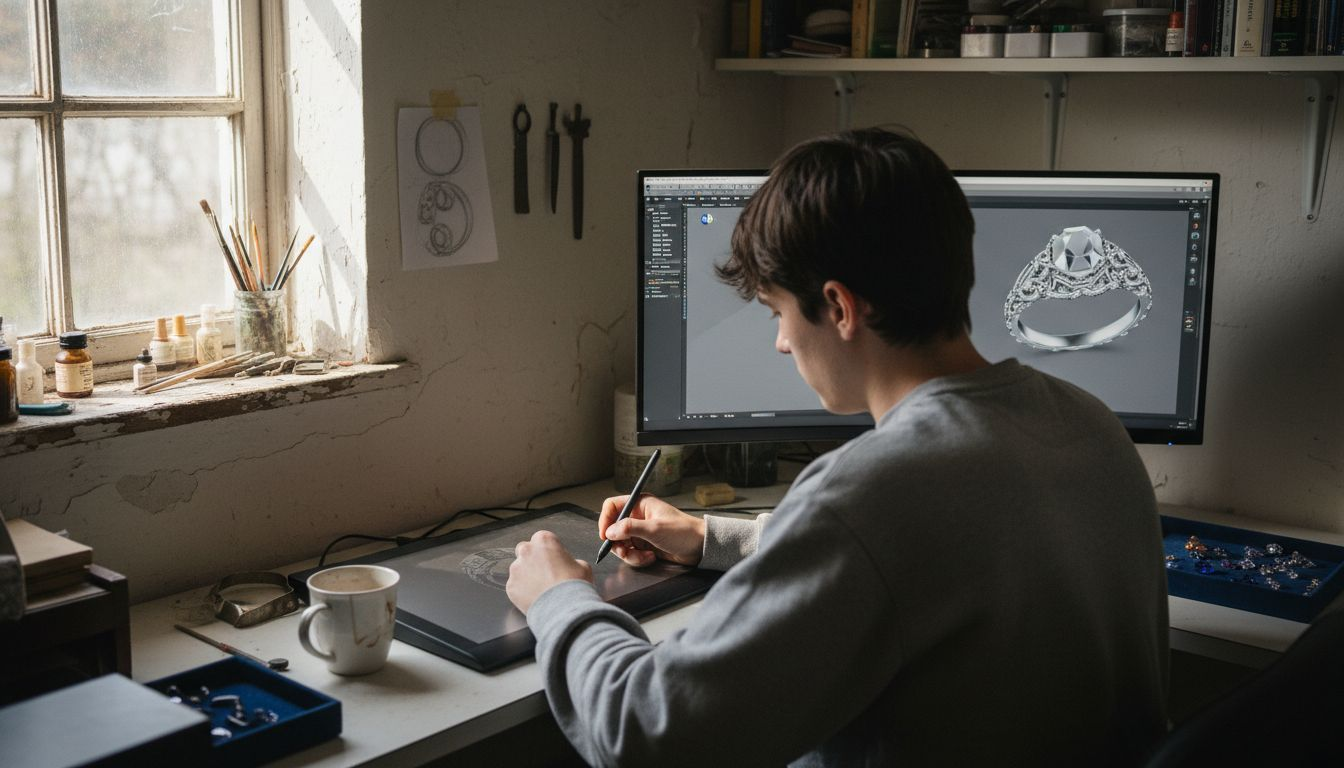
3D modeling technology enables detailed customization and precision throughout the design process. You’ll rotate the model from every angle. Look at it from the top, side, and bottom. Does the profile feel right? Are the proportions balanced?
This is your moment to request changes. Be specific about what you want adjusted.
- Stone placement: Is the diamond sitting at the right height? Does the setting frame it properly?
- Band width: Does it look proportional to your hand and the stone size?
- Surface details: Are engravings, textures, or patterns exactly as you imagined?
- Side views: How does the ring look from the side? Is the depth balanced?
Modern collaboration platforms make this process seamless. You and your designer can view the same 3D model in real-time, discuss changes, and track revisions. This isn’t a one-way process—your feedback directly shapes the final design.
Expect multiple rounds of refinement. Your first 3D model might need adjustments. Maybe the halo is too wide. Perhaps the prongs feel too delicate. Each revision gets you closer to your perfect ring.
When you see your 3D model and feel that spark of recognition, you’ll know the design is right.
Once you approve the final 3D model, your designer can create a physical sample or move directly to fabrication, depending on your preference and timeline.
Pro tip: Request high-resolution images and videos of your 3D model from multiple angles, and take screenshots of versions you love so you have a clear reference if any questions arise during production.
Step 4: Approve the Final Design and Begin Crafting
You’ve refined your design through multiple iterations. Now comes the moment of commitment—giving final approval and watching your ring move from digital file to physical reality.
Before you sign off, take one last look at everything. Pull up your 3D model on a large screen. Review your designer’s notes about materials, dimensions, and special requests. Make sure every detail matches your vision. This is your last chance to request changes without delaying production.
Once you approve, your designer sends the finalized specifications to the craftsperson or production facility. At Eternal Carat, this means your ring enters our careful fabrication process. Every element gets handcrafted with precision—whether your setting is being carved from metal, your band is being shaped, or accent stones are being set.
You’ll receive updates throughout production. Depending on the complexity of your design, crafting typically takes two to eight weeks. Your designer will communicate timelines clearly so you know exactly what to expect.
During production, you might receive progress photos or videos. This is genuinely exciting—seeing your ring take physical form. Some craftspeople send images at key milestones:
- Metal casting or shaping: Your setting and band framework are created.
- Stone setting: Your diamond and any accent stones are carefully placed and secured.
- Finishing and polishing: Details are refined, surfaces are polished to brilliance.
- Final quality check: Your ring is inspected for perfection before shipping.
How to design your own ring involves understanding the full crafting journey, from concept through completion. This transparency helps you appreciate the skill and time invested in your piece.
Stay in touch with your designer during this phase. If questions arise or you want updates, don’t hesitate to ask. Reputable designers welcome communication and pride themselves on keeping clients informed.
Your approval marks the official beginning of craftsmanship—the moment your unique vision becomes a wearable reality.
The waiting period can feel long, but it’s worth it. Soon you’ll hold a one-of-a-kind ring that tells your story.
Below is a summary of each custom ring production stage and what to watch for:
| Stage | What Happens | What to Check |
|---|---|---|
| Design Approval | Final specs confirmed | Model matches vision; dimensions accurate |
| Metalwork | Casting, shaping, solder | Smooth joints; band symmetry |
| Stone Setting | Diamonds and gems secured | Stones tight, secure, evenly spaced |
| Finishing | Polishing, engraving | High polish, crisp details, no scratches |
| Quality Inspection | Final check before shipping | Consistent quality, flawless presentation |
Pro tip: Ask your designer for a timeline with specific milestones and request progress photos at each stage so you can follow your ring’s creation from start to finish.
Step 5: Review and Verify Your Finished Jewelry
Your ring has arrived. This moment—unboxing your custom creation—is incredible. But before you slip it on and celebrate, take time to carefully inspect every detail.
Start with the overall appearance. Hold your ring under natural light and examine it from every angle. Does it match your approved 3D model? Look at the stone placement, the band symmetry, and the overall proportions. Compare it against the photos your designer shared during production.
Now focus on specific elements. Check the stone setting first. Your diamond or gemstone should sit securely in its setting with no movement or wobbling. The prongs or bezel should hold the stone firmly. If you notice any looseness, contact your jeweler immediately.
Inspect the band carefully for these details:
- Surface finish: Is it polished smoothly? Are engravings or textures crisp and even?
- Symmetry: Does the band curve evenly on both sides? Are dimensions balanced?
- Metal quality: Check for scratches, dents, or rough spots that shouldn’t be there.
- Sizing accuracy: Does it fit as expected? Comfort is crucial since you’ll wear this daily.
Examine the joints and connections. Where the band meets the setting, you should see clean, seamless transitions. Check any accent stone settings for security and alignment.
Under magnification, look at the craftsmanship details that define quality diamond jewelry. Tiny imperfections in setting work or metal finishing can indicate rushed production. Quality custom jewelry shows precision and care at every level.
If anything looks wrong or feels off, don’t hesitate to contact your jeweler. Reputable designers stand behind their work and will address any concerns promptly. Most offer adjustments or refinements if needed.
Your finished jewelry should exceed your expectations—it’s the physical manifestation of months of collaboration and craftsmanship.
Once you’re satisfied, take professional photos of your ring. These become cherished memories and useful documentation for insurance purposes.
Pro tip: Get your finished ring professionally photographed by your jeweler or a local photographer so you have high-quality images for insurance, social sharing, and simply admiring your custom creation.
Bring Your Custom Jewelry Vision to Life with Eternal Carat
Designing a truly unique ring can feel overwhelming when you face decisions about style, materials, and craftsmanship. Whether you are unsure about the perfect setting, want to explore eco-friendly lab-grown diamonds, or need expert guidance refining your vision, Eternal Carat is here to help. We understand the importance of balancing your personal story with sustainable luxury and unmatched quality.
Experience a personalized consultation at our secure Parker, Colorado location or explore our easy-to-navigate online collection to start your bespoke journey. With our expert team guiding every step from design sketches to final approval, your dream piece will reflect your lifestyle and values perfectly. Do not wait to create a custom ring as unique as your story by visiting Eternal Carat and learn more about how custom design & fine jewelry with lab-grown diamonds can transform your vision into reality.
Frequently Asked Questions
How do I define my vision for a custom jewelry design?
To define your vision, gather inspiration by exploring jewelry websites, Instagram posts, and Pinterest boards. Create a visual collection of styles, metals, and details that resonate with you to share with your designer during your consultation.
What materials should I consider for my custom ring?
Consider both the stone and the metal for your custom ring. Lab-grown diamonds are an excellent choice for their quality and sustainability; choose a metal like platinum, white gold, yellow gold, or rose gold that matches your style and daily wear requirements.
How does the design process work for custom jewelry?
The design process involves several stages, starting with sketches based on your inspiration and preferences, followed by 3D modeling for precise visualization. Collaborate closely with your designer to refine details through multiple iterations until the final design matches your vision.
What should I expect during the crafting of my custom ring?
You should expect regular updates during the crafting phase, which typically takes two to eight weeks. Your designer will communicate the progress and may provide photos at key milestones, ensuring you stay informed about the creation of your one-of-a-kind piece.
How can I ensure the final design meets my expectations?
To ensure the final design meets your expectations, thoroughly review the 3D model before giving final approval. Check dimensions, materials, and specific details like stone placement to confirm everything aligns with your vision before crafting begins.
What should I do if my finished ring has issues?
If your finished ring has any issues, contact your jeweler immediately. Reputable designers should be willing to address any concerns and may offer adjustments or refinements to ensure your jewelry meets the quality you expect.


