

Finding the ideal diamond setting in Denver can feel like balancing beauty, durability, and ethical values. The setting is much more than just metal—it shapes the sparkle, protects your stone, and expresses personal style. For couples seeking bespoke engagement rings with sustainable lab-grown diamonds, understanding these key concepts means you get both the brilliance and the resilience that fit your daily life. Discover how smart choices and expert consultation turn your vision into reality.
Table of Contents
- Diamond Settings Defined: Key Concepts And Myths
- Major Types Of Diamond Settings Explained
- How Settings Impact Brilliance And Durability
- Selecting The Right Setting For Your Lifestyle
- Common Pitfalls And Expert Care Tips
Key Takeaways
| Point | Details |
|---|---|
| Understanding Settings is Essential | The diamond setting significantly influences both the diamond’s brilliance and overall durability. Selecting an appropriate design can enhance your ring’s visual impact and longevity. |
| Choose Settings Based on Lifestyle | Assess your daily activities to choose a setting that offers the right balance of sparkle and protection for your specific lifestyle needs. |
| Regular Maintenance is Key | Different settings require varying levels of maintenance; regular check-ups can prevent costly repairs and ensure your diamond remains secure. |
| Lab-Grown vs. Mined Diamonds | Lab-grown diamonds perform identically to mined diamonds in any setting, providing a more sustainable option without sacrificing quality or brilliance. |
Diamond Settings Defined: Key Concepts and Myths
A diamond setting is the metal framework that holds your diamond in place, and it’s far more than just a functional component.
Your setting determines how light travels through your stone, which directly impacts its brilliance. It also shapes the overall aesthetic of your ring.
Let me explain what this means for you and your partner in the Denver area.
Understanding the Core Components
A diamond setting consists of several structural elements working together:
- Prongs - Metal fingers that grip the diamond from above, allowing maximum light entry
- Basket - The support structure beneath the diamond that connects to the band
- Gallery - The decorative metalwork between the basket and band
- Band - The foundation that sits on your finger
Each component plays a specific role in protecting your stone while maximizing its visual impact.
How Settings Affect Light Performance
Here’s something most people don’t realize: your setting can enhance or diminish your diamond’s sparkle significantly.
Diamond cut fundamentals determine how light bounces inside the stone, but your setting controls how light enters from above. A well-designed setting creates an open path for light, while poor design can shadow your diamond.
The metal choice matters too. White gold, platinum, and palladium all reflect light differently around your stone, creating distinct visual effects.
Your setting isn’t just protection—it’s an optical tool that directly influences how brilliant your diamond appears.
Common Setting Myths You Should Ignore
Myth 1: More prongs always mean better security.
Four prongs actually work better than six for round diamonds in most cases. Extra prongs can block light and create visual clutter without added security benefits.
Myth 2: Higher settings always show off diamonds better.
False. Extremely tall settings can make your ring catch on things and feel uncomfortable. A balanced proportion between height and width provides both security and wearability.
Myth 3: Lab-grown diamonds need different settings than mined diamonds.
This isn’t true. Lab-grown diamonds have identical physical properties to mined diamonds. They perform exactly the same in any setting you choose. Many affluent Denver couples select lab-grown options specifically because they receive the same brilliance at better value.
Myth 4: Vintage settings can’t hold modern diamonds.
Antique settings often feature gorgeous metalwork and can absolutely accommodate contemporary stones. Many couples find vintage and estate jewelry pieces offer character that new designs simply can’t replicate.
Why Setting Matters for Your Choice
Your setting choice affects three critical factors:
- Daily wearability - Does it catch on things? Sit comfortably under gloves or while working?
- Light performance - Does your diamond sparkle at its maximum potential?
- Long-term durability - Will prongs hold your stone securely through years of wear?
For couples in the Denver metro area considering bespoke designs, your setting is where personal style truly emerges. This is where Eternal Carat’s appointment consultations become invaluable—you can see how different settings transform the same diamond under various lighting conditions.
Pro tip: Visit Eternal Carat’s Parker office to handle settings in person before committing; watching how light moves through your diamond in different metal frameworks takes seconds but eliminates months of second-guessing.
Major Types of Diamond Settings Explained
When you’re designing your engagement ring, the setting type you choose fundamentally shapes how your diamond looks and feels on your hand.
Each setting style offers distinct advantages. Some maximize sparkle, while others prioritize security or create specific visual effects.
Let’s break down the main options you’ll encounter as you shop.
The Six Main Setting Types
The major diamond setting types each serve different purposes and aesthetic goals:
- Prong settings - Metal fingers grip the diamond, allowing maximum light entry and brilliant sparkle
- Bezel settings - Metal rim surrounds the diamond, providing excellent protection and a modern look
- Channel settings - Diamonds sit in a metal groove, ideal for wedding bands with multiple stones
- Pave settings - Tiny diamonds cover the band, creating an all-over sparkle effect
- Tension settings - Diamond appears to float between band ends, creating a contemporary, minimalist aesthetic
- Halo settings - Smaller diamonds surround the center stone, enhancing perceived size and adding brilliance
Each type carries different practical and visual implications for your ring.
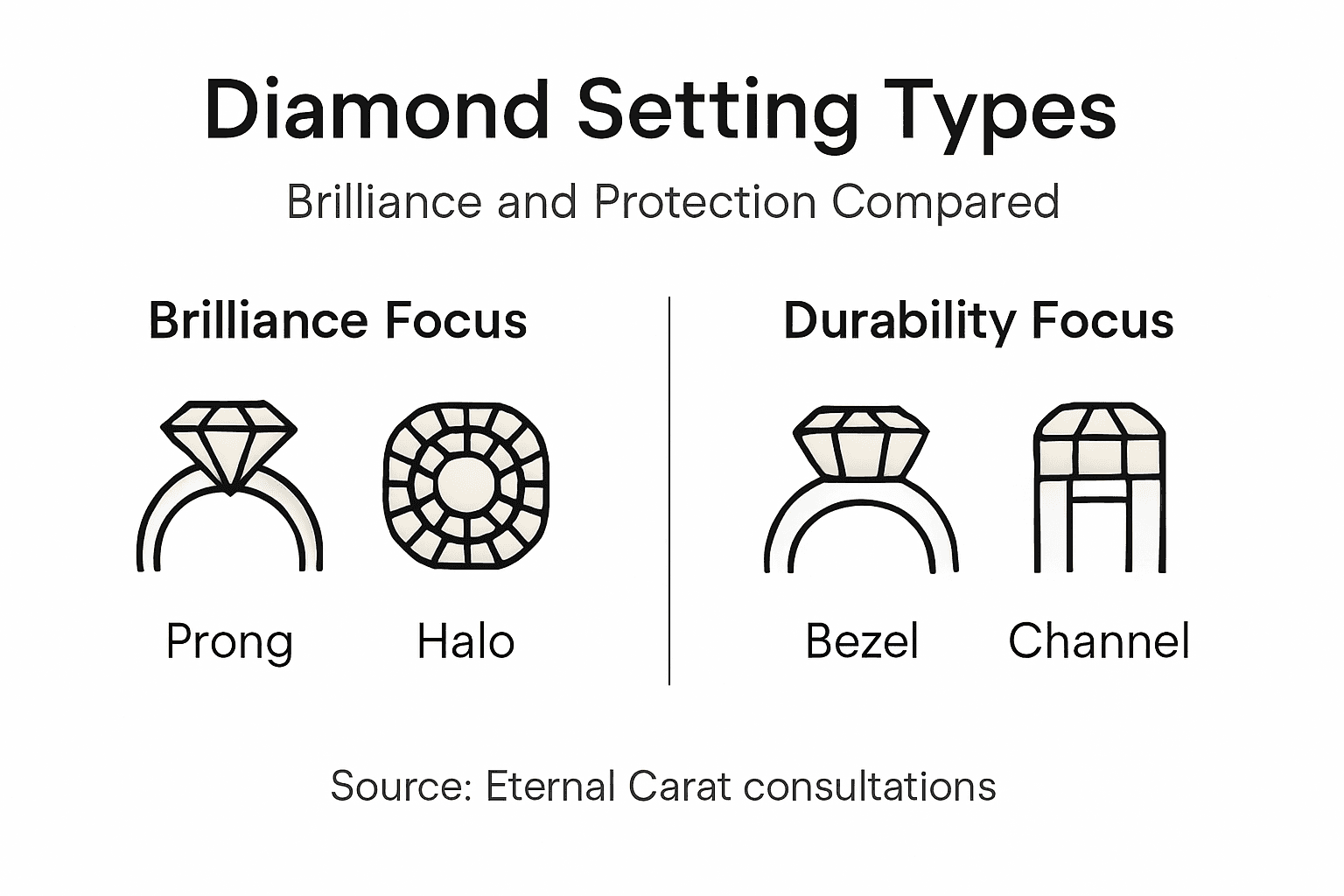
Here’s a concise comparison of diamond setting types and their main strengths:
| Setting Type | Brilliance Impact | Durability Strength | Maintenance Need |
|---|---|---|---|
| Prong | Maximum sparkle | Moderate protection | Annual inspection |
| Bezel | Subtle shine | Excellent protection | Minimal cleaning |
| Halo | Amplifies sparkle | Secure, but requires cleaning | Moderate maintenance |
| Channel | Consistent shine | Strong stone security | Occasional cleaning |
| Pave | Continuous sparkle | Moderate, can loosen stones | Frequent cleaning |
| Tension | Unique brilliance | Lower protection | Annual inspection |
Prong Settings: Maximum Brilliance
Prong settings remain the most popular choice for engagement rings, and for good reason.
They expose more of your diamond’s surface, allowing light to enter from multiple angles. This creates exceptional sparkle that catches attention under any lighting condition.

The downside? Prongs require regular maintenance to stay secure. You’ll want to have them checked annually by a professional jeweler.
For Denver couples who plan to wear their rings daily, four or six prongs typically work best, depending on your diamond’s shape and your lifestyle.
Bezel Settings: Protection and Durability
Bezel settings wrap metal around your diamond’s edges, creating a protective frame.
This design excels for active lifestyles. Whether you’re hiking in the Colorado mountains or working with your hands regularly, a bezel setting minimizes the risk of damage.
The tradeoff is reduced sparkle compared to prong settings. The metal rim blocks some light, creating a more subtle brilliance. Many couples find this sophisticated and timeless.
Bezel settings are perfect if you prioritize protection and longevity over maximum sparkle.
Halo Settings: Amplified Presence
Halo settings surround your center diamond with smaller diamonds in a circular or geometric pattern.
This design makes your diamond appear significantly larger than it actually is. It also adds exceptional brilliance by multiplying light sources across the entire setting.
Halos work beautifully with lab-grown diamonds, which many Denver couples choose for sustainability and value. The halo amplifies the visual impact, making a 1-carat lab-grown diamond look dramatically more substantial.
Channel and Pave Settings: Cohesive Design
Channel settings secure multiple diamonds in a groove along the band.
They work best for wedding bands, anniversary rings, or designs where you want diamonds integrated throughout rather than focused on one center stone.
Pave settings scatter tiny diamonds across the band and setting, creating continuous sparkle. This option transforms your entire ring into a glittering showcase.
Both styles require professional cleaning to maintain their appearance.
Tension Settings: Modern Minimalism
Tension settings create the illusion of your diamond floating unsupported between band ends.
This contemporary design appeals to couples who value clean lines and modern aesthetics. It maximizes light exposure and creates a striking visual statement.
Tension settings demand more precise engineering and maintenance, so they work best for people who can commit to regular professional care.
Choosing Your Setting Style
Consider these factors when deciding:
- Lifestyle - How active are you? Choose bezel for protection, prong for maximum sparkle
- Maintenance commitment - Are you willing to have your ring serviced regularly?
- Personal aesthetic - Do you prefer traditional elegance or contemporary minimalism?
- Metal choice - White gold, platinum, and rose gold all create different visual effects in the same setting style
At Eternal Carat, our custom engagement ring design process allows you to see how your diamond looks in different settings before committing.
Pro tip: Request to see your diamond in at least three different setting types during your consultation—what looks stunning in photos might feel different when you’re holding it, and personal preference often surprises people.
How Settings Impact Brilliance and Durability
Your setting choice directly affects two critical outcomes: how brilliant your diamond appears and how well it withstands daily wear.
These aren’t independent factors. The same design that maximizes light performance might require more frequent maintenance, while maximum protection sometimes means accepting reduced sparkle.
Understanding this tradeoff helps you make a decision aligned with your lifestyle and priorities.
How Settings Influence Light Performance
Settings act as optical devices that either amplify or diminish your diamond’s natural sparkle.
Accent diamond settings and light engineering shows how surrounding stones and metal structures reflect light through your center diamond.
Consider these light-related impacts:
- Open settings (prong, tension) allow light entry from multiple angles, maximizing brilliance
- Enclosed settings (bezel) restrict light paths slightly, creating subtler sparkle
- Accent-heavy settings (halo, pave) multiply light sources, creating overall dazzle
- Metal color reflects light differently—white metals appear brighter, rose gold creates warmth
Your diamond’s individual cut quality remains paramount, but your setting either showcases or hides that potential.
Protection and Long-Term Security
Durability depends heavily on setting design and structural engineering.
Vulnerable settings like tension and prong expose more of your diamond’s surface. This maximizes brilliance but increases exposure to impacts.
Protected settings like bezel and channel wrap metal around your stone, creating a protective barrier against scratches and knocks.
For Denver couples with active lifestyles—hiking, sports, outdoor activities—protection matters significantly. A bezel setting keeps your diamond safer during the activities you love.
Your setting structure determines whether your diamond thrives or merely survives daily wear.
Maintenance Requirements by Setting Type
More intricate settings demand more attention to maintain their brilliance and security.
High-maintenance settings:
- Pave and micro-pave require professional cleaning quarterly to prevent buildup
- Tension settings need annual professional inspection for structural integrity
- Prong settings need annual checks to ensure prongs still grip securely
Low-maintenance settings:
- Bezel settings resist dust accumulation and hold stones securely with minimal upkeep
- Channel settings need occasional professional cleaning but hold stones very securely
- Halo settings require regular cleaning but structural maintenance is minimal
If you prefer a “set it and forget it” ring, choose bezel or channel. If you enjoy regular professional care, pave and tension settings reward that attention.
Lab-Grown Diamonds and Setting Performance
Lab-grown diamonds perform identically to mined diamonds in any setting.
This matters for Denver couples choosing lab-grown options. Your setting choice has zero relationship to whether your diamond is lab-grown or mined.
What changes is value. A lab-grown diamond in a halo setting appears equally brilliant and receives equal protection as a mined diamond in the same setting—but costs significantly less.
Making Your Setting Decision
Balance these competing priorities:
- Sparkle priority - Choose prong, halo, or tension for maximum brilliance
- Protection priority - Choose bezel or channel for active lifestyles
- Maintenance commitment - Choose low-maintenance if you prefer minimal upkeep
- Long-term durability - Choose protected settings if you’ll wear your ring daily for decades
Your Eternal Carat consultation addresses exactly this tension. We’ll help you understand which settings match your actual lifestyle—not the lifestyle you imagine.
Pro tip: Test your desired setting in bright sunlight, indoor lighting, and evening light during your consultation—settings perform dramatically differently under various lighting conditions, and what you see in the jeweler’s case might not match how your ring looks in real life.
Selecting the Right Setting for Your Lifestyle
Your ideal setting isn’t the most expensive or the most popular—it’s the one that fits how you actually live.
Many couples choose settings based on Instagram aesthetics, then struggle with maintenance or worry about damage. The right approach is matching the setting to your real daily routine.
Let’s identify which setting works best for your specific situation.
Assessing Your Work Environment
Start by thinking honestly about what your hands encounter during a typical workday.
Do you work in an office, outdoors, with equipment, or hands-on? Your professional environment significantly influences which settings make sense.
Office-based work allows you more flexibility. Prong, halo, or tension settings work fine if you’re careful.
Hands-on professions (healthcare, construction, trades, athletics) demand protective settings. Bezel and channel settings keep your diamond secure when you’re working actively.
Active outdoor lifestyles like hiking and Colorado mountain activities require maximum protection. Bezel settings excel here.
Your Daily Habits and Risk Factors
Consider activities beyond work that might affect your ring.
Do you garden, exercise regularly, play sports, or work with your hands? These everyday activities create risks that some settings handle better than others.
Setting selection based on lifestyle factors shows that bezel and flush settings provide superior protection for active lives.
High-risk activities:
- Rock climbing, weightlifting, or team sports → choose bezel or channel
- Gardening, cooking with hands-on prep → choose protected settings
- Frequent hand contact with surfaces → avoid tension settings
- Water sports or beach activities → bezel or channel prevent corrosion and damage
Lower-risk activities:
- Desk work with minimal hand contact → prong or halo acceptable
- Mostly indoors with controlled environment → more options available
- Infrequent hands-on activities → can accommodate prong settings
Maintenance Reality Check
Before selecting an intricate setting, be honest about maintenance commitment.
Some settings look stunning but demand quarterly professional cleaning. Others need annual inspections. Will you actually follow through?
If you’re committed to professional care: Pave, tension, and prong settings reward regular maintenance with maximum sparkle.
If you prefer minimal upkeep: Bezel and channel settings stay beautiful with occasional cleaning.
Don’t choose high-maintenance settings if you won’t service them. A neglected pave setting looks worse than a simple bezel setting worn with pride.
Your setting should enhance your life, not create stress about maintenance you’ll skip.
Matching Setting Types to Lifestyle Categories
Here’s how to narrow your choices:
Use this summary to match diamond settings to your lifestyle:
| Lifestyle Type | Best Setting Choice | Why it Works |
|---|---|---|
| Very active | Bezel or channel | Resists daily impact |
| Moderate activity | Halo or prong | Balance of sparkle and security |
| Hands-on profession | Flush or bezel | Won’t snag or catch |
| Desk/office work | Prong or tension | More style flexibility |
| Minimal upkeep | Bezel or channel | Low maintenance need |
| Sparkle priority | Prong, halo, or tension | Maximum light exposure |
- Very active lifestyle - Bezel or channel settings for maximum protection
- Moderate activity - Halo or solitaire prong for balance of sparkle and protection
- Careful wearer - Prong, tension, or pave for maximum brilliance
- Hands-on profession - Flush or bezel settings that won’t snag or catch
- Daily wearer who wants zero worry - Bezel settings provide peace of mind
Considering Future Life Changes
Think beyond your current lifestyle for a moment.
Are you planning to start a family? Change careers? Move to a more active phase of life? Your ring needs to work today and tomorrow.
If you might become more active, choose a protective setting now rather than regretting it later. Conversely, if you’re temporarily very active but plan a more relaxed lifestyle, you have more flexibility.
The Personal Style Factor
Your lifestyle assessment matters, but aesthetics matter too.
You’ll wear this ring for decades. It must make you happy every time you look at your hand. Find the setting that balances your lifestyle needs with the look you genuinely love.
This is exactly what Eternal Carat’s appointment-based consultations solve. You’ll discuss your actual lifestyle with an expert, not imagined lifestyles, and find settings that genuinely work.
Pro tip: Bring photos of your hands during your activities—climbing, gardening, typing, whatever you do most—so we can see exactly how your ring will interact with your real life, not an idealized version.
Common Pitfalls and Expert Care Tips
Most diamond setting problems don’t happen because of bad design—they happen because owners don’t understand what their setting needs.
Knowing these common pitfalls helps you avoid expensive damage and keeps your ring brilliant for decades. Let me walk you through what actually goes wrong and how to prevent it.
The Neglected Prong Problem
Prong settings are beautiful but vulnerable to one specific failure: loose prongs.
Over time, metal fatigues from daily wear. Prongs gradually loosen their grip on your diamond. Many people don’t notice until their stone falls out completely.
This is preventable. Annual professional inspections catch loosening prongs before they become dangerous.
Signs your prongs need attention:
- Your diamond moves slightly when you touch it
- Prongs look visibly bent or worn
- You haven’t had a professional inspection in over a year
- Your ring catches more frequently on clothing
Don’t wait for visible problems. Schedule annual checkups like you would for your car.
Overlooking Routine Cleaning Needs
Dirty settings make diamonds look dull, even when the stone itself is brilliant.
Buildup of body oils, soap residue, and dust accumulates around prongs and under stones. Over months, this layer dims your diamond’s sparkle significantly.
Cleaning frequency by setting type:
- Prong settings: monthly gentle cleaning, professional quarterly
- Bezel settings: monthly gentle cleaning, professional as needed
- Pave and halo: professional cleaning every six to eight weeks
- Channel settings: monthly gentle cleaning, professional annually
Gently cleaning at home takes two minutes. Use lukewarm water, mild dish soap, and a soft brush. Don’t use ultrasonic cleaners unless your jeweler recommends it.
The Scratch and Snag Reality
High settings catch on things more frequently than you’d expect.
Your ring snags on hair, fabric, and other surfaces constantly. Each snag stresses prongs and can bend them permanently. Tension settings are especially vulnerable to catching.
If you notice increased snagging, talk to your jeweler about lowering the setting slightly or adding protective elements.
High settings look gorgeous, but they catch on everything—plan accordingly with your lifestyle.
Choosing Wrong Metal for Your Activities
Some metals hold up better to specific wear patterns than others.
Platinum is extremely durable and resists scratching, making it ideal for active lifestyles and sports.
White gold is softer and scratches more easily. This doesn’t affect your diamond’s security but creates a worn appearance over time.
Rose gold shows scratches less visibly but requires more careful handling than platinum.
For very active Denver couples, platinum settings provide better long-term durability despite higher initial cost.
Ignoring Warning Signs Until They’re Critical
Small problems become expensive ones when ignored.
A slightly loose prong costs fifty dollars to fix today. A fallen diamond costs thousands to recover and reset. Catch problems early by scheduling regular maintenance.
What to monitor:
- Any visible movement in your stone
- Changes in how your ring feels on your finger
- Increased catching or snagging
- Visible scratches or dings on metal
- Any time your ring takes a hard impact
Professional Care That Actually Matters
Not all jewelers service settings equally. Find someone who understands your specific setting type.
During professional cleaning and inspection, your jeweler should:
- Check all prongs or setting components for tightness
- Inspect metal for cracks or wear
- Clean thoroughly without damaging delicate elements
- Assess whether any repairs are needed
- Document the condition in writing
Establish a relationship with one trusted jeweler who knows your ring’s history. This matters tremendously for long-term care.
Lab-Grown Diamond Maintenance
Lab-grown diamonds need identical care to mined diamonds.
Your setting maintenance schedule doesn’t change based on whether your diamond is lab-grown or mined. Both require the same professional attention and cleaning.
The advantage? You’re investing less money upfront, so professional maintenance costs matter less relative to your total investment.
Pro tip: Schedule your annual inspection before summer or before holidays when you’ll wear your ring frequently—preventive maintenance before heavy-use periods saves you from emergency repairs and keeps your stone secure when it matters most.
Discover the Perfect Diamond Setting to Match Your Lifestyle and Style
Choosing the right diamond setting is crucial to enhancing your diamond’s brilliance and ensuring it withstands your everyday activities. Whether you prioritize maximum sparkle, long-term durability, low maintenance, or a design tailored to your unique lifestyle, Eternal Carat offers expert guidance and personalized solutions that bring clarity and confidence to your selection process. Understanding the impact of settings like prong, bezel, or halo on light performance and protection is key — and we are here to help you navigate these important decisions.
Explore our exclusive collection and collaborate on your dream piece through our custom design & fine jewelry services. Experience the difference of lab-grown diamonds that combine ethical luxury with exceptional sparkle, all within a private, appointment-only consultation in Parker, Colorado. Start your journey today by visiting Eternal Carat and see firsthand how the right setting transforms your diamond into an enduring symbol of your story.
Frequently Asked Questions
How do diamond settings enhance a diamond’s brilliance?
The right diamond setting allows maximum light entry, which enhances the diamond’s sparkle. Open settings, like prongs and tension settings, expose more of the diamond’s surface for better light performance.
What are the key types of diamond settings?
The key types of diamond settings include prong, bezel, channel, pave, tension, and halo. Each type offers different visual effects, durability, and levels of protection for the diamond.
How often should I have my diamond setting inspected?
It’s recommended to have prong settings inspected annually for loose stones. Other settings like pave and tension may require more frequent professional care, especially to maintain their brilliance and security.
Can a lab-grown diamond be set using the same types of settings as a mined diamond?
Yes, lab-grown diamonds have identical physical properties to mined diamonds and can be set in any of the same types of settings without affecting their performance or appearance.


