

Choosing an engagement ring feels more meaningful when every detail reflects your values. For couples in the Denver metro area, the search for a perfect stone often brings up questions about environmental impact and ethical sourcing. Lab-grown diamonds offer a blend of advanced craftsmanship and transparent origins, combining beauty with a conscious commitment to sustainability. Discover how these scientifically created gems compare to their mined counterparts while debunking common myths surrounding authenticity and quality.
Table of Contents
- Lab-Grown Diamonds Defined And Common Myths
- Production Methods And Distinct Types Explained
- Market Growth, Price Trends And Global Demand
- Sustainability, Ethics, And Buyer Priorities In 2026
- Comparing Lab-Grown Vs Mined Diamonds
- Legal Status, Certification, And Future Challenges
Key Takeaways
| Point | Details |
|---|---|
| Lab-Grown Diamonds are Genuine | Lab-grown diamonds are chemically and physically identical to mined diamonds, distinguished mainly by their origin and production methods. |
| Production Methods Matter | The two primary methods of producing lab-grown diamonds—HPHT and CVD—each offer unique advantages in terms of quality and environmental impact. |
| Market Demand is Rising | The lab-grown diamond market is projected to grow significantly, driven by consumer preferences for ethical and sustainable alternatives. |
| Buyers Prioritize Ethics | Modern consumers increasingly demand transparency, minimal environmental impact, and ethical practices in diamond sourcing and production. |
Lab-Grown Diamonds Defined and Common Myths
Lab-grown diamonds represent a groundbreaking advancement in gemstone technology, creating chemically identical stones through sophisticated scientific processes. Unlike traditional mined diamonds, these scientifically engineered gems are crafted in controlled laboratory environments using advanced techniques like Chemical Vapor Deposition (CVD) and High Pressure High Temperature (HPHT) methods.
Understanding the fundamental characteristics of lab-grown diamonds requires dispelling several persistent misconceptions. Comprehensive laboratory research reveals these diamonds are not synthetic imitations, but genuine carbon crystalline structures indistinguishable from natural diamonds at the molecular level. Key differences emerge not in quality, but in origin and production method.
The primary production methods for lab-grown diamonds include:
- Chemical Vapor Deposition (CVD): A process involving hydrocarbon gas heated to extreme temperatures, allowing carbon atoms to gradually deposit and crystallize
- High Pressure High Temperature (HPHT): Simulating natural diamond formation by subjecting carbon to immense pressure and heat
- Seed Crystal Technique: Using a small diamond fragment as a growth foundation for the new stone
Common myths surrounding lab-grown diamonds frequently misrepresent their quality and authenticity. These stones possess identical:
- Physical properties
- Chemical composition
- Optical characteristics
- Structural integrity
The primary distinction lies in their point of origin: a controlled laboratory versus underground geological formations. This difference translates into significant advantages for environmentally conscious consumers seeking ethically produced gemstones.
Pro tip: When evaluating lab-grown diamonds, request certification from recognized gemological institutions to verify their precise specifications and quality standards.
Production Methods and Distinct Types Explained
Lab-grown diamonds are produced through two primary scientific techniques that meticulously recreate the extreme conditions responsible for natural diamond formation. Advanced production methods enable manufacturers to engineer diamonds with remarkable precision and consistency, challenging traditional gemstone creation paradigms.
The two predominant lab-grown diamond production techniques represent sophisticated scientific approaches:
-
High Pressure High Temperature (HPHT): This method mimics Earth’s natural diamond formation environment
- Replicates mantle-like conditions of extreme pressure and temperature
- Uses metallic catalysts to facilitate carbon crystallization
- Produces diamonds with distinct growth patterns
-
Chemical Vapor Deposition (CVD): A newer, more controlled technological approach
- Involves introducing carbon-rich gases into sealed chambers
- Allows precise layering of carbon atoms
- Enables more consistent diamond quality control
Each production method generates unique characteristics in lab-grown diamonds, though both ultimately create stones chemically and physically identical to mined diamonds. The primary differences emerge in the growth processes and environmental conditions.

Here is a summary comparing the main lab-grown diamond production methods and their distinguishing features:
| Method | Process Description | Key Advantages | Typical Applications |
|---|---|---|---|
| HPHT (High Pressure High Temperature) | Uses extreme pressure and heat to crystallize carbon | Produces larger diamonds, mimics natural formation | Industrial and gem-grade stones |
| CVD (Chemical Vapor Deposition) | Builds diamond layers from carbon-rich gases | Superior control, consistent quality | Fine jewelry and electronics |
| Seed Crystal Technique | Grows diamonds from a small seed crystal | Customizable shapes and sizes | Specialty gemstones |
Lab-grown diamonds represent technological innovation that mirrors nature’s most complex geological processes, transforming scientific understanding of gemstone creation.
The sophisticated techniques used in lab diamond production offer significant advantages over traditional mining, including:
- Reduced environmental impact
- Elimination of mining-related ecological disruption
- Precise control over diamond characteristics
- Potentially lower production costs
- More transparent supply chain
Pro tip: Request detailed documentation about the specific production method used when purchasing a lab-grown diamond to understand its unique formation characteristics.
Market Growth, Price Trends and Global Demand
Global market projections reveal a remarkable trajectory for lab-grown diamonds, with the market expected to reach USD 33.29 billion by 2026. This explosive growth reflects shifting consumer preferences, technological advancements, and increasing awareness about sustainable jewelry alternatives.
Key market dynamics driving lab-grown diamond expansion include:
- Growing environmental consciousness among younger consumers
- Significant price advantages compared to mined diamonds
- Technological improvements reducing production costs
- Increasing acceptance of lab-created gemstones
- Expanding online sales channels
Regional market trends demonstrate fascinating patterns of adoption and production:
- Asia Pacific leads global manufacturing capabilities
- North America represents the fastest-growing demand center
- European markets show increasing consumer interest
- Emerging economies demonstrate rapid technological adaptation
The lab-grown diamond market represents a transformative force in the global jewelry and technology industries, challenging traditional supply chain models.
Consumer preferences are dramatically reshaping diamond market dynamics. Younger generations prioritize:
- Ethical sourcing
- Environmental sustainability
- Technological innovation
- Transparent production processes
- Affordable luxury alternatives
Pro tip: Research current market trends and compare lab-grown diamond prices across multiple retailers to ensure you’re getting the best value for your investment.
Sustainability, Ethics, and Buyer Priorities in 2026
Consumer priorities in the diamond market are undergoing a profound transformation, with sustainability and ethical sourcing emerging as decisive factors for modern buyers. The traditional diamond industry faces unprecedented pressure to demonstrate transparency, environmental responsibility, and social accountability.
Key ethical considerations driving consumer choices include:
- Complete supply chain transparency
- Minimal environmental disruption
- Fair labor practices
- Reduced carbon footprint
- Verifiable origin of gemstones
The environmental advantages of lab-grown diamonds are substantial:
- Significantly reduced land displacement
- Dramatically lower water consumption
- Minimized ecosystem destruction
- Decreased carbon emissions
- No human rights concerns associated with mining
Ethical luxury is no longer a niche market preference, but a fundamental expectation for conscious consumers seeking meaningful purchasing decisions.
Younger generations are particularly driving this ethical revolution, prioritizing:
- Technological innovation
- Sustainable production methods
- Transparent corporate practices
- Environmentally responsible manufacturing
- Personal values alignment with product origins
Pro tip: Request detailed sustainability documentation and third-party certifications when purchasing lab-grown diamonds to verify their ethical credentials.
For quick reference, here is how ethical and sustainability priorities impact diamond buyers in 2026:
| Buyer Priority | Sustainability Impact | Ethical Impact | Market Influence |
|---|---|---|---|
| Transparent sourcing | Supports eco-friendly manufacturing | Ensures fair labor | Drives brand reputation |
| Reduced carbon footprint | Lowers greenhouse emissions | Improves public trust | Expands target audience |
| Certification/documentation | Encourages responsible practices | Verifies stone provenance | Increases purchase rates |
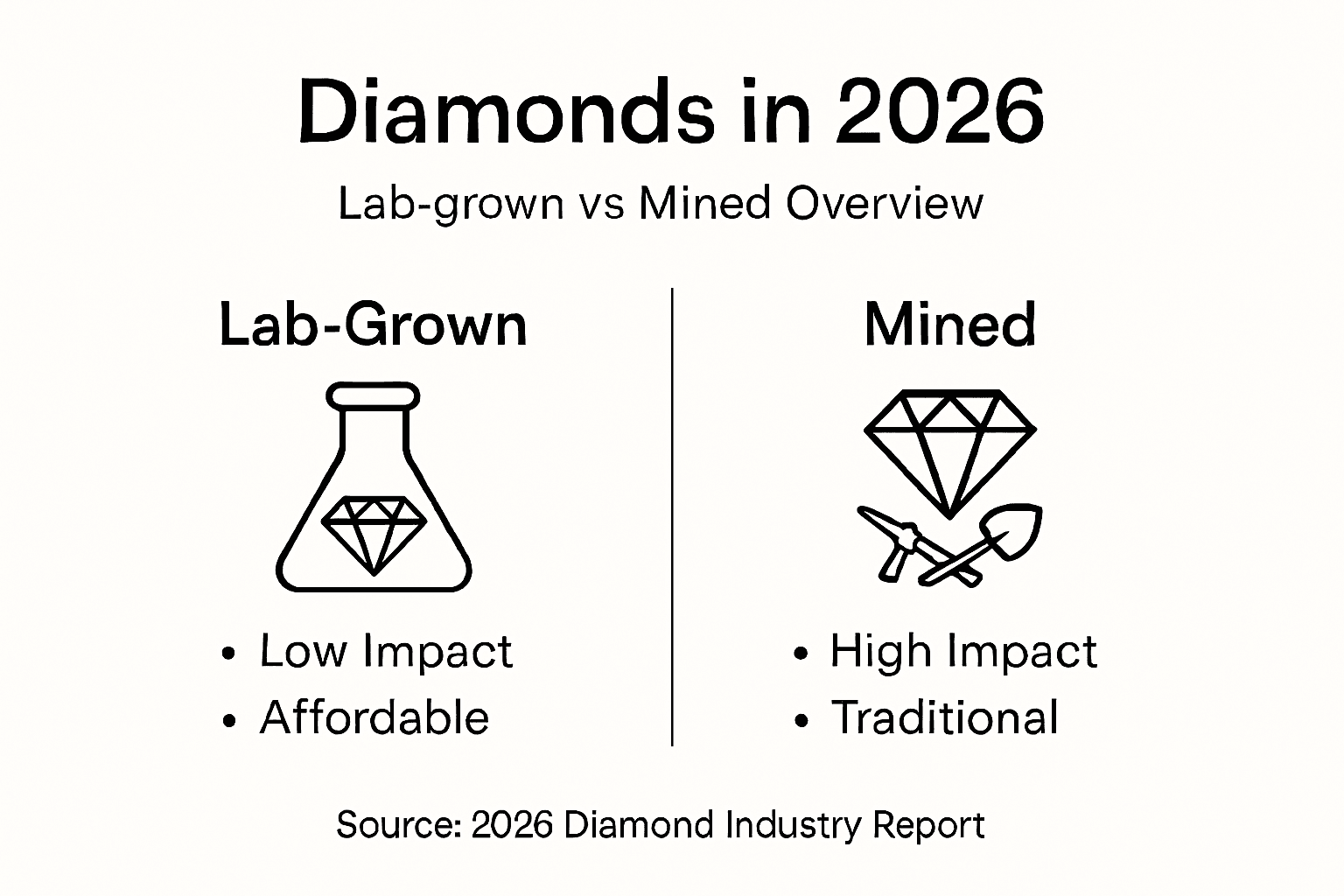
Comparing Lab-Grown vs Mined Diamonds
Scientific comparisons of diamond origins reveal that lab-grown and mined diamonds are fundamentally identical at the molecular level, challenging traditional perceptions about gemstone authenticity. The critical distinction lies not in their physical properties, but in their method of creation and environmental impact.
Key comparative characteristics include:
- Chemical Composition: Identical in both lab-grown and mined diamonds
- Physical Structure: Indistinguishable molecular arrangement
- Optical Properties: Equivalent light performance and brilliance
- Hardness: Identical 10/10 rating on Mohs scale
- Durability: Matching long-term wear characteristics
Environmental and ethical differences are stark:
- Lab-grown diamonds require significantly less ecological disruption
- Mined diamonds involve extensive land displacement
- Lab processes have lower carbon footprint
- Controlled production eliminates human rights concerns
- Transparent supply chain for lab-created stones
The future of diamonds is not about origin, but about conscious choice, ethical production, and technological innovation.
Price and market positioning reveal additional nuanced differences:
- Lab-grown diamonds typically cost 30-50% less
- Faster production cycles
- More consistent quality control
- Greater customization potential
- Emerging preference among younger consumers
Pro tip: Request a detailed certification and origin report to understand the specific characteristics of your diamond, regardless of its production method.
Legal Status, Certification, and Future Challenges
Global regulatory landscapes for lab-grown diamonds are rapidly evolving, with international organizations developing comprehensive standards to ensure transparency and consumer protection. The complex regulatory environment requires ongoing adaptation as technology and market dynamics continue to shift.
Key regulatory considerations include:
- Mandatory disclosure of diamond origin
- Clear labeling requirements
- Standardized grading protocols
- Ethical marketing guidelines
- International certification standards
Critical certification challenges involve:
- Harmonizing international grading standards
- Developing AI-assisted evaluation techniques
- Creating blockchain-based traceability systems
- Establishing tier-based quality classifications
- Implementing transparent supply chain tracking
The future of lab-grown diamond regulation is not about restriction, but about creating a transparent, ethical marketplace that empowers consumer choice.
Emerging technological innovations are reshaping certification processes:
- Advanced spectroscopic analysis
- Machine learning grading algorithms
- Molecular origin verification techniques
- Real-time digital certification platforms
- Comprehensive digital documentation systems
Pro tip: Always request a comprehensive, third-party certification that details the precise origin, production method, and comprehensive characteristics of your lab-grown diamond.
Embrace Ethical Luxury with Lab-Grown Diamonds at Eternal Carat
The future of lab-grown diamonds lies in sustainability, innovation, and transparency. If you are seeking a diamond that aligns with your values of environmental responsibility and ethical sourcing while offering uncompromised brilliance and quality you are addressing key concerns explored in the article such as reduced carbon footprint, supply chain transparency, and personalized quality control. Eternal Carat specializes in transforming these challenges into opportunities by providing expertly crafted lab-grown diamonds paired with bespoke fine jewelry designs.

Explore our exclusive collection and benefit from our expert consultation services to select or design your perfect piece. Act now to invest in a symbol of conscious luxury that speaks to the next generation’s demand for ethical transparency and sustainability. Visit Eternal Carat today to discover how our custom design & fine jewelry experience offers more than just a purchase but a meaningful choice. Learn more about the advantages and production methods of lab-grown diamonds by reading our detailed insights and then schedule your private appointment to experience the difference firsthand.
Frequently Asked Questions
What are the main production methods for lab-grown diamonds?
Lab-grown diamonds are primarily produced using two techniques: High Pressure High Temperature (HPHT) and Chemical Vapor Deposition (CVD). HPHT mimics natural diamond formation by applying extreme pressure and heat, while CVD allows for precise layering of carbon atoms in sealed chambers.
How do lab-grown diamonds compare to mined diamonds?
Lab-grown diamonds and mined diamonds are chemically, physically, and optically identical, making them indistinguishable at the molecular level. The key differences lie in their origin and production methods, with lab-grown diamonds having a lower environmental impact and ethical advantages.
What factors are driving the growth of the lab-grown diamond market?
The lab-grown diamond market is expanding due to growing consumer awareness of environmental issues, significant cost advantages compared to mined diamonds, technological improvements in production, and increasing acceptance of lab-created gemstones.
Why is sustainability important in the diamond industry?
Sustainability is crucial in the diamond industry because it addresses environmental concerns, such as land displacement and ecological disruption caused by mining. Lab-grown diamonds offer a more sustainable option with minimal environmental impact, appealing to ethically conscious consumers.
Recommended
- Why Invest in Lab Diamonds: Ethical Luxury Explained – Eternal Carat
- Lab-Grown Diamonds: Transforming Sustainable Luxury – Eternal Carat
- Why Lab Diamonds Matter for Ethical Luxury – Eternal Carat
- Lab-Grown Diamonds Explained: Luxury, Value, Ethics – Eternal Carat
- Fabric Sustainability Trends 2025: What Changes Next - fabric fabric
- 7 Key Sustainable Fashion Trends 2025 for Eco Shoppers – The Cork Store


